Uttarakhand winter pilgrimage extended to 12 months for tourism
Source:mid-day ↗
Why It Matters
This development is highly significant for UKPSC Prelims as it directly touches upon Uttarakhand's cultural geography (specifically the winter seats of the Char Dham deities) and state government initiatives aimed at infrastructure, regional development, and tourism-based livelihood promotion.
Summary
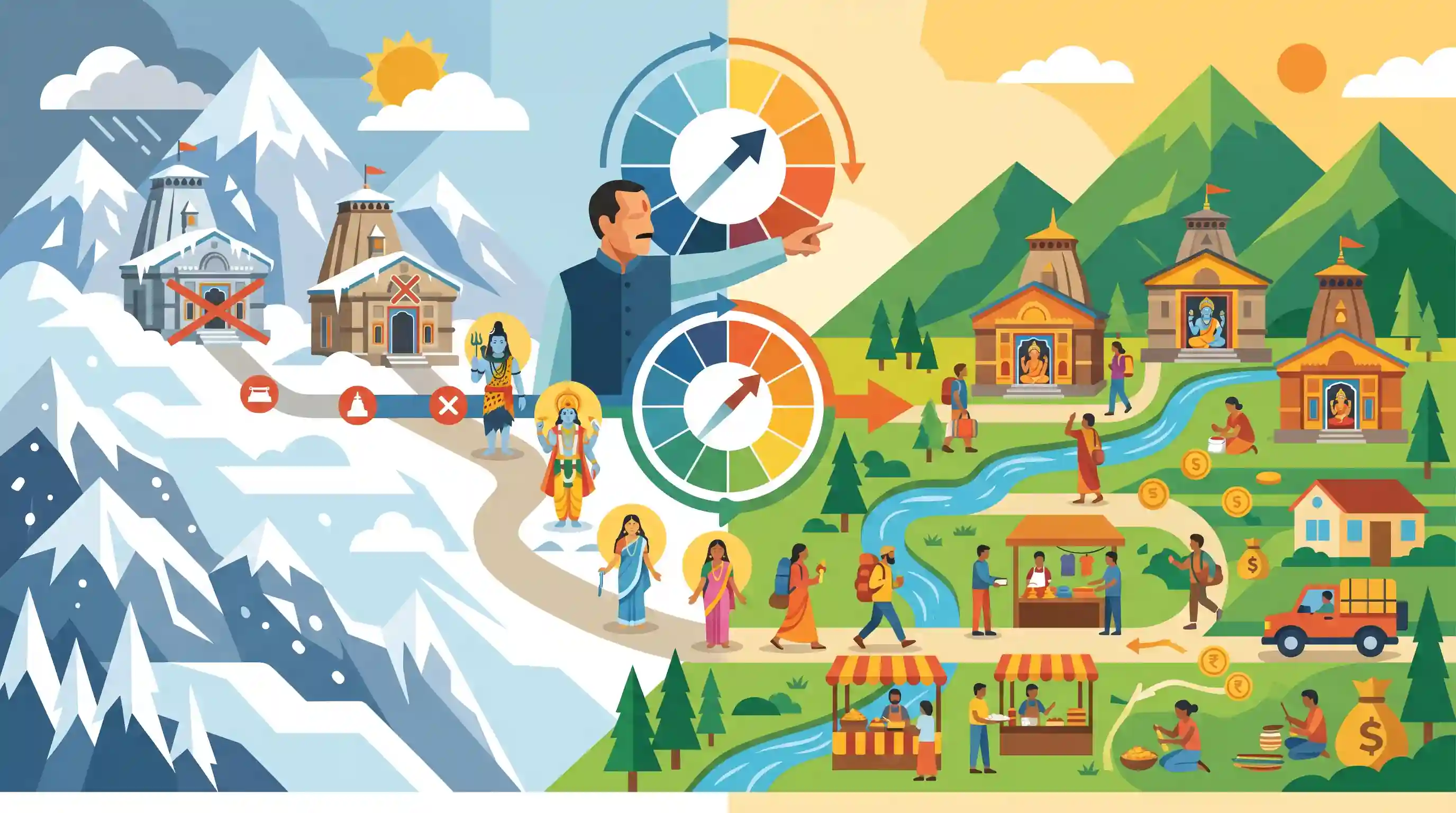
Uttarakhand Chief Minister Pushkar Singh Dhami has officially extended the state's winter pilgrimage initiative into a year-round (12-month) calendar. While the high-altitude Char Dham temples remain closed during heavy winter snows, the government is promoting spiritual travel to the designated winter seats of these deities (Ukhimath, Joshimath, Mukhba, and Kharsali). This policy transformation is designed to generate sustainable, year-round local employment, boost spiritual tourism, and support the state's mountain economy.
Key Points
- Uttarakhand Chief Minister Pushkar Singh Dhami announced the extension of the state's winter pilgrimage initiative to a year-round (12-month) tourism framework.
- Traditionally, the high-altitude Char Dham temples (Badrinath, Kedarnath, Yamunotri, and Gangotri) shut down for six months during winter due to heavy snow, leaving a restricted travel window.
- The new initiative encourages pilgrimage to the official winter seats of the deities where worship continues during the winter: Omkareshwar Temple in Ukhimath (for Kedarnath), Vasudev Temple in Joshimath (for Badrinath), Ganga Temple in Mukhba (for Gangotri), and Yamuna Temple in Kharsali (for Yamunotri).
- The shift to a 12-month pilgrimage cycle aims to expand local employment opportunities, boost religious tourism during the off-season, and decentralize tourism congestion.
Important Terms
Char Dham Pilgrimage

A revered Himalayan circuit in Uttarakhand consisting of four sacred shrines: Yamunotri, Gangotri, Kedarnath, and Badrinath, which traditionally close during winters due to heavy snow.
UPSC context
GS Paper I (Indian Heritage and Culture) & GS Paper III (Environmental concerns in Himalayan regions).
Winter Seats of Char Dham
Lower-altitude temporary shrines where the idols of the Char Dham deities are ceremoniously relocated and worshiped during the harsh, snowy winter months when the main temples are inaccessible.
UPSC context
GS Paper I (Art and Culture: Indian Pilgrimages) & GS Paper III (Mountain State Economy).
Winter Pilgrimage Initiative
A strategic initiative by the Uttarakhand government to promote year-round spiritual tourism and generate local livelihood opportunities by promoting travel to the deities' winter seats.
UPSC context
GS Paper III (Economic Development and Employment Generation).
Uttarakhand Tourism Development Board (UTDB)
The statutory apex body established in 2001 to advise the Uttarakhand government, formulate tourism policies, and manage infrastructure in an eco-friendly manner.
UPSC context
GS Paper II (Statutory Bodies) & GS Paper III (Sustainable Tourism Development).
Prelims Trap
The winter seats of the Char Dham deities are built in the identical Nagara style of stone architecture as the main high-altitude temples.
While the primary high-altitude temples are Nagara stone structures, several winter seats (like Kharsali and Mukhba) feature indigenous timber-and-stone Koti Banal architecture.
Static Concepts Connected
What is Koti Banal architecture and what are its key features?
- Origin & Region: Indigenous earthquake-resistant construction style developed over 900 years ago in the Garhwal Himalayas of Uttarakhand.
- Structural Design: Employs dry-stone masonry interlaid with thick timber beams (deodar wood) without using mortar, allowing structural flexibility during seismic events.
- Seismic Resilience: Built on elevated, solid stone platforms with a low center of gravity to withstand high-intensity Himalayan tremors.
What are the Panch Kedar and Panch Badri circuits?
- Panch Kedar: A group of five Shiva temples (Kedarnath, Tungnath, Rudranath, Madmaheshwar, Kalpeshwar) whose winter worship is centralized at Omkareshwar Temple in Ukhimath.
- Panch Badri: A circuit of five Vishnu temples (Badrinath, Yogadhyan Badri, Bhavishya Badri, Vriddha Badri, Adi Badri) representing different manifestations of Vishnu.
Cross-Topic Patterns
Himalayan carrying capacity vs. 12-month tourism
Shifting to year-round tourism tests the ecological carrying capacity of the fragile, landslide-prone Garhwal Himalayas, highlighting the conflict between economic growth and disaster vulnerability.
Char Dham Project and judicial oversight
The 889-km Char Dham project bridges federal infrastructure goals with environmental jurisprudence, balancing national security, strategic border connectivity, and eco-sensitive zone protections.

UPSC may couple Himalayan river headwaters (Mandakini, Alaknanda) with the cultural-architectural transition from Nagara to Koti Banal.
Linked PYQs · 3
Linked PYQs · 3
- 2025UKPSC_PRELIMSGS1
As per Uttarakhand Budget 2025-26, the amount allocated for Char Dham Road network improvement is
- 2024UKPSC_PRELIMSGS1
UTDB is established in Uttarakhand to promote:
- 2007UKPSC_PRELIMSGS1
Name the river which flows between Kedarnath | Rudra Prayag?
