Parliament winter session passes major bills bypassing scrutiny
Source:The Hindu ↗
Why It Matters
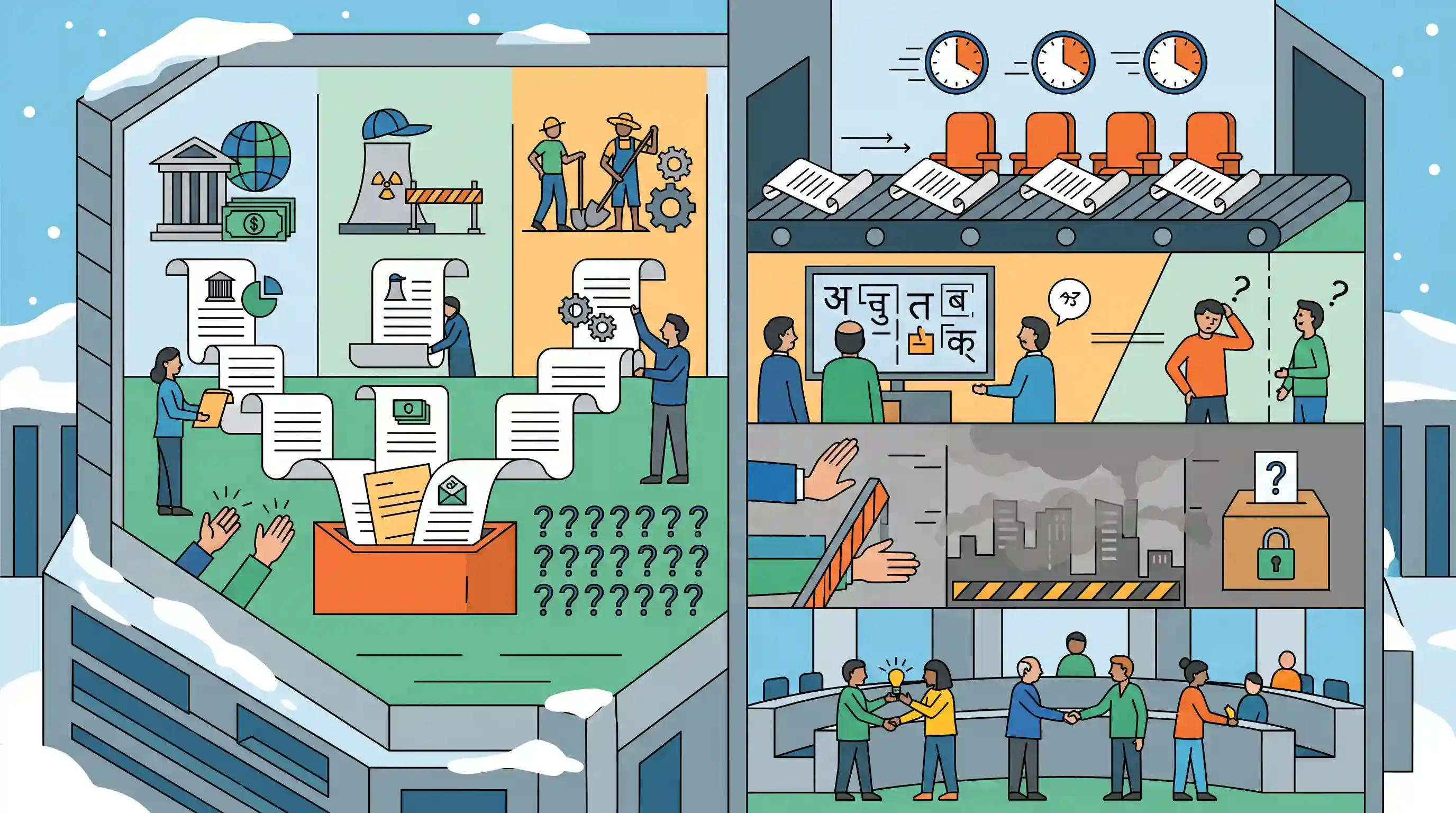
The article provides a real-world evaluation of how legislative business is conducted in the Indian Parliament, touching on critical UPSC themes such as the role of parliamentary committees, the impact of rebranding welfare schemes (MGNREGA), the politicization of legislative drafting (Hindi impositions), and the broader dynamics between the ruling party and the opposition.
Summary
The Winter Session of Parliament saw a mix of consequential legislation and political posturing. While the passage of eight major bills—including 100% FDI in insurance, nuclear liability limits, and the controversial revamping of MGNREGA—marked the session's productivity, the democratic process was criticized. Bills were rushed through without parliamentary committee scrutiny, and the use of Hindi titles alienated non-Hindi-speaking MPs. Despite the government's refusal to debate urgent issues like Delhi's air pollution and a lack of consensus on electoral reforms, the session was somewhat less acrimonious than past ones, with productive Question Hours and instances of cross-party cordiality.
Key Points
- The Winter Session of Parliament concluded with the passage of eight significant bills, but was marked by political grandstanding and controversial government maneuvers, notably surrounding the 150th anniversary of Vande Mataram.
- Major legislative shifts were enacted, including the authorization of 100% FDI in the insurance sector and the limitation of private supplier liability in the nuclear power sector.
- The flagship rural welfare scheme, MGNREGA, was substantially altered and rebranded as the Viksit Bharat – Guarantee for Rozgar and Ajeevika Mission (Gramin).
- The introduction of bills with exclusively Hindi titles caused friction with non-Hindi-speaking MPs, violating constitutional norms that mandate English drafting with translations.
- Legislation was rushed without adequate scrutiny by parliamentary committees, and the government rejected opposition demands to debate critical issues like Delhi's air pollution.
- Despite legislative bulldozing, the session exhibited some cordiality, with productive Question and Zero Hours and positive interactions between government and opposition leaders.
Important Terms
VB-G RAM G (Viksit Bharat – Guarantee for Rozgar and Ajeevika Mission)

A 2025 social welfare law replacing MGNREGA; it guarantees 125 days of unskilled wage employment per rural household, aiming to integrate employment with infrastructure creation.
UPSC context
GS II (Welfare Schemes). Tests knowledge of rural development reforms and the transition from demand-driven to mission-mode employment.
MGNREGA (Mahatma Gandhi National Rural Employment Guarantee Act)
A landmark 2005 rights-based act guaranteeing 100 days of manual work to rural households; it served as India's primary rural safety net before the 2025 revamp.
UPSC context
GS II (Social Justice/Governance). Tests understanding of rights-based legislation and rural poverty alleviation mechanisms.
Sabka Bima Sabki Raksha (Insurance Amendment Bill)
The 2025 amendment to insurance laws raising the Foreign Direct Investment (FDI) limit from 74% to 100% to advance the goal of 'Insurance for All by 2047'.
UPSC context
GS III (Economy). Tests awareness of financial sector liberalization, FDI policy, and resource mobilization for universal social security.
SHANTI Bill (Sustainable Harnessing and Advancement of Nuclear Energy for Transforming India)
The 2025 'SHANTI' Act overhauling nuclear laws to allow private sector participation while removing supplier liability and setting graded liability caps for plant operators.
UPSC context
GS III (Science/Energy). Tests understanding of nuclear governance, energy transition targets (100GW by 2047), and legal liability frameworks.
Parliamentary Standing Committees
Permanent multi-party bodies of Parliament that provide in-depth scrutiny of bills; bypassing them is often cited as a decline in legislative deliberation.
UPSC context
GS II (Polity). Tests understanding of the legislative process and the importance of committee-level scrutiny for democratic accountability.
Question Hour
The first hour of a parliamentary sitting where MPs question ministers; its productivity reflects the effectiveness of the legislature in holding the executive accountable.
UPSC context
GS II (Parliament). Tests knowledge of parliamentary procedures and tools of executive oversight during sessions.
Prelims Trap
"The Constitution mandates that the authoritative text of all Bills introduced in Parliament must be in both Hindi and English."
Article 348(1)(b) of the Constitution explicitly mandates that the authoritative texts of all Bills introduced in Parliament must strictly be in the English language.
Static Concepts Connected
What are the constitutional rules for language in Parliament?
- General Business: Article 120 states business in Parliament shall be transacted in Hindi or English, though presiding officers can permit mother tongues.
- Authoritative Texts: Article 348(1)(b) mandates that the authoritative texts of all Bills and Acts must be in the English language.
- Official Languages Act 1963: Provided for the continued use of English (alongside Hindi) for transaction of business in Parliament.
What is the role of Departmentally-Related Standing Committees (DRSCs) in scrutinizing Bills?
- Core Mandate: To ensure detailed legislative scrutiny, demand for grants review, and long-term policy examination outside the partisan floor environment.
- Referral Rule: Referral of bills to DRSCs is not mandatory; it depends entirely on the discretion of the Speaker/Chairman.
- Advisory Nature: Their recommendations are purely advisory and hold persuasive value, but are not binding on the government.
Cross-Topic Patterns
Nuclear Liability & Net-Zero Targets
Removing equipment supplier liability aligns India with the Convention on Supplementary Compensation (CSC) and unlocks foreign/private reactor technology essential for India's 2070 Net-Zero 'Panchamrit' goals.
MGNREGA redesign & Agrarian Labor Cycles
The new 60-day pause in the revamped MGNREGA (VB-GRAM G) directly addresses agricultural economics, solving the long-standing farmer complaint that welfare works cause severe farm-labour shortages during harvest.

Expect a 2026 prelims question contrasting the new Nuclear Energy Act with the 2010 Act, specifically targeting supplier liability shifts.
Linked PYQs · 5
Linked PYQs · 5
- 2023MainsGS2
Explain the structure of the Parliamentary Committee system. How far have the financial committees helped in the institutionalisation of Indian Parliament?
- 2018MainsGS2
Why do you think the committees are considered to be useful for parliamentary work? Discuss, in this context, the role of the Estimates Committee.
- 2024MainsGS2
Examine the need for electoral reforms as suggested by various committees with particular reference to "one nation one election" principle.
- 2019MainsGS2
Performance of welfare schemes that are implemented for vulnerable sections is not so effective due to absence of their awareness and active involvement at all stages of policy process. Discuss.
- 2011PrelimsGS1
Among the following who are eligible to benefit from the “Mahatma Gandhi National Rural Employment Guarantee Act”?
