Trade war impacts and anti dumping measures for domestic industry
Source:The Hindu ↗
Why It Matters
The article connects global geopolitical trade tensions directly to Indian economic policy, touching upon core UPSC syllabus themes like protectionism, WTO trade rules (Anti-Dumping Duties), and domestic manufacturing resilience.
Summary
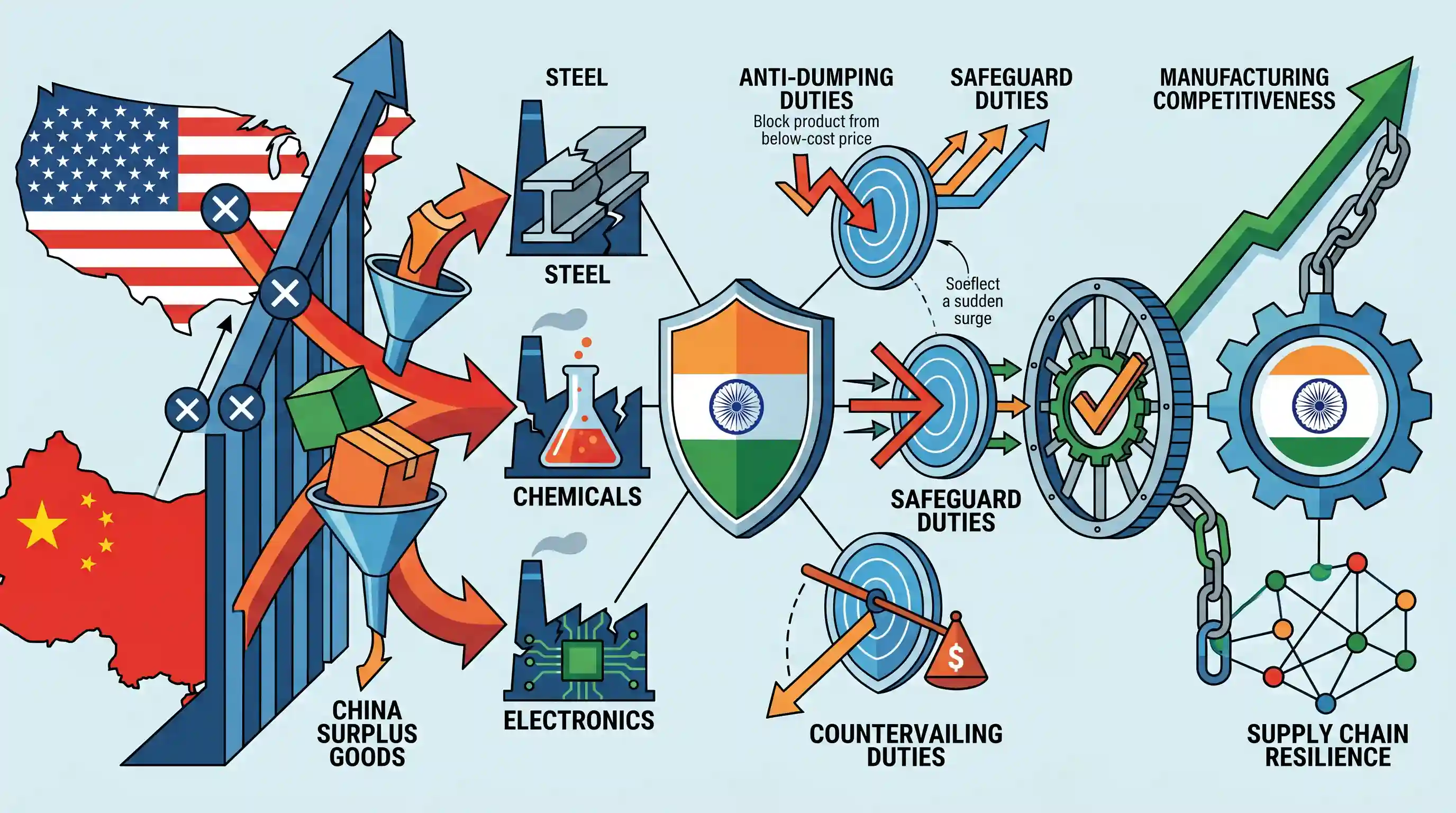
A potential US-China trade war, likely involving steep US tariffs on Chinese goods, poses a risk of large-scale dumping of surplus Chinese products into the Indian market. Vulnerable sectors include steel, chemicals, and electronics. To protect its domestic industry, India must proactively utilize trade defense measures such as Anti-Dumping Duties, Safeguard Duties, and Countervailing Duties, alongside Non-Tariff Barriers like Quality Control Orders (QCOs). This scenario highlights the broader geopolitical shift toward protectionism and underscores the need for India to enhance its manufacturing competitiveness and supply chain resilience.
Key Points
- A potential US-China trade war involving steep tariffs could divert surplus Chinese goods, leading to a surge of imports (dumping) into India.
- Vulnerable Indian sectors include steel, chemicals, electronics, electric vehicles (EVs), and solar panels.
- India can deploy trade defense measures like Anti-Dumping Duties (ADD), Countervailing Duties (CVD), and Safeguard Duties under WTO rules to protect domestic industries.
- The Indian government is increasingly relying on Non-Tariff Barriers (NTBs) such as Quality Control Orders (QCOs) to check substandard imports.
- Global protectionism underscores the necessity for India to build robust domestic manufacturing and resilient supply chains.
Important Terms
Quality Control Orders (QCOs)

Regulatory directives issued under the Bureau of Indian Standards (BIS) Act, 2016, mandating conformity to Indian quality standards for specific products, effectively curbing sub-standard imports.
UPSC context
GS Paper 3 (Economy); relevant for topics on industrial policy and trade defense mechanisms (Non-Tariff Barriers).
World Trade Organization (WTO)
An international body established in 1995 to regulate and facilitate global trade through a rules-based framework, replacing the General Agreement on Tariffs and Trade (GATT).
UPSC context
GS Paper 2 (International Relations); central to international institutions and global governance topics.
Anti-Dumping Duty (ADD)
A trade defense duty imposed by a government on imports priced below their 'normal value' in the home market, protecting domestic industry from unfair pricing.
UPSC context
GS Paper 3 (Economy); tested under trade policy and mechanisms to address unfair trade practices.
Non-Tariff Barriers (NTBs)
Trade restrictions other than direct taxes, such as quotas, technical regulations, and licensing, that create regulatory obstacles for foreign goods entering a domestic market.
UPSC context
GS Paper 3 (Economy); examines protectionism and challenges to global trade liberalization.
Safeguard Duty
A temporary, non-discriminatory trade levy applied to all countries when a sudden import surge causes or threatens serious injury to a domestic industry.
UPSC context
GS Paper 3 (Economy); focuses on emergency trade measures allowed under WTO rules to protect domestic producers.
Countervailing Duty (CVD)
A duty imposed to offset the price advantage gained by foreign exporters due to subsidies provided by their own governments, leveling the domestic playing field.
UPSC context
GS Paper 3 (Economy); relevant for understanding market distortions and India's response to foreign industrial subsidies.
Prelims Trap
Safeguard duties are country-specific measures applied exclusively to counter subsidized imports.
Safeguard duties are non-discriminatory (applied globally) to tackle sudden import surges. CVDs specifically target foreign subsidies, and ADDs target price dumping.
Static Concepts Connected
What are the three primary trade defense measures under WTO rules?
- Anti-Dumping Duty: Counters goods imported at a price significantly lower than their normal value in the exporting country's domestic market.
- Countervailing Duty: Offsets unfair advantages gained by foreign exporters through specific government subsidies in their home country.
- Safeguard Duty: A temporary, non-discriminatory measure to protect domestic industry against a sudden, massive surge in imports, regardless of dumping.
How do Quality Control Orders (QCOs) function as Non-Tariff Barriers?
- Standardization Mechanism: They mandate that specific products comply with Bureau of Indian Standards (BIS) norms before they can be manufactured, imported, or sold.
- WTO Compliance: They are permitted under the WTO's Technical Barriers to Trade (TBT) agreement if applied equally to both domestic and foreign goods.
- Economic Impact: They effectively check the influx of sub-standard, cheap imports without technically violating tariff bindings or raising customs duties.
Cross-Topic Patterns
Protectionism vs. downstream Make in India
Heavy use of trade remedies protects domestic steel and chemicals but raises input costs for downstream sectors like electronics and EV manufacturing, creating friction with Make in India goals.
Trade wars + Currency devaluation dynamics
A US-China tariff war often prompts China to artificially devalue the Yuan, making Chinese exports even cheaper globally and exacerbating the dumping threat to emerging markets like India.

Expect a 2026 multi-statement Prelims question distinguishing ADD (pricing), CVD (subsidies), and Safeguard duties (non-discriminatory).
Linked PYQs · 2
Linked PYQs · 2
- 2018MainsGS2
What are the key areas of reform if the WTO has to survive in the present context of "Trade War', especially keeping in mind the interest of India?
- 2016MainsGS2
The broader aims and objectives of WTO are to manage and promote international trade in the era of globalization. But the Doha round of negotiations seem doomed due to differences between the developed and the developing countries." Discuss in the Indian perspective.
