Cancer Drug Price Caps and Healthcare Affordability Challenges
Source:The Hindu ↗
কেন এটি গুরুত্বপূর্ণ
Cancer care affordability directly impacts public health, social equity, and household financial resilience, making drug pricing policies and health security crucial areas of study under GS Paper III.
সারসংক্ষেপ
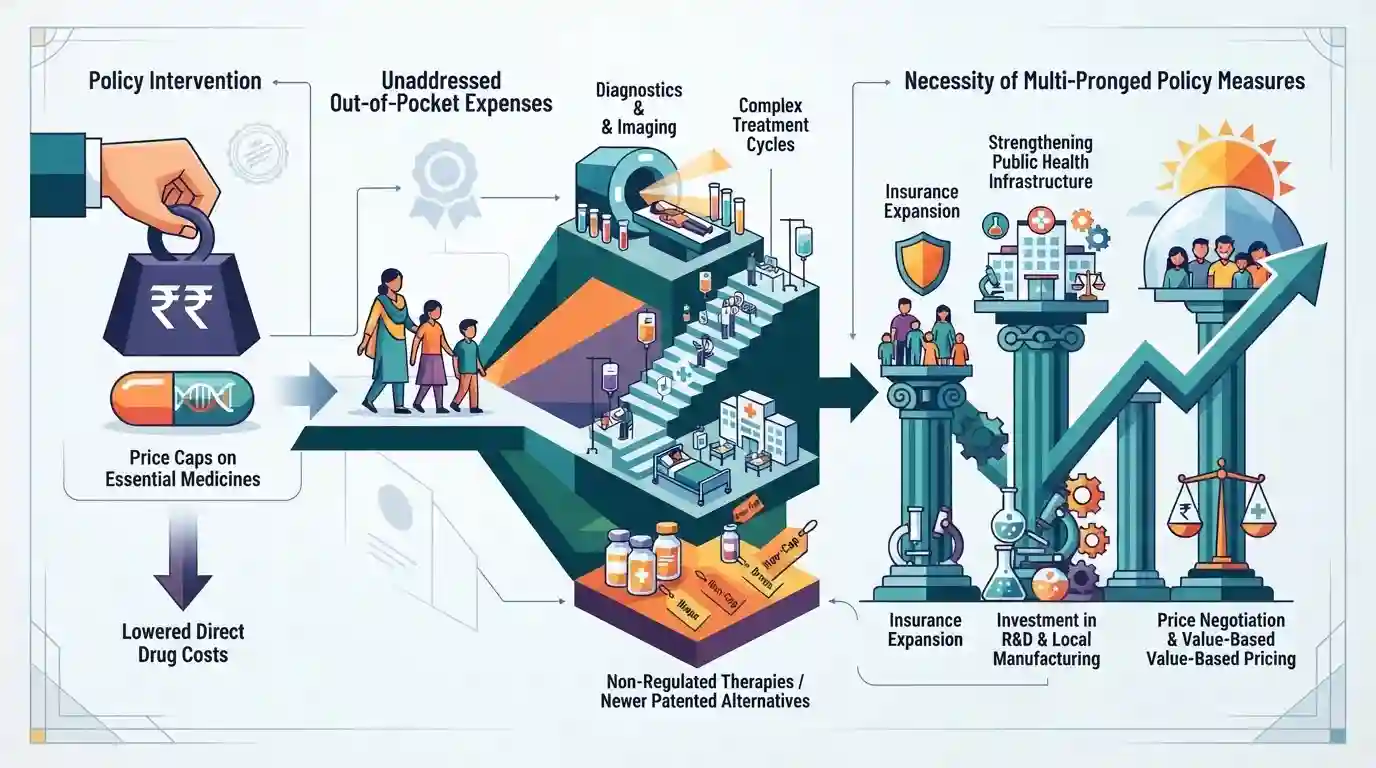
The article examines whether imposing price caps on cancer drugs effectively brings down the overall cost of treatment in India. While price caps by regulatory bodies like the NPPA help reduce the direct cost of specific essential medicines, out-of-pocket expenses remain high due to complex treatment cycles, diagnostics, hospitalization, and the prevalence of non-regulated therapies or newer patented alternatives. The analysis highlights the necessity of multi-pronged policy measures to address cancer care affordability comprehensively.
মূল বিষয়
- Price caps on essential cancer drugs aim to curb exorbitant costs and improve affordability for patients.
- High out-of-pocket expenditure on oncology treatment remains a major driver of catastrophic health expenditure and impoverishment in India.
- Structural challenges like trade margins, supply chain markups, and substitution by non-capped or newer patented drugs can limit the overall impact of price controls.
- A comprehensive approach involving price capping, promotion of generics, strengthening public health infrastructure, and strategic government procurement is necessary to truly reduce cancer treatment costs.
গুরুত্বপূর্ণ শব্দ
National Pharmaceutical Pricing Authority

An expert regulatory body established by the Government of India in 1997 to fix and revise prices of pharmaceutical products and enforce the Drugs (Prices Control) Order.
UPSC context
GS Paper II (Health Policy, Governance); tests institutional framework for drug price regulation and consumer protection in India.
Drugs (Prices Control) Order
A statutory order issued by the central government under the Essential Commodities Act to regulate the prices of essential medicines and curb profiteering.
UPSC context
GS Paper II (Health, Welfare Schemes); tests statutory backing and mechanisms for controlling healthcare and pharmaceutical costs.
National List of Essential Medicines
A curated compilation of medicines considered fundamental to basic healthcare needs, prioritizing public health relevance, cost, and safety.
UPSC context
GS Paper II (Social Justice - Health); tests government strategies for ensuring affordable access to crucial treatments like cancer therapies.
প্রিলিমস ফাঁদ
Price caps imposed by the NPPA successfully eliminate catastrophic out-of-pocket expenditure for all oncology patients in India.
Aspirants often assume price caps automatically cover all cancer treatments, missing that patented single-source drugs and non-scheduled therapies often escape regulation.
সংযুক্ত স্থির ধারণা
What are the constitutional and statutory provisions governing drug pricing in India?
- NPPA mandate: Statutory Body: The National Pharmaceutical Pricing Authority (NPPA) was established in 1997 under the Department of Pharmaceuticals, Ministry of Chemicals and Fertilizers.
- DPCO framework: Enforcement Order: It enforces the Drugs (Prices Control) Order (DPCO), issued under Section 3 of the Essential Commodities Act, 1955.
- NLEM role: NLEM linkage: Price ceilings are typically applied to medicines listed in the National List of Essential Medicines (NLEM).
আন্তঃবিষয় প্যাটার্ন
NPPA Price Caps vs. TRIPS Flexibilities
Drug price caps set by the NPPA intersect with intellectual property rights and TRIPS flexibilities, balancing public health imperatives against pharmaceutical patent protections.
Health OOP and Household Impoverishment
Catastrophic out-of-pocket expenditure on oncology drives vulnerable households into poverty, testing the efficacy of national social security safety nets.

NPPA pricing powers + TRIPS flexibilities + OOP health expenditure likely to appear as a linked statement-based question.
সংযুক্ত PYQ · 2
সংযুক্ত PYQ · 2
- 2022MainsGS3
The increase in life expectancy in the country has led to newer health challenges in the community. What are those challenges and what steps need to be taken to meet them?
- 2013MainsGS3
Bringing out the circumstances in 2005 which forced amendment to the section 3(d) in Indian Patent Law, 1970, discuss how it has been utilized by the Supreme Court in its judgement in rejecting Novratis' patent application for 'Glivec'. Discuss briefly the pros and cons of the decision.
