India Pledges to Protect National Interests Against External Tariffs
Source:Indian Express ↗
Why It Matters
The potential imposition of high tariffs by the US is a classic example of rising global protectionism. For UPSC aspirants, understanding its impact on India's macroeconomic stability, export competitiveness, and India-US bilateral trade relations is crucial for GS2 (IR) and GS3 (Economy).
Summary
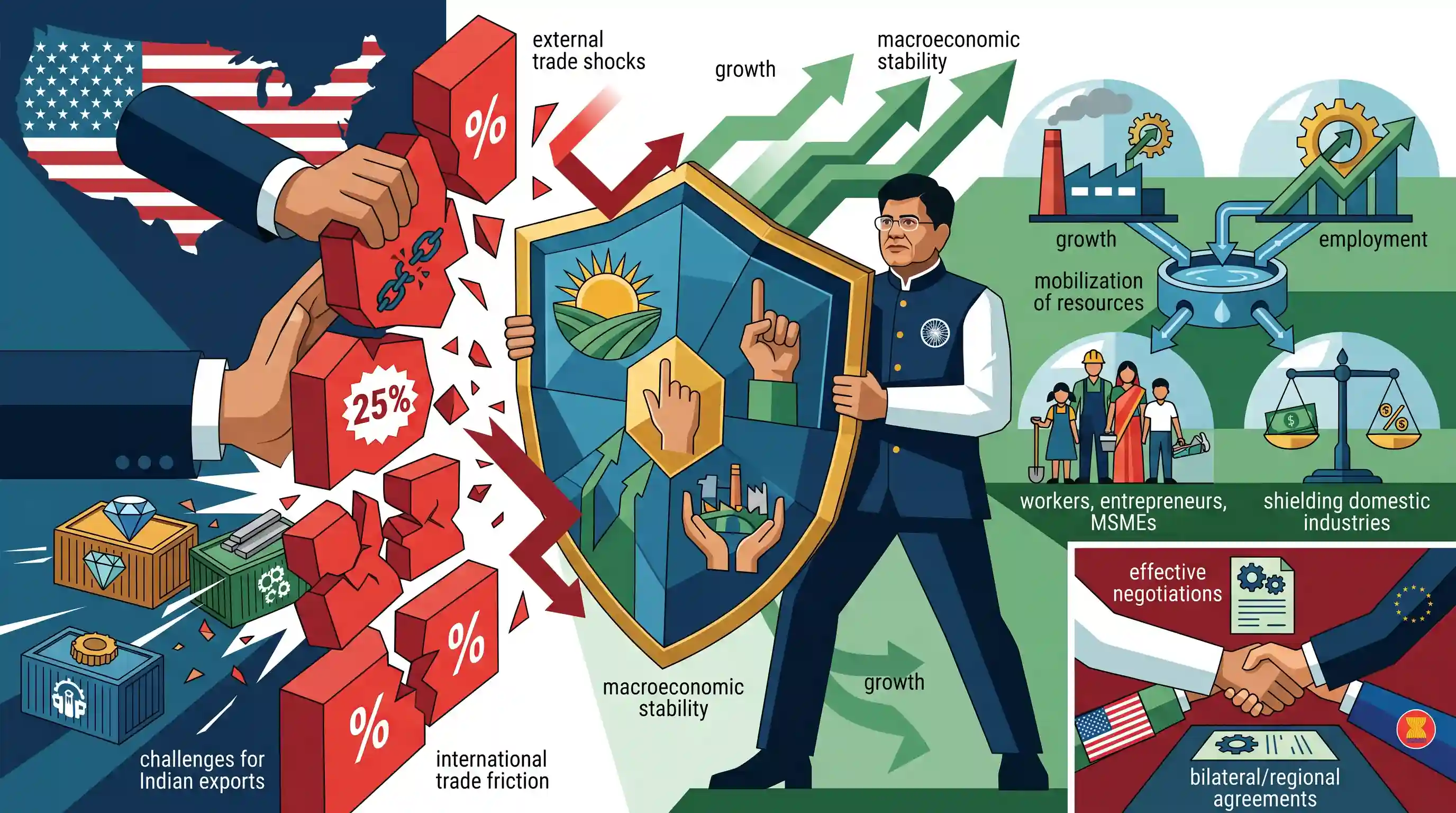
Union Commerce and Industry Minister Piyush Goyal stated that India will take all necessary measures to safeguard and advance its national interests in response to US President Donald Trump's proposal to impose a 25% tariff on imports. The statement highlights India's readiness to counter external trade shocks and negotiate effectively amid a rising global trend of economic protectionism. It underscores the challenges Indian exports may face and the government's commitment to shielding domestic industries and macroeconomic stability from international trade friction.
Key Points
- Union Minister Piyush Goyal emphasized that India is prepared to take necessary steps to protect its national interests amid changing global trade policies.
- The assertion comes in response to US President Donald Trump's proposed 25% tariff on imports, which could impact Indian exports.
- This development underscores a global shift towards economic protectionism and bilateralism, moving away from free trade frameworks.
- India's stance indicates a proactive approach to negotiate and shield domestic industries and the broader economy from adverse external tariff shocks.
Important Terms
Trade Protectionism

Economic policy of restricting imports through tariffs, quotas, or regulations to shield domestic industries from foreign competition. It aims to protect local jobs and promote self-reliance but can trigger trade wars.
UPSC context
GS3: Economy; GS2: International Relations. Tests understanding of globalization's retreat and its impact on Indian exports and macroeconomic stability.
Reciprocal Tariff
A 'tit-for-tat' trade policy where a country matches the import duties imposed by its trading partners to ensure a level playing field and address trade imbalances.
UPSC context
GS2: International Relations. Relevant for India-US bilateral trade friction and the challenges to the WTO's multilateral rules-based order.
Generalised System of Preferences (GSP)
A preferential trade program by developed countries (like the US) providing duty-free or reduced-duty access to thousands of products from developing nations to promote their economic growth.
UPSC context
GS2: Bilateral Relations. Specifically tests knowledge of US-India trade history, including the 2019 withdrawal of India’s GSP status.
Trade Deficit
An economic condition where the value of a country's imports exceeds its exports. In this article, it is the primary justification used by the US to propose higher tariffs.
UPSC context
GS3: Indian Economy. Key indicator of trade health and a driver of diplomatic friction in bilateral negotiations.
Bilateral Trade Agreement (BTA)
A trade agreement between two nations to reduce or eliminate tariffs, quotas, and other barriers to foster deeper economic cooperation and market access for goods and services.
UPSC context
GS2: Bilateral Groupings and Agreements. Tests understanding of how India navigates trade tensions through direct negotiations.
MSMEs (Micro, Small and Medium Enterprises)
The backbone of India's industrial sector, these enterprises are prioritized by the government for protection against global trade shocks due to their high employment potential and export contribution.
UPSC context
GS3: Economy (Growth and Employment). Critical for understanding domestic policy responses to international trade barriers.
Prelims Trap
"The US Generalized System of Preferences (GSP) is a bilateral trade agreement granting India duty-free access."
The GSP is not a negotiated bilateral treaty. It is a unilateral, non-reciprocal tariff preference scheme granted by developed countries to developing ones, which can be withdrawn at will.
Static Concepts Connected
What are the primary exceptions to the WTO's Most-Favored-Nation (MFN) principle?
- Regional Trade Agreements: Countries can grant higher tariff preferences to partners within FTAs or Customs Unions without extending them to all WTO members.
- Generalized System of Preferences: Developed nations can offer unilateral, non-reciprocal tariff cuts to developing countries (e.g., the US GSP).
- Trade Defense Instruments: Members can apply specific duties against certain countries to counter unfair subsidies, dumping, or sudden import surges.
What are the 3 main trade remedy measures permitted under WTO rules?
- Anti-dumping Duty: Imposed on goods from a specific country that are exported at prices below their normal domestic value.
- Countervailing Duty: Imposed to neutralize the negative effects of specific subsidies provided by a foreign government to its exporters.
- Safeguard Measures: A temporary restriction (applied globally, not country-specific) to protect a domestic industry from a sudden, unforeseen surge in imports.
Cross-Topic Patterns
Tariff shocks + Currency Depreciation
US tariff hikes often pressure the RBI to tolerate strategic Rupee depreciation, using currency adjustment as a natural shock absorber to keep Indian exports (pharma, textiles) competitive globally.
Trade Barriers + Strategic Autonomy
The US increasingly links economic barriers to geopolitical stances, testing India's multi-alignment strategy (e.g., threats of trade penalties over Russian oil and arms procurement).

US tariff threats + WTO MFN exceptions + India's recent FTA diversification will likely fuse into a complex 2026 Prelims economy question.
Linked PYQs · 4
Linked PYQs · 4
- 2025MainsGS3
What are the challenges before the Indian economy when the world is moving away from free trade and multilateralism to protectionism and bilateralism? How can these challenges be met?
- 2018MainsGS3
How would the recent phenomena of protectionism and currency manipulations in world trade affect macroeconomic stability of India?
- 2019MainsGS2
‘What introduces friction into the ties between India and the United States is that Washington is still unable to find for India a position in its global strategy, which would satisfy India's national self-esteem and ambitions.’ Explain with suitable examples.
- 2012MainsGS2
Discuss the likely negative impact of the protectionist measures proposed by the US on India's software industry.
