West Bengal Seeks MEA Clearance for Nepal Flood Rescue Mission
Source:The Hindu ↗
Why It Matters
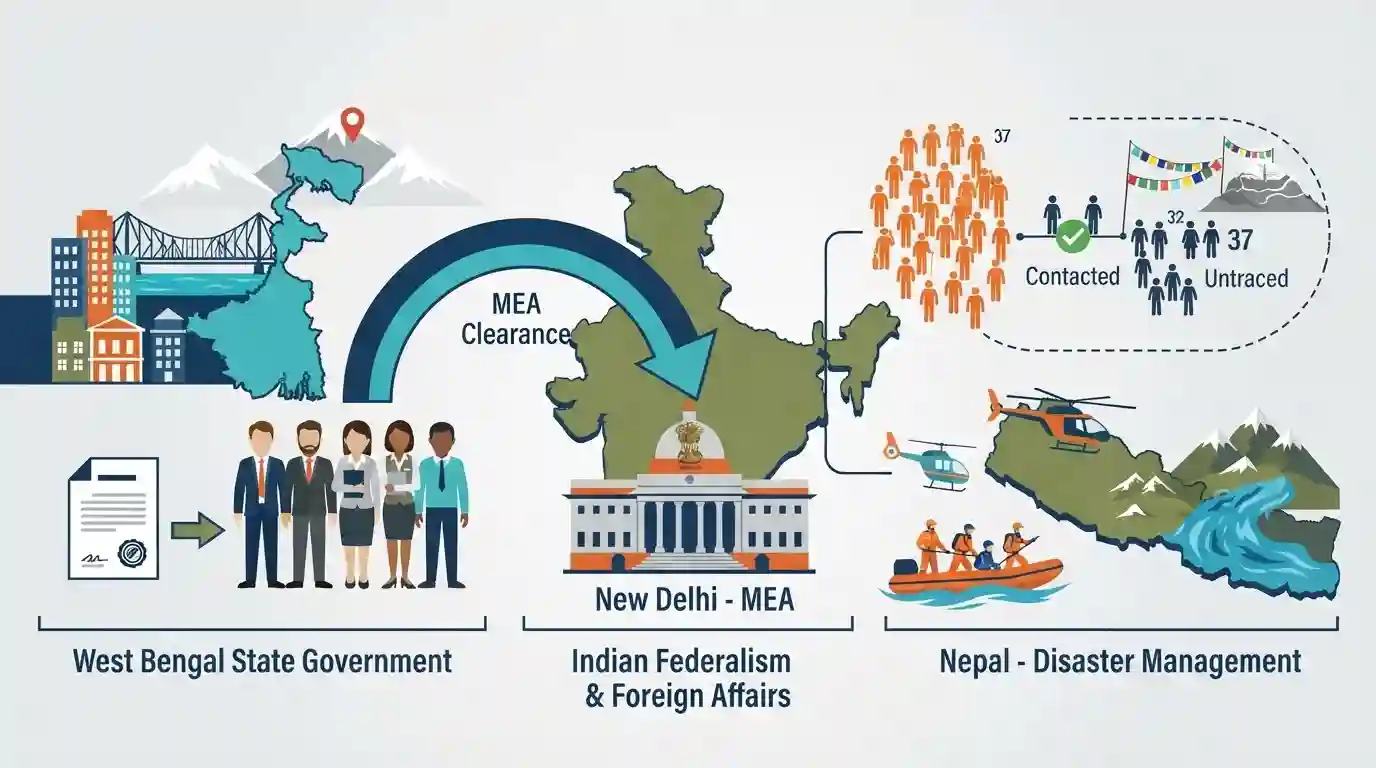
This scenario illustrates the strict constitutional boundaries of Indian federalism, where state governments must seek central clearance (MEA) before sending administrative delegations or undertaking operations in sovereign foreign territories. It connects to the Seventh Schedule's separation of powers (Union List Entry 10 on Foreign Affairs) and disaster coordination protocols.
Summary
West Bengal Chief Minister Suvendu Adhikari announced that the state government is seeking permission from the Ministry of External Affairs (MEA) to send a four-member administrative and political delegation to Kathmandu, Nepal. This delegation aims to assist in search, rescue, and relief operations following devastating flash floods in Nepal. Out of 39 reported missing tourists from West Bengal, two have been successfully contacted, while 37 remain untraced, including a group of 32 pilgrims on the Kailash-Mansarovar Yatra. The constitutional necessity of obtaining MEA clearance highlights the division of powers under the Seventh Schedule of the Constitution.
Key Points
- West Bengal Chief Minister Suvendu Adhikari has directed the state's Chief Secretary to seek clearance from the Union Ministry of External Affairs (MEA) to send an official delegation to Nepal.
- The proposed state delegation will consist of a State Minister, an MLA, an IG-rank police officer, and a senior IAS officer (secretary or joint secretary level) to coordinate rescue operations in Kathmandu.
- This initiative comes in the wake of the devastating August 2026 Nepal flash floods, which left several Indian tourists stranded or missing.
- As per official records, 39 people from West Bengal were reported missing; of these, two senior citizens from Basirhat (Anukul Poddar and his wife) have been successfully contacted, while 37 remain untraced.
- Out of the 37 untraced individuals, 32 were undertaking the Kailash-Mansarovar Yatra through a Kolkata-based travel agency named 'Cholo Jai'.
- Among the untraced is Sharmistha Bhowmik Roy, the daughter-in-law of the late founding member of TMC, Mukul Roy, and wife of former MLA Subhrangshu Roy.
- The administrative procedure of seeking MEA clearance highlights the constitutional division of power under the Seventh Schedule, which places foreign affairs exclusively under the Union List (Entry 10).
Important Terms
Seventh Schedule of the Constitution of India

Under Article 246, this schedule details the division of legislative powers between the Union and States through three categories: the Union List, State List, and Concurrent List.
UPSC context
Paper V (Constitution). Evaluates knowledge of the federal division of powers, list items, and constitutional amendments.
Disaster Management Act 2005
A statutory law that establishes a systematic framework for disaster preparedness and mitigation, creating the National, State, and District Disaster Management Authorities in India.
UPSC context
Paper V (Polity/Governance) and Paper III. Tests statutory bodies, legislative provisions, and emergency response mechanisms.
Ministry of External Affairs (MEA)
The central government ministry responsible for India's foreign policy, diplomacy, and relations with foreign states, holding sole constitutional jurisdiction over matters linking India to external nations.
UPSC context
Paper V (Polity) and Paper III. Assesses understanding of Union prerogative in foreign relations and federal limits.
West Bengal State Government
The subnational administrative authority of West Bengal, consisting of the Governor, the Chief Minister-led Cabinet, and the State Legislature, operating within India’s federal structure.
UPSC context
Paper V (State Executive). Tests knowledge of state executive authority, local governance, and center-state interactions.
Prelims Trap
Pilgrimages, regardless of destination, are a State subject under List II of the Seventh Schedule.
Under the Seventh Schedule, 'Pilgrimages to places outside India' is explicitly under Entry 20 of List I, whereas domestic pilgrimages are under Entry 7 of List II.
Static Concepts Connected
How does the Seventh Schedule divide jurisdiction over foreign relations and pilgrimages?
- Foreign Relations: Entry 10 of List I (Union List) grants exclusive jurisdiction over foreign affairs and relations with foreign countries to the Union.
- External Pilgrimages: Entry 20 of List I governs "Pilgrimages to places outside India" (e.g., Kailash-Mansarovar, Hajj).
- Domestic Pilgrimages: Entry 7 of List II (State List) governs pilgrimages within India, giving states legislative competence.
What is the nodal structure under the Disaster Management Act, 2005?
- NDMA: Chaired by the Prime Minister, it is the apex body for disaster management in India.
- SDMA: Chaired by the respective Chief Minister, responsible for state-level disaster planning and execution.
- NIDM: Renamed from National Centre of Disaster Management (est. 1995), it focuses on national capacity building and research.
Cross-Topic Patterns
Paradiplomacy and Constitutional Boundaries
State-level cross-border relief initiatives require absolute alignment with the MEA, highlighting how India's unitary bias restricts sub-national foreign relations.
Border Geography and Trans-boundary Hazards
West Bengal's unique geography, bordering Nepal, Bhutan, and Bangladesh, links state disaster response directly with cross-border ecological hazards.

Distinct jurisdictional separation of internal vs. external pilgrimages in Seventh Schedule likely to be tested in Polity.
Linked PYQs · 3
Linked PYQs · 3
- 2015WBCS_PRELIMSGS1
West Bengal has international boundaries on
- 2019WBCS_PRELIMSGS1
Which Schedule of the Constitution of India distributes power between the Union and the States?
- 2020WBCS_PRELIMSGS1
National Institute of Disaster Management or NIDM was previously named as:
