US Extradition Bid for Lawrence Bishnoi Raises Legal Challenges
Source:Indian Express ↗
Why It Matters
This case demonstrates the evolution of local gang networks into transnational criminal syndicates that interface with geopolitical security threats, such as foreign-based separatist groups. It highlights the security-nexus challenges of global terror-crime operations and provides a practical context for examining the legal bottlenecks in bilateral extradition treaties.
Summary
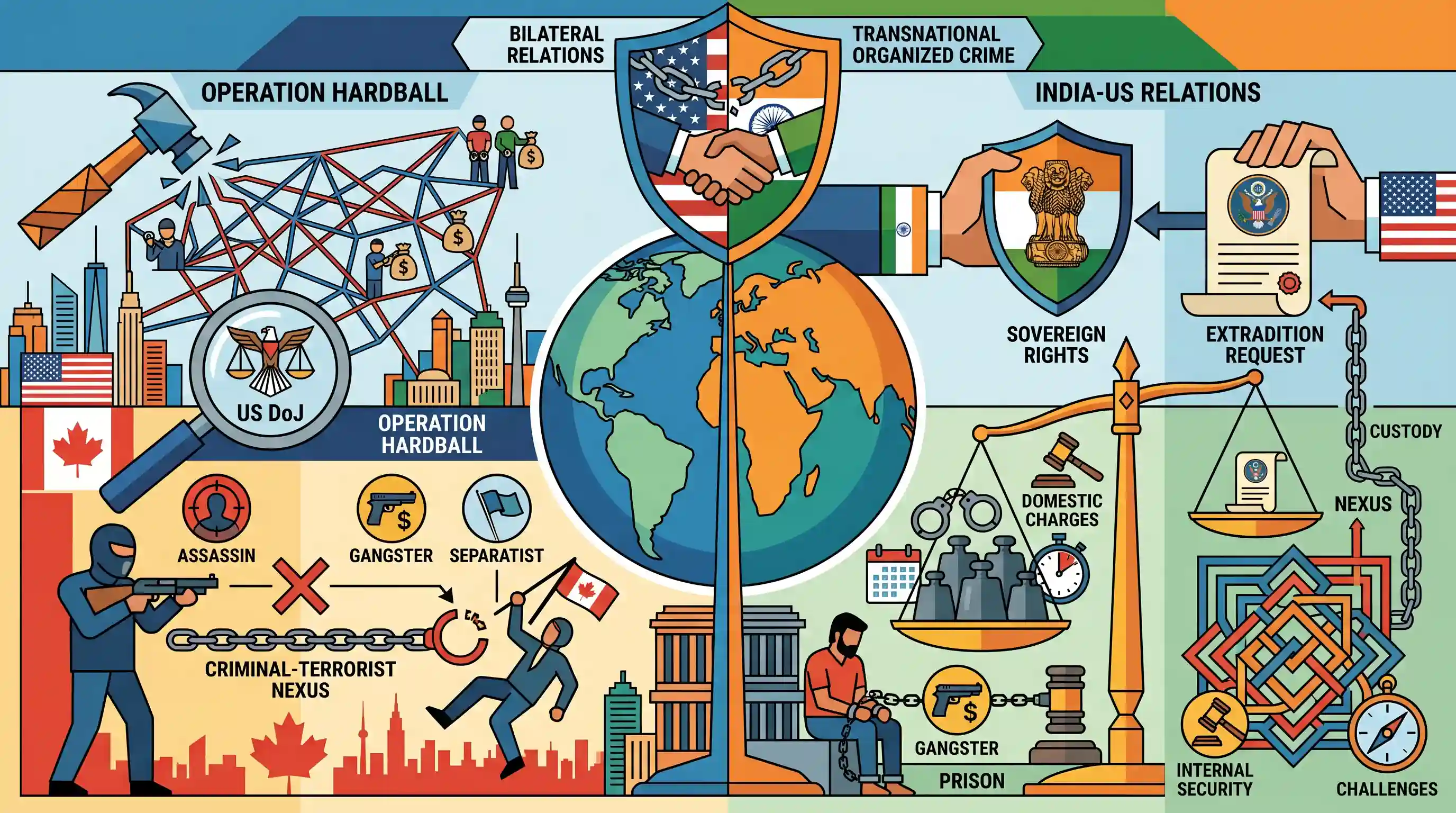
The United States Department of Justice (DoJ) has announced plans to seek the extradition of jailed Indian gangster Lawrence Bishnoi. This development follows his indictment under 'Operation Hardball', an international law enforcement operation targeting transnational crime networks. Bishnoi and his associate, Goldy Brar, face charges in the US regarding the assassination of Canada-based separatist Hardeep Singh Nijjar. However, because Bishnoi is already in Indian custody and facing multiple domestic charges, legal provisions allow India to complete domestic criminal trials and sentences before addressing the extradition request, highlighting complex challenges in bilateral extradition and tackling transnational organized crime.
Key Points
- The US Justice Department confirmed its intention to seek the extradition of incarcerated Indian gangster Lawrence Bishnoi.
- Bishnoi and his Canada-based aide, Goldy Brar, have been charged with ordering the assassination of Khalistan separatist Hardeep Singh Nijjar under 'Operation Hardball'—a transnational crackdown targeting Indian crime syndicates in the US, Canada, and Europe.
- Extradition between India and the US is governed by the bilateral Extradition Treaty (1997) and India's Extradition Act, 1962.
- A major legal bottleneck exists as Bishnoi is currently in judicial custody in Gujarat and faces multiple trials in India; under international law, India can argue he must finish domestic trials and serve any domestic sentences before extradition.
- The standard procedure requires the US DoJ to prepare the request, which is transmitted via the US State Department to India's MEA, followed by domestic evaluation involving the MHA and CBI.
Important Terms
India-US Extradition Treaty of 1997

A bilateral treaty establishing a legal framework to surrender fugitive criminals between India and the United States, requiring "dual criminality" and offenses punishable by at least one year of imprisonment.
UPSC context
GS Paper II (Bilateral Relations, Treaties) and GS Paper III (Internal Security); tests international law, security cooperation, and extradition dynamics.
Extradition Act, 1962
India's domestic legislation governing the extradition of fugitive criminals to and from foreign countries, detailing the judicial procedures, treaty integration, and sovereign rights involved in transfer processes.
UPSC context
GS Paper II (Polity and Legislation) and GS Paper III (Internal Security); tests understanding of domestic legal frameworks for cross-border criminal justice.
Ministry of External Affairs (MEA)
The Indian government's nodal ministry responsible for conducting foreign relations, managing international treaties, and processing all incoming and outgoing extradition requests through diplomatic channels.
UPSC context
GS Paper II (Governance and Institutional Frameworks); tests institutional roles in handling foreign policy, diplomacy, and international legal assistance.
Ministry of Home Affairs (MHA)
The nodal Indian ministry for internal security, domestic law enforcement, and coordinating with investigative agencies to examine and clear extradition requests before formal diplomatic transmission.
UPSC context
GS Paper III (Internal Security and Law & Order); tests administrative mechanisms for managing domestic security and evaluating cross-border criminal cases.
Central Bureau of Investigation (CBI)
India's premier federal investigating agency that serves as the National Central Bureau for Interpol, facilitating international police cooperation, tracking fugitives, and executing red notices.
UPSC context
GS Paper III (Security Forces and Agencies); tests understanding of premier investigating bodies and their role in global law enforcement networks.
Prelims Trap
India must immediately extradite a requested fugitive criminal even if they are currently undergoing domestic trial or serving a sentence in India.
Section 31(d) of India's Extradition Act, 1962 explicitly bars surrender of a fugitive until they are acquitted or have fully served their domestic sentence.
Static Concepts Connected
What are the core international law principles of 'Dual Criminality' and 'Rule of Speciality'?
- Dual Criminality: Requires that the offense must be a crime in both the requesting and requested nations, carrying a specified minimum punishment.
- Rule of Speciality: Mandates that the extradited person can only be prosecuted for the specific crime for which extradition was formally granted.
- Section 31 integration: Both principles are statutorily integrated into India's Extradition Act, 1962 to prevent arbitrary foreign prosecutions.
How does the legal process of extradition operate under Indian law?
- Nodal Agency: The Ministry of External Affairs (MEA) is the central authority in India that receives and initiates all extradition requests.
- Extradition Act 1962: Governs extradition with treaty states and non-treaty states based on reciprocity assurances under Section 3.
- Magisterial Inquiry: A judicial magistrate must hold an inquiry to determine if a prima facie case exists before the executive can order surrender.
Cross-Topic Patterns
Transnational syndicates + Sovereign law enforcement
Cross-border syndicates exploit legal variances between nations, making extradition treaties a vital tool that directly impacts domestic internal security and geopolitical relationships.
Organized crime + State sovereignty
The intersection of foreign indictments with pending domestic prosecutions tests the limits of bilateral judicial cooperation under the Extradition Act, 1962.

Expect a 2026 Prelims question on Extradition Act, 1962 exceptions, specifically testing the Rule of Speciality and Section 31 restrictions.
Linked PYQs · 2
Linked PYQs · 2
- 2022MainsGS3
Discuss the types of organised crimes. Describe the linkages between terrorists and organised crime that exist at the national and transnational levels.
- 2021MainsGS3
Analyse the complexity and intensity of terrorism, its causes, linkages and obnoxious nexus. Also suggest measures required to be taken to eradicate the menace of terrorism.
