Jammu and Kashmir statehood demand and federal dynamics
Source:The Hindu ↗
Why It Matters
The transition of Jammu & Kashmir from a state with special status to a Union Territory, and the demand for the restoration of its statehood, forms a key case study in Indian federalism. Furthermore, the complexities surrounding the reservation policy in J&K highlight significant issues in social justice and governance.
Summary
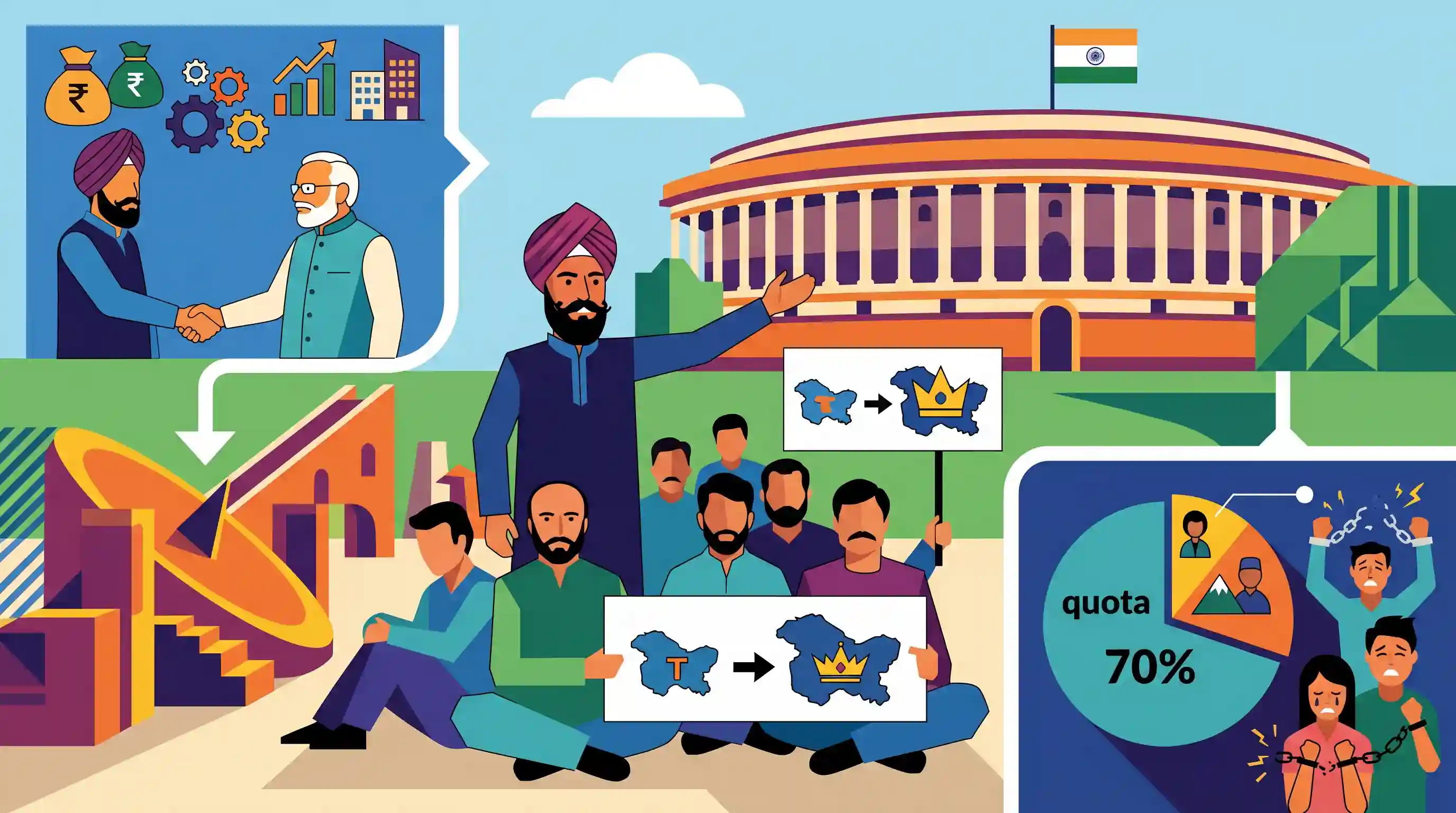
Jammu & Kashmir Chief Minister Omar Abdullah stated that National Conference legislators will stage a sit-in at Jantar Mantar during the upcoming Monsoon Session of Parliament to remind the Centre of its promise to restore statehood. Highlighting that the UT government will pursue statehood through democratic means, Abdullah noted he recently discussed the issue, along with J&K's financial and developmental needs, with Prime Minister Narendra Modi. Additionally, the administration is reviewing the reservation policy in J&K, which has sparked protests from general category students as the quota has reached up to 70% following the inclusion of groups like Paharis.
Key Points
- Jammu and Kashmir Chief Minister Omar Abdullah announced that National Conference legislators will hold a sit-in protest at Jantar Mantar during the upcoming Monsoon Session of Parliament.
- The protest aims to remind the Union Government of its commitment to restore full statehood to Jammu & Kashmir.
- The National Conference government intends to pursue the restoration of statehood through democratic and constitutional means, including recent meetings with the Prime Minister.
- The J&K administration is also dealing with protests by general category students against a revised reservation policy that has pushed quotas up to 60%-70% after the inclusion of Paharis and an increased OBC quota.
Important Terms
Jammu and Kashmir Reorganisation Act, 2019

Enacted in 2019 to bifurcate the state of Jammu and Kashmir into two Union Territories: Jammu & Kashmir (with a legislature) and Ladakh (without a legislature), while repealing Article 370.
UPSC context
GS Paper II: Functions and responsibilities of the Union and the States; reorganization of states and its impact on the federal structure.
Statehood
The constitutional status of a region as a primary administrative unit within the Union, granting it independent legislative and executive powers over subjects listed in the State List of the Seventh Schedule.
UPSC context
GS Paper II: Federalism and Indian Constitution; distinguishes the division of powers between States and Union Territories (Articles 1-4).
Cooperative Federalism
A constitutional principle where the Union and States work together to solve common problems, balancing centralized authority with regional autonomy to maintain national integrity and democratic governance.
UPSC context
GS Paper II: Federal structure and Centre-State relations; tests understanding of the balance between unitary and federal features.
Reservation Policy (J&K)
The legal framework allotting a percentage of jobs and educational seats to specific groups; in J&K, recent amendments have pushed total quotas to 70%, sparking debates on merit and the 50% cap.
UPSC context
GS Paper II: Social Justice and Statutory bodies; examines the rationale and legal limits (Indra Sawhney case) of affirmative action.
Pahari Ethnic Group
An ethnic and linguistic group in Jammu and Kashmir recently granted Scheduled Tribe (ST) status, leading to a 10% separate quota and triggering protests regarding the reduction of open-merit seats.
UPSC context
GS Paper II: Welfare schemes for vulnerable sections; tests understanding of criteria for ST status and socio-political impact of group inclusions.
Article 3 of the Constitution
Grants Parliament the power to form new states, increase or diminish the area of any state, or alter the boundaries or name of any state through a simple majority.
UPSC context
GS Paper II: Indian Constitution; tests knowledge of the parliamentary procedure for reorganizing the territory of India.
Prelims Trap
The J&K Legislative Assembly has jurisdiction over all subjects enumerated in the State List.
Under the J&K Reorganisation Act, 2019, 'Police' and 'Public Order' are explicitly kept under exclusive Union control via the LG, unlike full states.
Static Concepts Connected
How does the J&K UT legislature differ from a full State Assembly?
- Restricted State List: J&K cannot legislate on 'Police' and 'Public Order', which are reserved for the Lieutenant Governor.
- Discretionary powers: The Lieutenant Governor holds broader discretionary powers over assembly bills and executive actions compared to a traditional State Governor.
What is the constitutional process for adding new communities to the ST list?
- Article 342: The President notifies the initial list under Article 342. Any subsequent inclusions or exclusions require an Act of Parliament.
- Mandatory approvals: The process requires sequential clearance from the State/UT government, the Registrar General of India (RGI), and the National Commission for Scheduled Tribes (NCST).
- Reservation ceiling: The Supreme Court's Indra Sawhney (1992) ruling set a 50% cap on total reservations, which can only be breached under extraordinary circumstances.
Cross-Topic Patterns
Asymmetric federalism: Delhi vs J&K
Delhi derives its unique legislative structure directly from constitutional Article 239AA, whereas the J&K assembly functions under a statutory law (the J&K Reorganisation Act, 2019).
Fiscal federalism and the 1% carve-out
The 15th Finance Commission reduced states' vertical tax devolution to 41% from 42% specifically to account for the security and developmental needs of the newly created J&K and Ladakh UTs.

Expect a 2026 prelims multi-statement question contrasting the LG's powers and State List restrictions across Delhi, Puducherry, and J&K.
Linked PYQs · 3
Linked PYQs · 3
- 2024MainsGS2
What changes has the Union Government recently introduced in the domain of Centre-State relations ? Suggest measures to be adopted to build the trust between the Centre and the States and for strengthening federalism.
- 2025MainsGS2
Discuss the nature of Jammu and Kashmir Legislative Assembly after the Jammu and Kashmir Reorganization Act, 2019. Briefly describe the powers and functions of the Assembly of the Union Territory of Jammu and Kashmir.
- 2016MainsGS2
To what extent is Article 370 of the Indian Constitution, bearing marginal note "Temporary provision with respect to the State of Jammu and Kashmir", temporary? Discuss the future prospects of this provision in the context of Indian polity.
