Macroeconomic Rankings and India G7 Engagement
Source:The Hindu ↗
Why It Matters
Understanding India's macroeconomic standing (Nominal GDP vs PPP) and growth trajectory is important for assessing its evolving geopolitical clout, negotiating power in global forums like the G7, and domestic developmental progress.
Summary
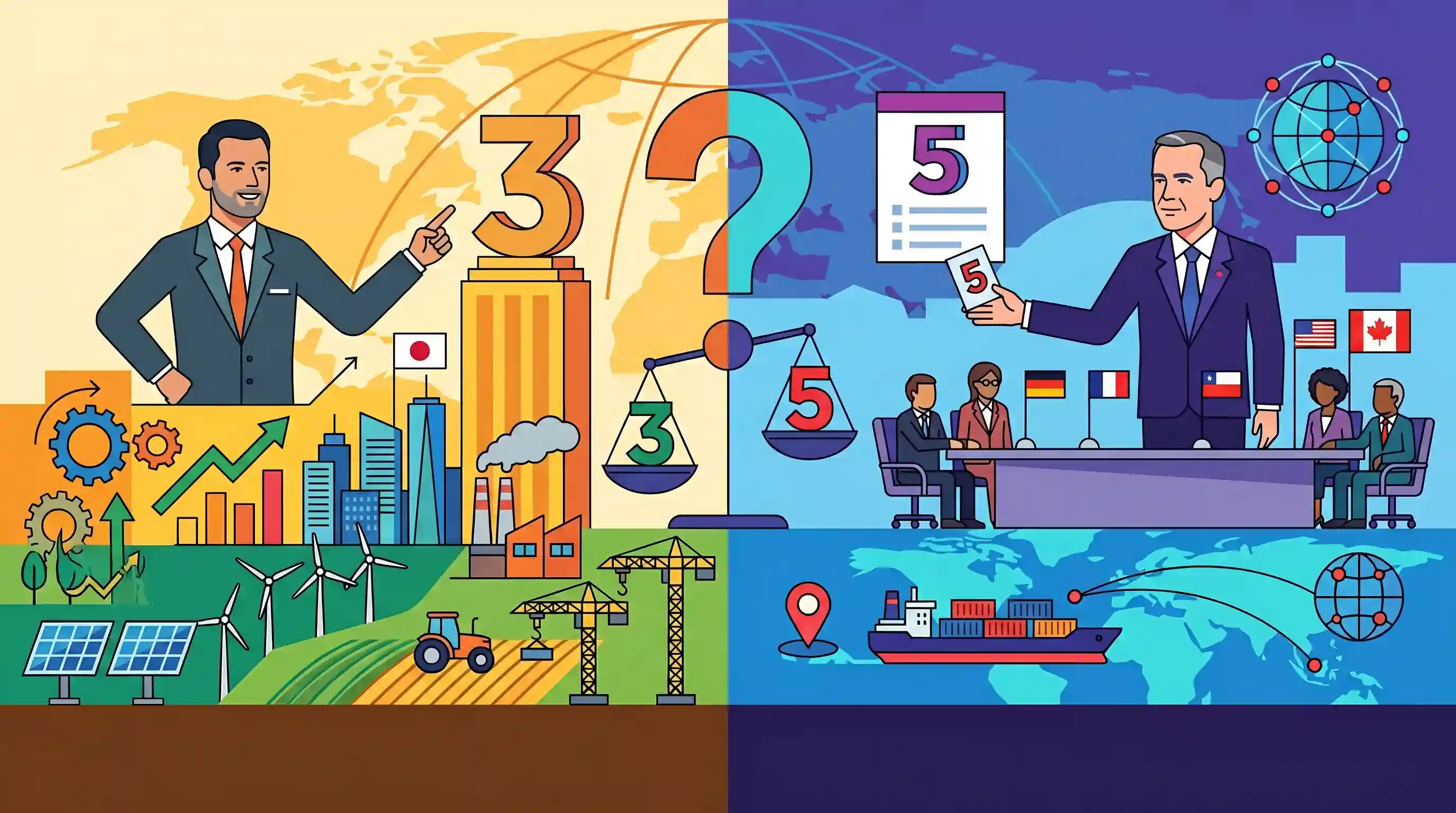
Congress leader Jairam Ramesh took a political dig at PM Narendra Modi over conflicting claims regarding the size of India's economy. While the NITI Aayog CEO recently asserted that India has surpassed Japan to become the world's third-largest economy, Canadian Prime Minister Mark Carney, while inviting PM Modi to the 52nd G7 Summit, referred to India as the fifth-largest economy. The discrepancy highlights domestic debates over India's macroeconomic ranking, even as its international importance in global supply chains and forums like the G7 continues to grow.
Key Points
- Prime Minister Narendra Modi was invited to the 52nd G7 Summit in Kananaskis, Canada, by Canadian PM Mark Carney.
- Carney highlighted India's status as the fifth-largest economy and its vital role in global supply chains as reasons for its inclusion in the summit.
- Congress leader Jairam Ramesh highlighted a contradiction, noting that the NITI Aayog CEO recently claimed India had already surpassed Japan to become the third-largest economy.
- The discrepancy underscores the ongoing political debate over the exact size and ranking of India's Gross Domestic Product (GDP).
Important Terms
G7 (Group of Seven)

An informal forum of seven leading advanced economies (US, UK, France, Germany, Italy, Japan, Canada) plus the EU, meeting annually to coordinate global economic and security policies.
UPSC context
GS Paper II: International Relations; tests knowledge of global groupings, their mandate, and India's 'Outreach Country' status.
NITI Aayog
The premier policy think tank of the Indian government, providing strategic and technical advice. It replaced the Planning Commission in 2015 to promote 'Cooperative Federalism'.
UPSC context
GS Paper III: Indian Economy and Planning; essential for understanding institutional frameworks for development and economic monitoring.
Nominal GDP
The market value of all final goods and services produced within a country, calculated at current market exchange rates without adjusting for inflation or cost-of-living differences.
UPSC context
GS Paper III: Economic Development; critical for comparing national economic sizes and understanding India's trajectory toward becoming a $5 trillion economy.
Outreach Country
A non-member nation (like India) invited to participate in G7 summits to broaden discussions on global issues like climate change and supply chain resilience.
UPSC context
GS Paper II: International Relations; tests India's strategic positioning and its role as a representative of the Global South.
Purchasing Power Parity (PPP)
An economic theory that compares different countries' currencies through a 'basket of goods' approach. India currently ranks as the world's third-largest economy by this metric.
UPSC context
GS Paper III: Economy; used to contrast with Nominal GDP for a more comprehensive view of economic power and living standards.
Prelims Trap
"India has surpassed Japan to become the third-largest economy by nominal GDP."
India is 5th by nominal GDP but 3rd by Purchasing Power Parity (PPP). UPSC exploits this by swapping the metrics in statement-based questions.
Static Concepts Connected
What is the difference between Nominal GDP and GDP at PPP?
- Nominal GDP: Values a country's total economic output at current market exchange rates without adjusting for inflation or living costs.
- GDP at PPP: Adjusts for differing price levels and cost of living to reflect actual domestic purchasing power.
- India's Status: India is currently the 5th largest economy by Nominal GDP, but the 3rd largest when measured by PPP.
What are the core characteristics of the G7 grouping?
- Informal Nature: It operates as an informal intergovernmental forum with no formal legal charter or permanent secretariat.
- Rotating Presidency: The presidency rotates annually among member states, who host the summit and have the discretion to invite guest nations.
- India's Role: India is not a formal member but is consistently invited as an 'outreach partner' due to its strategic and economic weight.
Cross-Topic Patterns
Growth vs Development metrics
Despite being a top 5 global economy, India ranks much lower (134th) on the Human Development Index (HDI), highlighting the frequent UPSC focus on the gap between aggregate GDP and per capita welfare.
G7 outreach and the Global South
India's consistent invitation to G7 summits reflects its strategic positioning as the 'Voice of the Global South', acting as a bridge between advanced Western economies and developing nations.

Expect a 2026 prelims question contrasting Nominal vs PPP GDP calculation methods, specifically testing India's exact global rankings.
Linked PYQs · 3
Linked PYQs · 3
- 2021MainsGS3
Explain the difference between computing methodology of India's Gross Domestic Product (GDP) before the year 2015 and after the year 2015.
- 2020MainsGS3
Define potential GDP and explain its determinants. What are the factors that have been inhibiting India from realizing its potential GDP?
- 2012MainsGS2
What is meant by the G8 + 5 group?
