Parliamentary Oversight on National Security Strategy
Source:The Hindu ↗
Why It Matters
This article brings together several critical UPSC themes: the management of cross-border terrorism (GS3 Security), the necessity of defense reforms and strategic reviews after military operations (GS3 Security), and the dynamics of India-Pakistan bilateral relations vis-à-vis third-party mediation like the US (GS2 IR). It also touches upon the functional role of parliamentary debates and all-party consensus in shaping national security policy (GS2 Polity).
Summary
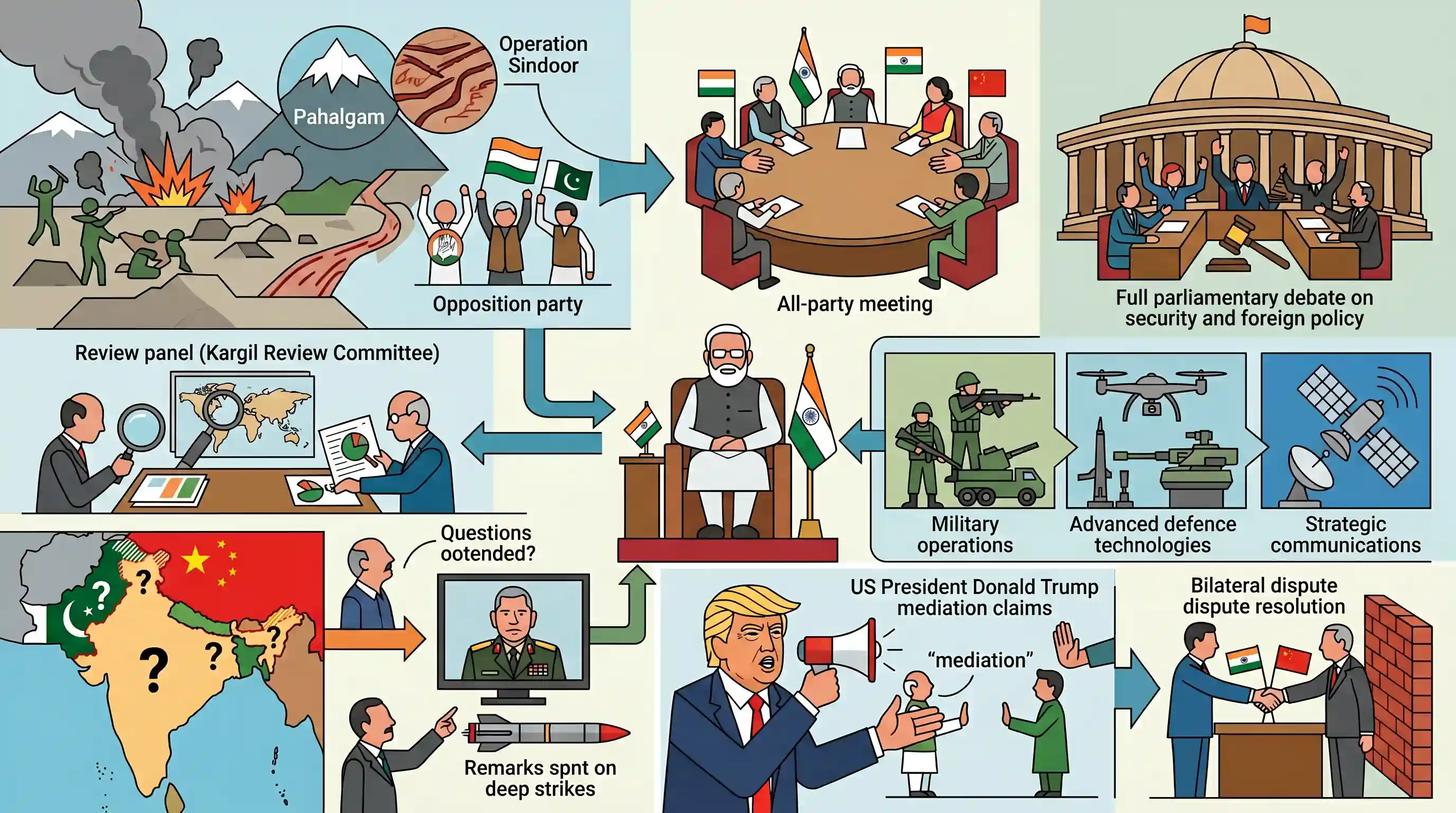
The Congress party has urged Prime Minister Narendra Modi to hold an all-party meeting and a full parliamentary debate on India's security and foreign policy in the aftermath of the Pahalgam terror attack and 'Operation Sindoor'. The Opposition suggested establishing a review panel similar to the Kargil Review Committee to analyze the military operations, emerging defense technologies, and strategic communications. Additionally, the party questioned the government on its strategy towards Pakistan and China, sought clarity on the CDS's remarks regarding deep strikes in Pakistan, and demanded a firm response to U.S. President Donald Trump's claims of mediating an India-Pakistan ceasefire, emphasizing the need to uphold bilateral dispute resolution.
Key Points
- The Congress party demanded a comprehensive debate in Parliament's monsoon session regarding India's post-Pahalgam security strategy and foreign policy challenges.
- The Opposition proposed the formation of an expert panel akin to the Kargil Review Committee to evaluate 'Operation Sindoor', future warfare strategies, and emerging military technologies.
- Multi-party parliamentary delegations were recently sent to 32 countries to project national unity and convey India's stance on eradicating terrorism post the Pahalgam attack.
- Remarks by Chief of Defence Staff (CDS) Gen Anil Chauhan in Singapore confirmed that India executed deep strikes inside Pakistani territory after recent military clashes.
- Congress sought clarification on U.S. President Donald Trump's claims of mediating a ceasefire between India and Pakistan, reiterating India's stance on strict bilateralism without third-party intervention.
Important Terms
Operation Sindoor

Indian military operation (May 2025) involving precision strikes on terror infrastructure in Pakistan/PoJK, launched as a direct retaliation for the Pahalgam terror attack.
UPSC context
GS III (Internal Security); tests knowledge of counter-terror doctrines and the use of air/missile power in cross-border responses.
Kargil Review Committee
1999 high-level committee (chaired by K. Subrahmanyam) that analyzed Kargil War lapses, recommending landmark reforms including the creation of the Chief of Defence Staff (CDS).
UPSC context
GS III (Security Reforms); tests historical understanding of institutional changes and the origins of modern defense restructuring.
Chief of Defence Staff (CDS)
The professional head of the Indian Armed Forces and permanent chairman of the Chiefs of Staff Committee, serving as the single-point military advisor to the government.
UPSC context
GS III (Defense Reforms); tests knowledge of "jointness" and military command-and-control frameworks in the Indian context.
The Resistance Front (TRF)
A militant group and offshoot of Lashkar-e-Taiba active in Jammu and Kashmir, responsible for the April 2025 Pahalgam attack on civilians.
UPSC context
GS III (Internal Security); tests awareness of current terror organizations and the nature of proxy warfare in J&K.
Strategic Autonomy
India's foreign policy principle of independent decision-making based on national interest, rejecting external coercion or third-party mediation in bilateral disputes.
UPSC context
GS II (International Relations); tests understanding of non-alignment and India's insistence on bilateralism (e.g., Shimla Agreement).
Parliamentary Oversight
The constitutional mechanism where Parliament monitors and reviews executive actions, including security and foreign policy, ensuring accountability to the legislature.
UPSC context
GS II (Polity); tests the role of the Opposition and the Executive's responsibility toward Parliament in matters of national interest.
Prelims Trap
"The Chief of Defence Staff (CDS) exercises direct operational command over the Army, Navy, and Air Force."
The CDS acts as the Principal Military Advisor and Permanent Chairman of the Chiefs of Staff Committee, but does not exercise direct operational military command over the Service Chiefs.
Static Concepts Connected
What is the legal basis for India rejecting third-party mediation with Pakistan?
- Shimla Agreement (1972): Signed after the 1971 war, it legally binds India and Pakistan to resolve differences peacefully through strictly bilateral negotiations.
- Lahore Declaration (1999): Reaffirmed the bilateral nature of dispute resolution between the two nations, systematically excluding external actors or mediators.
What are the key mandates and limitations of the Chief of Defence Staff (CDS)?
- Advisory Role: Acts as the Principal Military Advisor to the Defence Minister on all tri-service matters.
- Integration: Facilitates the restructuring of military commands for optimal resource utilization via Integrated Theatre Commands.
- No Command Role: The CDS does not exercise direct military command over the individual Service Chiefs.
Cross-Topic Patterns
Executive powers vs. Parliamentary oversight
While the Executive dominates foreign policy under Article 73, parliamentary debates and Standing Committees on External Affairs are crucial for ensuring accountability and projecting unified national consensus during crises.
From Strategic Restraint to Pre-emptive Deterrence
'Operation Sindoor' and confirmed deep strikes reflect India's ongoing doctrinal shift from post-26/11 strategic restraint to active, pre-emptive deterrence against state-sponsored proxy wars.

Expect a 2026 GS-3 Mains question on India's shift from strategic restraint to active deterrence, contextualizing recent deep strikes.
Linked PYQs · 3
Linked PYQs · 3
- 2020MainsGS3
Analyze internal security threats and transborder crimes along Myanmar, Bangladesh and Pakistan borders including Line of Control (LoC). Also discuss the role played by various security forces in this regard.
- 2015MainsGS2
Terrorist activities and mutual distrust have clouded India-Pakistan relations. To what extent the use of soft power like sports and cultural exchanges could help generate goodwill between the two countries? Discuss with suitable examples.
- 2019MainsGS2
‘What introduces friction into the ties between India and the United States is that Washington is still unable to find for India a position in its global strategy, which would satisfy India's national self-esteem and ambitions.’ Explain with suitable examples.
