Palestine President Pledges Gaza Peace Plan Cooperation at UN
Source:Indian Express ↗
Why It Matters
The Israel-Palestine conflict is a highly recurrent theme in UPSC examinations, both in Prelims (geography/maps, diplomatic initiatives) and Mains (International Relations, global security). Understanding the evolving stance of the Palestinian Authority, the involvement of major global players (US, France, Saudi Arabia, UN), and the exclusion of non-state actors like Hamas from future governance is crucial for analyzing the geopolitical dynamics of West Asia.
Summary
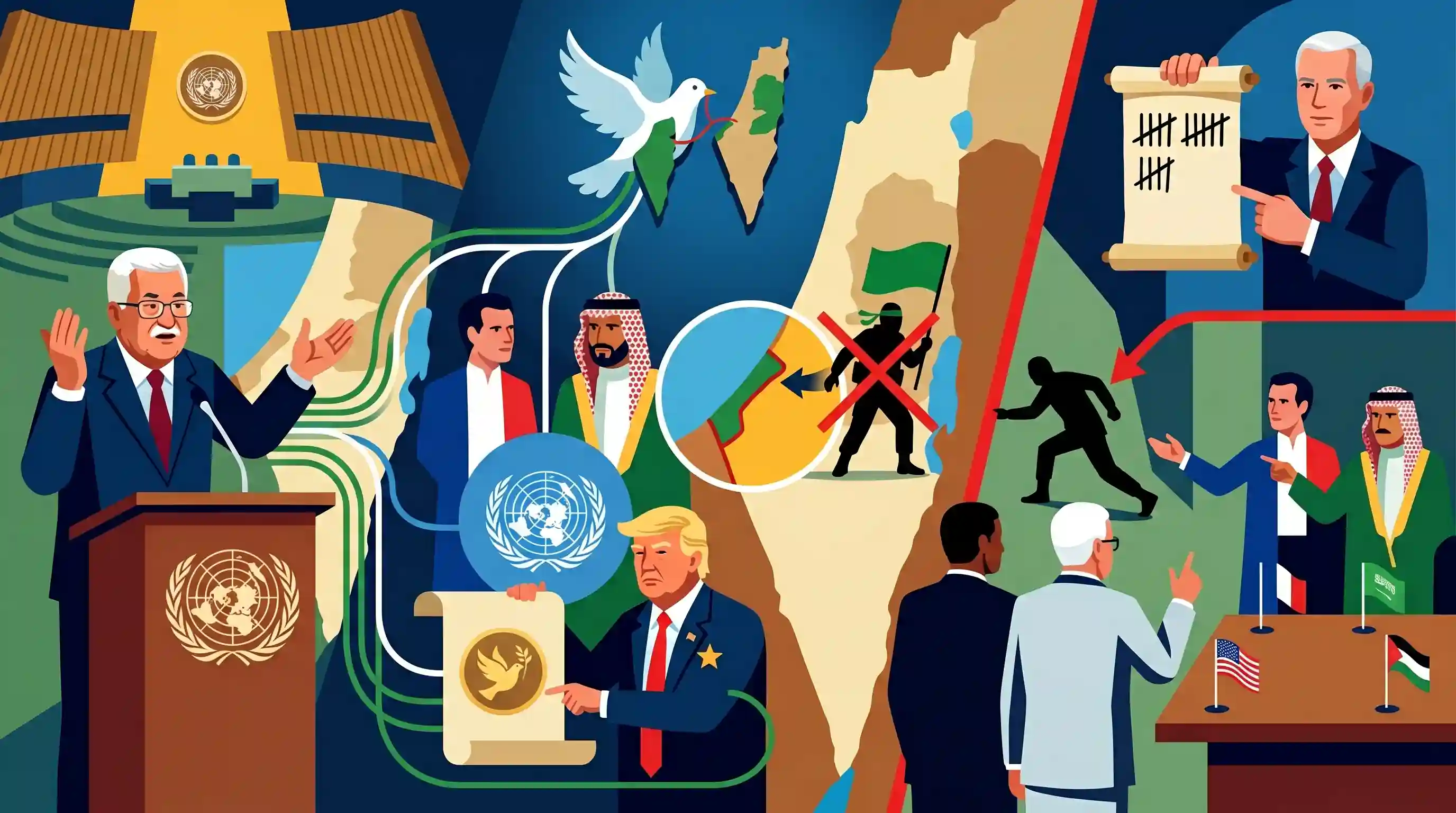
Addressing the UN General Assembly, Palestinian President Mahmoud Abbas declared a commitment to a two-state solution and pledged cooperation with Donald Trump's administration, the UN, Saudi Arabia, and France to implement a peace plan for Gaza. He firmly stated that Hamas would have no role in governing Gaza, which he reaffirmed as an inseparable part of the State of Palestine. The diplomatic landscape remains complex, evidenced by the US and Israel boycotting a recent peace conference hosted by Saudi Arabia and France, while the US envoy hinted at a forthcoming 21-point peace initiative from President Trump.
Key Points
- Palestinian President Mahmoud Abbas pledged to work with the US (under Donald Trump), the UN, Saudi Arabia, and France on a peace plan for Gaza.
- Abbas asserted that Gaza is an integral part of the State of Palestine and emphasized that Hamas will have no role in its governance.
- The UN General Assembly endorsed the two-state solution and called for an end to the Israel-Hamas war.
- A recent Middle East peace conference hosted by Saudi Arabia and France was boycotted by both the United States and Israel.
- US Middle East envoy Steve Witkoff indicated that President Trump has presented a 21-point plan aiming to secure long-term regional stability.
Important Terms
Two-state solution

A proposed diplomatic resolution establishing an independent State of Palestine alongside the State of Israel, typically based on the pre-1967 borders.
UPSC context
GS Paper 2 (International Relations); critical for understanding India’s official diplomatic stance and West Asian geopolitical stability.
UN General Assembly (UNGA)
The chief deliberative and representative organ of the United Nations, where all 193 member states discuss global issues with equal voting rights.
UPSC context
GS Paper 2 (International Institutions); tests knowledge of multilateral diplomacy and the standard-setting role of the UN.
Hamas
A Palestinian Sunni-Islamic militant and political group governing the Gaza Strip since 2007; designated as a terrorist organization by several Western nations.
UPSC context
GS Paper 2 (International Relations); relevant for analyzing regional security, non-state actors, and the internal Palestinian political divide.
Gaza Strip
A densely populated Palestinian enclave on the Mediterranean coast, bordering Israel and Egypt; it is the focal point of current regional peace and reconstruction efforts.
UPSC context
GS Paper 1 & 2 (Geography & Geopolitics); vital for mapping regional conflicts and understanding the Levant's political dynamics.
Trump’s 21-Point Peace Plan
A 2025/2026 diplomatic initiative seeking a ceasefire, hostage release, and a transitional "post-Hamas" governance structure involving an international "Board of Peace."
UPSC context
GS Paper 2 (International Relations); reflects major current developments in U.S. Middle East policy and alternative multilateral peace-building frameworks.
Prelims Trap
"UN General Assembly resolutions endorsing the two-state solution are legally binding on all member states."
UNGA resolutions are generally non-binding recommendations. Only UN Security Council resolutions (specifically those passed under Chapter VII) carry legally binding force in international law.
Static Concepts Connected
What is the political and geographical distinction between the West Bank and Gaza Strip?
- Location: The West Bank is landlocked between Israel and Jordan. Gaza is a coastal strip bordering Israel, Egypt, and the Mediterranean Sea.
- Governance Divide: The internationally recognized Palestinian Authority (Fatah) administers parts of the West Bank, while Hamas has exclusively controlled Gaza since 2007.
- Oslo Accords Legacy: The West Bank is uniquely divided into Areas A, B, and C, dictating varying degrees of Palestinian civil and Israeli military control.
What is the core framework of the 2002 Arab Peace Initiative?
- Origin: Proposed by Saudi Arabia in 2002 and endorsed by the Arab League as a comprehensive regional peace framework.
- Core Trade-off: It offers Israel full diplomatic normalization with Arab states in exchange for a complete withdrawal to pre-1967 borders and the establishment of a Palestinian state.
Cross-Topic Patterns
Abraham Accords vs. Arab Peace Initiative
The Abraham Accords bypassed the traditional Arab Peace Initiative consensus by normalizing Arab-Israeli ties before securing a Palestinian state, fundamentally altering regional geopolitical leverage.
Levant Geography and Map Questions
Geopolitical churn frequently triggers Prelims map questions. Expect pair-matching questions linking territories like the Golan Heights, Sinai Peninsula, West Bank, and Gaza to their bordering seas or states.

A 2026 Prelims map question matching Levant territories to borders, or a statement on UNGA vs UNSC resolution powers, is highly likely.
Linked PYQs · 4
Linked PYQs · 4
- 2023PrelimsGS1
Consider the following statements: Statement-I: Israel has established diplomatic relations with some Arab States. Statement-II: The 'Arab Peace Initiative' mediated by Saudi Arabia was signed by Israel and Arab League. Which one of the following is correct in respect of the above statements?
- 2018MainsGS2
“India’s relations with Israel have, of late, acquired a depth and diversity, which cannot be rolled back.” Discuss.
- 2025MainsGS2
"The reform process in the United Nations remains unresolved, because of the delicate imbalance of East and West and entanglement of the USA vs. Russo-Chinese alliance.” Examine and critically evaluate the East-West policy confrontations in this regard.
- 2022PrelimsGS1
The term "Levant" often heard in the news roughly corresponds to which of the following regions?
