नया विधायी ढांचा और भारत के परमाणु ऊर्जा विकास लक्ष्य
स्रोत:द हिंदू ↗
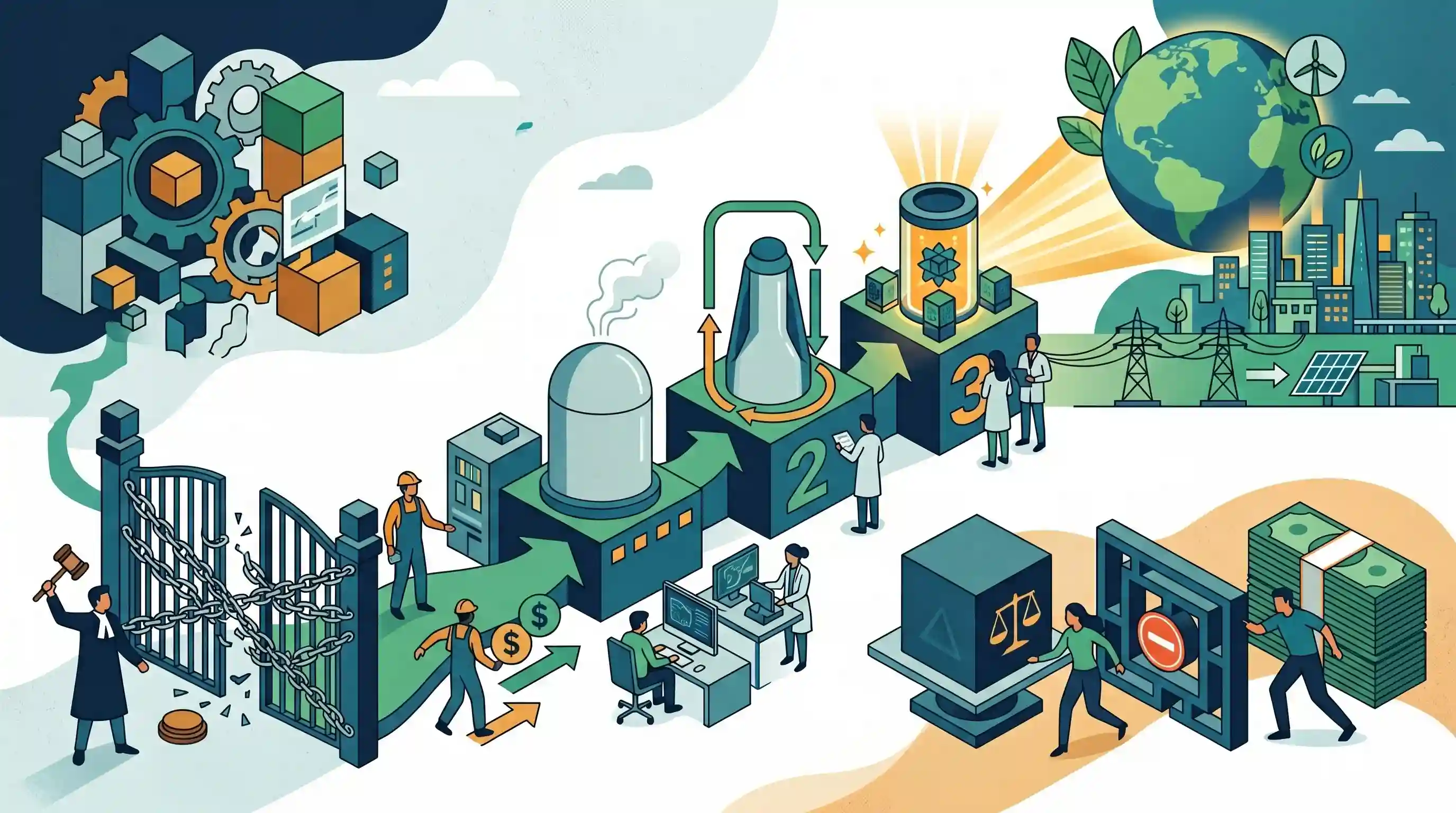
क्यों मायने रखता है
Understanding changes to India's nuclear legislative framework is crucial for aspirants, as it directly impacts the country's strategy for meeting its growing energy demands while adhering to climate commitments. It connects Science and Technology with economic policies and international regulatory standards.
सारांश
This article evaluates the potential impact of new legislation on India's nuclear energy sector. The proposed legal reforms aim to address long-standing bottlenecks in the country's nuclear development by facilitating private sector participation, improving funding avenues, and strengthening research and development. It underscores the critical need for legislative backing to advance India's three-stage nuclear program, particularly focusing on Fast Breeder Reactors and the utilization of domestic thorium reserves. The article concludes that while the new Act presents a progressive framework for scaling up nuclear capacity to achieve energy security and climate goals, effectively managing civil liability concerns, regulatory hurdles, and high capital costs will determine its ultimate success.
मुख्य बिंदु
- यह लेख एक नए विधायी अधिनियम का विश्लेषण करता है जिसका उद्देश्य विनियमों को सरल बनाकर और अधिक भागीदारी को प्रोत्साहित करके भारत के परमाणु विकास में तेजी लाना है।
- A major focus is on integrating private sector investments and fostering public-private partnerships (PPPs) in the nuclear energy sector to meet capacity-addition targets.
- The new framework aims to support India's indigenous three-stage nuclear program, particularly the commercialization of Fast Breeder Reactors (FBRs) and future thorium-based systems.
- It addresses persistent challenges in India's nuclear ecosystem, including high capital requirements, stringent liability laws (like CLNDA), and regulatory bottlenecks.
- By revamping the legal framework, India seeks to align its nuclear power capacity expansion with its broader net-zero and long-term energy security goals.
महत्वपूर्ण शब्द
Atomic Energy Act, 1962

भारत के परमाणु क्षेत्र को नियंत्रित करने वाला प्राथमिक कानून। यह केंद्र सरकार को परमाणु ऊर्जा के विकास, नियंत्रण और उपयोग पर अनन्य अधिकार प्रदान करता है, जिसमें यूरेनियम और थोरियम जैसे खनिजों का खनन भी शामिल है।
UPSC context
GS Paper 3: विज्ञान एवं प्रौद्योगिकी। परमाणु ऊर्जा में विधिक ढांचे और सरकारी एकाधिकार के ज्ञान का परीक्षण करता है।
परमाणु क्षति के लिए नागरिक दायित्व अधिनियम, 2010
A legal framework ensuring prompt compensation for victims of nuclear accidents. It establishes 'no-fault liability' for operators, caps their financial liability, and allows for the 'right of recourse' against suppliers.
UPSC context
GS Paper 2: International Relations and GS Paper 3: Energy Security. Key for understanding India-US civil nuclear cooperation.
Department of Atomic Energy (DAE)
A department under the direct charge of the Prime Minister responsible for nuclear technology development. It oversees research, power production, and non-power applications in agriculture, medicine, and industry.
UPSC context
GS Paper 3: Institutional framework. Tests understanding of the administrative structure of India’s nuclear program.
Nuclear Power Corporation of India Limited (NPCIL)
A Public Sector Enterprise under the DAE responsible for the design, construction, operation, and maintenance of nuclear power plants to generate electricity in India.
UPSC context
GS पेपर 3: इन्फ्रास्ट्रक्चर और ऊर्जा। परमाणु ऊर्जा क्षमता और उपयोगिता से संबंधित प्रश्नों के लिए महत्वपूर्ण।
परमाणु ऊर्जा नियामक बोर्ड (AERB)
India’s principal nuclear safety regulator. It formulates safety standards, grants licenses for nuclear facilities, and ensures compliance with radiation protection and industrial safety regulations.
UPSC context
GS Paper 2: Governance (Regulatory Bodies). Focuses on the oversight and safety mechanisms of nuclear technology.
International Atomic Energy Agency (IAEA)
An autonomous international organization within the UN system that promotes the peaceful use of nuclear energy and prevents its military use through a system of safeguards and inspections.
UPSC context
GS पेपर 2: अंतर्राष्ट्रीय संस्थान। वैश्विक परमाणु गवर्नेंस और अंतर्राष्ट्रीय सुरक्षा उपायों के साथ भारत के अनुपालन की समझ का परीक्षण करता है।
प्रारंभिक ट्रैप
The SHANTI Act 2025 allows 100% private ownership and operational control in nuclear power plants to rapidly boost capacity.
The new legislation only permits up to 49% minority equity for private companies. The state strictly retains majority control and ultimate operational authority over nuclear power generation.
संबंधित अवधारणाएँ
What are the distinct stages of India's three-stage nuclear power programme?
- चरण 1 (PHWRs): Pressurised Heavy Water Reactors (PHWRs) use natural uranium to produce electricity and yield plutonium-239 as a byproduct.
- Stage 2 (FBRs): Fast Breeder Reactors (FBRs) use plutonium-239 and depleted uranium. They 'breed' more fuel than they consume, converting thorium into fissile uranium-233.
- चरण 3 (AHWRs): Advanced Heavy Water Reactors (AHWRs) will exclusively utilize India's vast thorium reserves alongside U-233 for sustainable, long-term energy generation.
What is the Convention on Supplementary Compensation for Nuclear Damage (CSC)?
- Global Framework: यह परमाणु दुर्घटना की स्थिति में पीड़ितों के लिए त्वरित, न्यायसंगत और पर्याप्त मुआवजा सुनिश्चित करने के लिए एक समान वैश्विक कानूनी ढांचा स्थापित करता है।
- Operator Liability: It strictly channels exclusive liability to the operator of the nuclear installation, regardless of fault, essentially indemnifying equipment suppliers.
- भारत की स्थिति: India ratified the IAEA-backed CSC in 2016, which mandated aligning domestic laws (like CLNDA) to international supplier-indemnity standards.
अंतर-विषय पैटर्न
SHANTI Act + मेक इन इंडिया
Removing the controversial 'Right of Recourse' supplier liability integrates domestic private equipment manufacturers into global nuclear supply chains, directly boosting high-tech manufacturing and self-reliance.
Net-Zero Targets + Clean Baseload Power
To meet the 2070 net-zero target, scaling nuclear power to 100GW by 2047 solves the renewable intermittency dilemma, providing crucial clean baseload power alongside solar and wind.
Small Modular Reactors (SMRs) + PPP Framework
Allowing 49% private equity lays the groundwork for the future deployment of Small Modular Reactors (SMRs), which require corporate agility, decentralized micro-grids, and rapid scalable financing.

A composite Prelims question linking the SHANTI Act's private equity cap (49%), the removal of supplier liability, and IAEA's CSC is highly likely.
संबद्ध PYQ · 4
संबद्ध PYQ · 4
- 2017MainsGS3
Give an account of the growth and development of nuclear science and technology in India. What is the advantage of fast breeder reactor programme in India?
- 2025MainsGS3
The fusion energy programme in India has steadily evolved over the past few decades. Mention India's contributions to the international fusion energy project International Thermonuclear Experimental Reactor (ITER). What will be the implications of the success of this project for the future of global energy?
- 2020PrelimsGS1
In India, why are some nuclear reactors kept under "IAEA Safeguards" while others are not?
- 2016PrelimsGS1
India is an important member of the 'International Thermonuclear Experimental Reactor'. If this experiment succeeds, what is the immediate advantage for India?
