Maharashtra Rules of Business Centralize Executive Authority
Source:whispersinthecorridors ↗
Why It Matters
The article is relevant for MPSC Combined Prelims as it deals directly with the executive functioning of the state government, specifically the distribution of power and the Rules of Business under Article 166 of the Constitution. It highlights the evolving dynamics of the Chief Minister's role and the administrative processes involving the Chief Secretary, which are crucial topics under Indian Polity and State Governance.
Summary
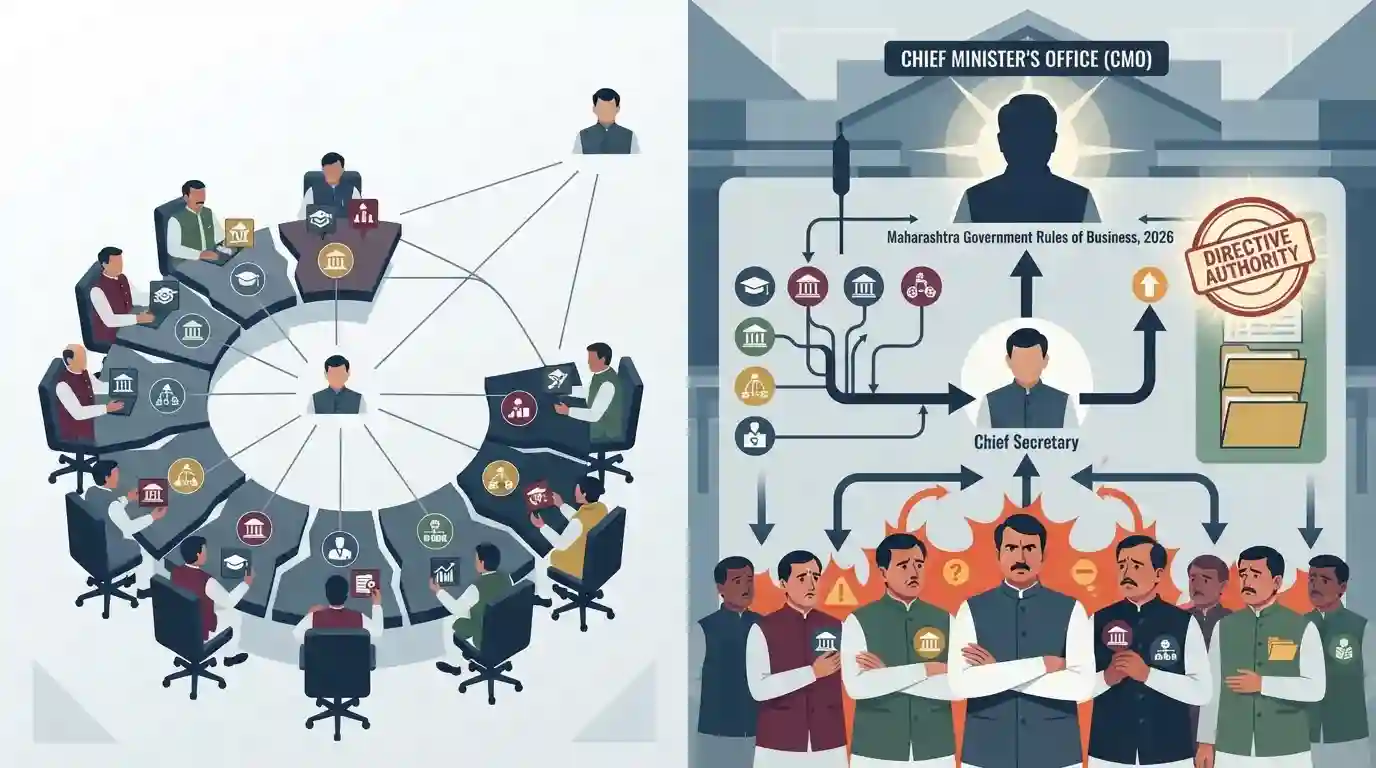
The Maharashtra government has introduced the Maharashtra Government Rules of Business, 2026, which significantly centralize executive authority within the Chief Minister's Office (CMO). Under the new framework, all proposals meant for the Cabinet must be routed through the Chief Secretary to the Chief Minister, who is also empowered to issue directives to the Chief Secretary concerning any department's business. While intended to streamline governance, this consolidation of power may lead to friction in coalition scenarios, as alliance partners might view this as an overreach into their respective portfolios.
Key Points
- The Maharashtra government has updated its Rules of Business for 2026, granting unprecedented executive power to the Chief Minister's Office (CMO).
- The new rules state that all proposals to the Cabinet or Cabinet committees must be submitted to the Chief Secretary (CS), who will then present them to the Chief Minister (CM).
- The CM now has the authority to issue directions to the Chief Secretary regarding business related to any department.
- These sweeping powers centralized in the CMO could potentially cause friction within coalition governments, particularly if key departments are held by alliance partners.
- The changes raise questions about whether they will streamline governance or trigger internal coalition conflicts.
Important Terms
Maharashtra Government Rules of Business, 2026

The 2026 rules formulated under Article 166(2) and (3) of the Constitution governing Maharashtra's executive administration. They centralise power in the Chief Minister's Office and empower the CM to explicitly override any minister's decision in the public interest.
UPSC context
GS-II (State Executive). Tests understanding of CM vs. Council of Ministers powers, Article 166, and coalition governance dynamics.
General Administration Department (GAD)
The central administrative department of the state government. In Maharashtra, it is responsible for issuing and notifying the Rules of Business that dictate how executive power is classified, distributed, and transacted among ministers and departments.
UPSC context
GS-II (State Administration). Highlights the mechanism of issuing state gazettes, executive rules, and the role of the Chief Secretary.
Article 166(3) of the Constitution
A constitutional provision allowing the Governor to make rules for the more convenient transaction of state government business and for the allocation of business among Ministers. The 2026 Maharashtra rules derive their authority from this Article.
UPSC context
GS-II (Indian Constitution). Crucial for questions on executive functioning, gubernatorial powers, and statutory framing of the Rules of Business.
Chief Minister's Office (CMO)
The administrative office that supports the Chief Minister. Under the 2026 Rules of Business, the CMO's authority is significantly expanded, requiring Cabinet proposals to be routed through it and allowing it to request files from any department.
UPSC context
GS-II (State Executive). Tests knowledge of administrative centralisation, the evolving role of the CMO, and intra-cabinet accountability.
Prelims Trap
"The State Rules of Business are enacted by the State Legislature to regulate the Chief Minister's Office and executive actions."
Under Article 166(3) of the Constitution, the Governor—not the legislature—makes rules for the convenient transaction of state government business and allocation among ministers.
Static Concepts Connected
What are the constitutional provisions under Article 166 regarding State Government business?
- Executive Action: All executive actions of the Government of a State shall be expressed to be taken in the name of the Governor.
- Authentication of Orders: Orders authenticated as per rules made by the Governor cannot be questioned on the ground that they were not executed by the Governor.
- Rule-making Power: The Governor shall make rules for the more convenient transaction of government business and for the allocation of this business among Ministers.
What are the primary administrative roles of the Chief Secretary in a State?
- Principal Advisor: Acts as the chief administrative advisor to the Chief Minister on all matters of state policy, administration, and governance.
- Cabinet Secretary: Functions as the Secretary to the State Cabinet, coordinating inter-departmental proposals, preparing agendas, and maintaining cabinet records.
- Civil Service Head: Serves as the highest-ranking civil servant, acting as the nodal point linking all state departments and supervising the administrative machinery.
Cross-Topic Patterns
Coalition dynamics vs. collective responsibility
The tension between a highly centralized CMO and independent portfolios held by coalition partners frequently tests the practical application of collective responsibility mandated under Article 164(2).
Article 166(3) and limits of Governor's discretion
While the Governor formally notifies the Rules of Business under Article 166(3), this is done on the aid and advice of the CoM, highlighting the boundaries of gubernatorial discretion.

Expect a multi-statement question mixing Article 166 Governor rule-making powers with the Chief Secretary's administrative/cabinet role.
Linked PYQs · 2
Linked PYQs · 2
- 2023MPSC_PRELIMSGS1
Which of the following statement is not included in Article 164 ?
- 2020MPSC_PRELIMSGS1
Which of the following statements are true about the Cabinet Secretariat ? (a) It came into existence in 1950. (b) It operates under the direction of Prime Minister. (c) It is a Line agency. (d) It function is as the Chief coordinating agency in the Central Government. Answer Options :
