Manipur ethnic conflict and political representation dilemma
Source:Indian Express ↗
Why It Matters
The political representation of ethnic groups in conflict-ridden states is a vital aspect of internal security and governance. Understanding the dynamics of the Manipur crisis helps in analyzing the challenges of federalism, democratic integration, and conflict resolution in Northeast India, which are key themes in UPSC GS2 (Governance/Polity) and GS3 (Internal Security).
Summary
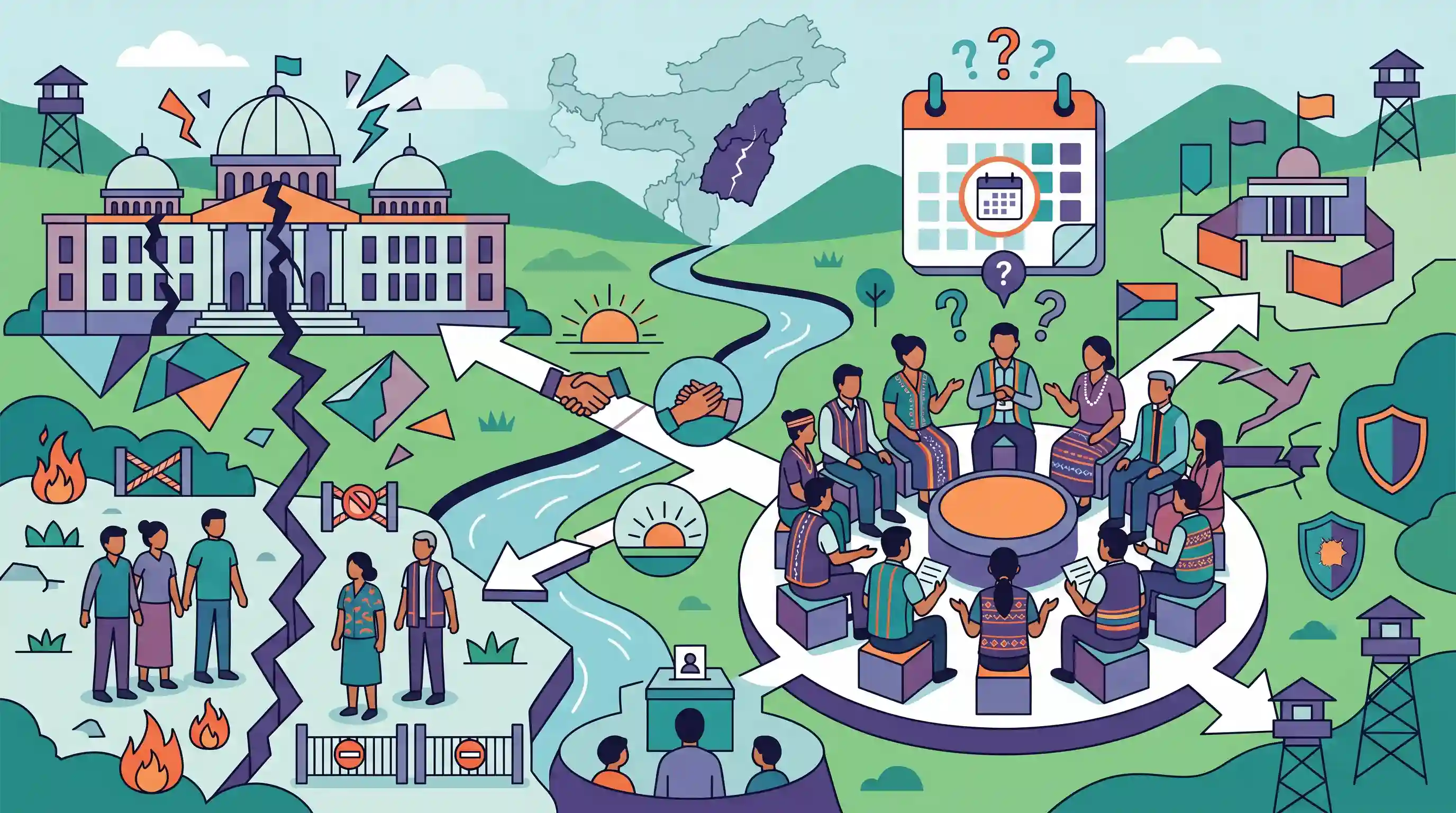
The article examines the ongoing political dilemma faced by Kuki-Zo MLAs in Manipur regarding their participation in the state's popular government. Following months of ethnic conflict that led to political estrangement, Kuki-Zo civil society groups and leaders are weighing their options. A crucial meeting scheduled for next week is expected to finalize their official stance. The situation underscores the complex interplay of ethnic identity, democratic representation, and the challenges of restoring governance and political reconciliation in Northeast India.
Key Points
- Kuki-Zo MLAs in Manipur are deliberating whether to participate in the state's popular government amid the ongoing ethnic divide.
- Civil society groups and community leaders are playing a crucial role in weighing the political and social implications of this decision.
- A key meeting scheduled for next week is expected to determine the official stance of the Kuki-Zo community's political representatives.
- The development highlights the broader challenges of restoring administrative normalcy, political representation, and democratic integration in conflict-affected regions.
Important Terms
Kuki-Zo

An umbrella ethnic identity for several tribes, including Kukis, Zomis, and Hmars, primarily residing in Manipur's hills. They share cultural ties with the Chin of Myanmar and Mizos of Mizoram.
UPSC context
GS Paper I (Social Diversity) and GS III (Internal Security); tests understanding of ethnic identity and regional conflict.
Article 371C
A special constitutional provision for Manipur allowing the President to create a committee of the state assembly comprising members from Hill Areas to ensure tribal welfare and administrative oversight.
UPSC context
GS Paper II (Indian Constitution); relevant for special provisions for states and federalism.
Separate Administration
The demand by Kuki-Zo groups for a distinct administrative unit, such as a Union Territory, to operate independently from the Meitei-dominated Manipur state government following ethnic estrangement.
UPSC context
GS Paper II (Governance) and GS III (Internal Security); focuses on regionalism and territorial demands.
Suspension of Operations (SoO) Agreement
A ceasefire pact between the Centre, State, and insurgent groups to halt hostilities. It mandates cadres stay in designated camps while peace talks progress within a constitutional framework.
UPSC context
GS Paper III (Internal Security); key to counter-insurgency strategies and peace-building.
Hill Areas Committee (HAC)
A statutory body within the Manipur Legislative Assembly, consisting of all MLAs from hill districts, empowered to oversee legislation and development specifically for the state’s tribal regions.
UPSC context
GS Paper II (Polity and Governance); examines administrative mechanisms for tribal areas.
Popular Government
A state government led by an elected council of ministers responsible to the legislature, distinguishing it from direct central administration under President's Rule.
UPSC context
GS Paper II (Polity); explores the transition from Article 356 to democratic state governance.
Kuki-Zo Civil Society Groups
Influential non-state actors like the Kuki Inpi Manipur (KIM) and ITLF that articulate community grievances, influence MLA decisions, and mediate in ethnic conflict resolutions.
UPSC context
GS Paper II (Role of CSOs and NGOs); tests the impact of non-state organizations on governance.
Prelims Trap
"Manipur's tribal hill areas are administered under the Sixth Schedule of the Indian Constitution."
Manipur is NOT covered by the Sixth Schedule (which covers AMTM states). Its hill areas are governed by statutory ADCs and Article 371C.
Static Concepts Connected
What is the Hill Areas Committee (HAC) under Article 371C?
- Constitutional basis: Inserted by the 27th Amendment Act, 1971, it mandates special provisions specifically for the administration of the state of Manipur.
- Composition: It consists of all Members of the Legislative Assembly (MLAs) elected from the designated Hill Areas of the state.
- Governor's oversight: The Governor has special responsibility for the Hill Areas and must submit an annual report to the President regarding their administration.
How do Manipur's Hill Councils differ from Sixth Schedule ADCs?
- Legal origin: Manipur's Autonomous District Councils are statutory (created by a 1971 parliamentary Act), whereas Sixth Schedule ADCs are directly mandated by the Constitution.
- Autonomy level: Sixth Schedule councils possess significantly broader legislative, judicial, and financial autonomy compared to Manipur's statutory ADCs, fueling local demands for Sixth Schedule inclusion.
Cross-Topic Patterns
Myanmar Crisis & Border Management
The 2021 Myanmar junta coup triggered an influx of refugees, prompting India to suspend the Free Movement Regime (FMR) and highlighting how external geopolitics directly inflame internal ethnic anxieties.
Civil Society in Governance
The dependence of elected MLAs on civil society groups to dictate their participation in government illustrates the supersession of formal democratic structures by ethnic allegiances during protracted conflict.

Expect a comparative Prelims question on Article 371C (Manipur) vs the Sixth Schedule (AMTM) focusing on Governor's special powers.
Linked PYQs · 2
Linked PYQs · 2
- 2017MainsGS3
The North-East region of India has been infested with insurgency for a very long time. Analyze the major reasons for the survival of armed insurgency in this region.
- 2022MainsGS1
Given the diversities among tribal communities in India, in which specific contexts should they be considered as a single category ?
