CJI Promises Transparency in Judicial Appointments
Source:Indian Express ↗
Why It Matters
The Collegium system and the appointment of judges is a core component of GS Paper 2 (Polity). Statements by the CJI regarding transparency directly relate to frequent UPSC questions on judicial independence, the National Judicial Appointments Commission (NJAC), and the separation of powers.
Summary
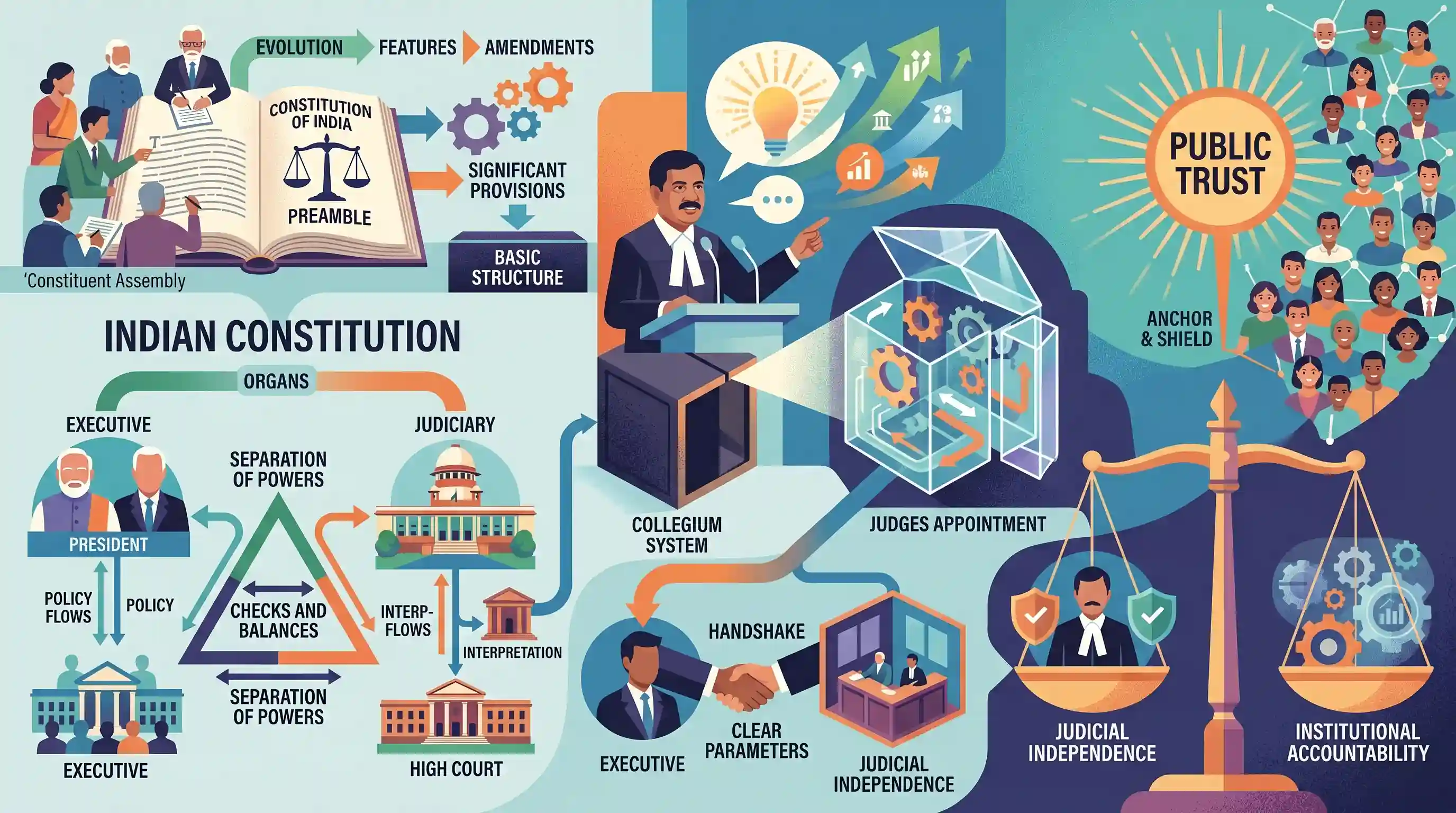
Speaking in Mumbai, Chief Justice of India B.R. Gavai emphasized the judiciary's commitment to ensuring complete transparency in the appointment of judges to the Supreme Court and High Courts. His remarks come amidst long-standing debates over the Collegium system, which has often faced criticism for its opacity. By asserting a focus on transparency, the CJI seeks to reinforce public trust and balance the fundamental principle of judicial independence with institutional accountability, potentially hinting at internal reforms or adherence to clear parameters in the consultative process with the executive.
Key Points
- Chief Justice of India B.R. Gavai assured complete transparency in the appointment of judges to the constitutional courts.
- The statement addresses ongoing concerns and criticisms regarding the perceived opacity and lack of accountability in the Supreme Court Collegium system.
- It highlights the continuing effort to balance judicial independence with the need for an objective, merit-based selection process.
- The remarks reflect the broader institutional dialogue between the judiciary and the executive concerning the Memorandum of Procedure (MoP) for judicial appointments.
Important Terms
Collegium System

A system of judicial appointments and transfers evolved through Supreme Court judgments (Three Judges Cases) rather than the Constitution, comprising the CJI and senior-most judges.
UPSC context
GS Paper 2: Judicial appointments process, criticisms of opacity, and the debate over judicial vs. executive primacy.
National Judicial Appointments Commission (NJAC)
A body proposed via the 99th Constitutional Amendment Act (2014) to replace the Collegium system; it was struck down by the Supreme Court for violating judicial independence.
UPSC context
GS Paper 2: Constitutional amendments, the Basic Structure doctrine, and transparency in high-level judicial appointments.
Memorandum of Procedure (MoP)
An administrative document/agreement between the Judiciary and the Executive that outlines the detailed guidelines and criteria for appointing and transferring judges to higher courts.
UPSC context
GS Paper 2: Consultative process between the executive and judiciary, institutional accountability, and ongoing reforms for transparency.
Judicial Independence
The constitutional principle that the judiciary must remain free from external influence (political or executive) to ensure impartial justice; recognized as part of the Basic Structure.
UPSC context
GS Paper 2: Salient features of the Indian Constitution, Basic Structure doctrine, and judicial accountability.
Separation of Powers
A constitutional doctrine (notably Article 50) that divides functions between the Executive, Legislature, and Judiciary to provide mutual checks and balances and prevent power concentration.
UPSC context
GS Paper 2: Separation of powers between various organs, dispute redressal mechanisms, and institutional functioning.
Supreme Court of India
The highest judicial court under the Indian Constitution (Article 124), serving as the ultimate court of appeal, the protector of fundamental rights, and the final interpreter.
UPSC context
GS Paper 2: Structure, organization, and functioning of the Judiciary; powers and jurisdiction of the apex court.
Prelims Trap
The Collegium system for appointing judges is explicitly mandated under Article 124 of the Constitution.
The Collegium system is a judicial innovation born from the 'Three Judges Cases.' The Constitution only mentions appointment by the President after 'consultation'.
Static Concepts Connected
What is the Memorandum of Procedure (MoP)?
- Definition: An executive-judiciary playbook outlining the exact criteria, timeline, and procedure for appointing judges to higher constitutional courts.
- Origin: Drafted by the government in agreement with the CJI post the Second Judges Case (1993) to operationalize the Collegium system.
- Ongoing Friction: Friction persists over finalization, especially regarding the executive's push for a 'national security' veto to reject recommended names.
How did 'consultation' evolve into 'concurrence' in judicial appointments?
- First Case (1981): SC held that 'consultation' with CJI does not mean 'concurrence', leaving ultimate power with the executive.
- Second Case (1993): Reversed the 1981 ruling, stating CJI's recommendation (formed with 2 senior judges) is binding on the President.
- Third Case (1998): A Presidential Reference (Article 143) reaffirmed concurrence but expanded the SC Collegium to CJI plus 4 senior-most judges.
Cross-Topic Patterns
Basic Structure & Judicial Primacy
The 2015 striking down of the NJAC (99th Amendment) cemented judicial primacy in appointments as an unalterable feature of the Basic Structure doctrine.
Tribunalization vs. Judicial Independence
The executive-judiciary tug-of-war over appointments extends beyond the Collegium into the delayed appointments and structural independence of statutory administrative tribunals.

A 2026 Prelims statement will likely contrast the literal text of Articles 124/217 (consultation) with the evolved MoP (concurrence).
Linked PYQs · 5
Linked PYQs · 5
- 2025MainsGS2
Discuss the evolution of collegium system in India. Critically examine the advantages and disadvantages of the system of appointment of the Judges of the Supreme Court of India and that of the USA.
- 2023MainsGS2
“Constitutionally guaranteed judicial independence is a prerequisite of democracy.” Comment.
- 2017MainsGS2
Critically examine the Supreme Court's judgement on 'National Judicial Appointments Commission Act, 2014' with reference to appointment of judges of higher judiciary in India.
- 2021PrelimsGS1
With reference to Indian judiciary, consider the following statements : 1. Any retired judge of the Supreme Court of India can be called back to sit and act as a Supreme Court judge by the Chief Justice of India with prior permission of the President of India. 2. A High Court in India has the power to review its own judgement as the Supreme Court does. Which of the statements given above is/are correct?
- 2012PrelimsGS1
What is the provision to safeguard the autonomy of the Supreme Court of India? 1. While appointing the Supreme Court Judges, the President of India has to consult the Chief Justice of India. 2. The Supreme Court Judges can be removed by the Chief Justice of India only. 3. The salaries of the Judges are charged on the Consolidated Fund of India to which the legislature does not have to vote. 4. All appointments of officers and staffs of the Supreme Court of India are made by the Government only after consulting the Chief Justice of India. Which of the statements given above is/are correct?
