India-Russia Energy Security and Bilateral Trade Relations
Source:The Hindu ↗
Why It Matters
Highlights India's ongoing diplomatic balancing act—securing crucial energy supplies from Russia for economic growth while managing retaliatory trade pressures and sanctions from the United States.
Summary
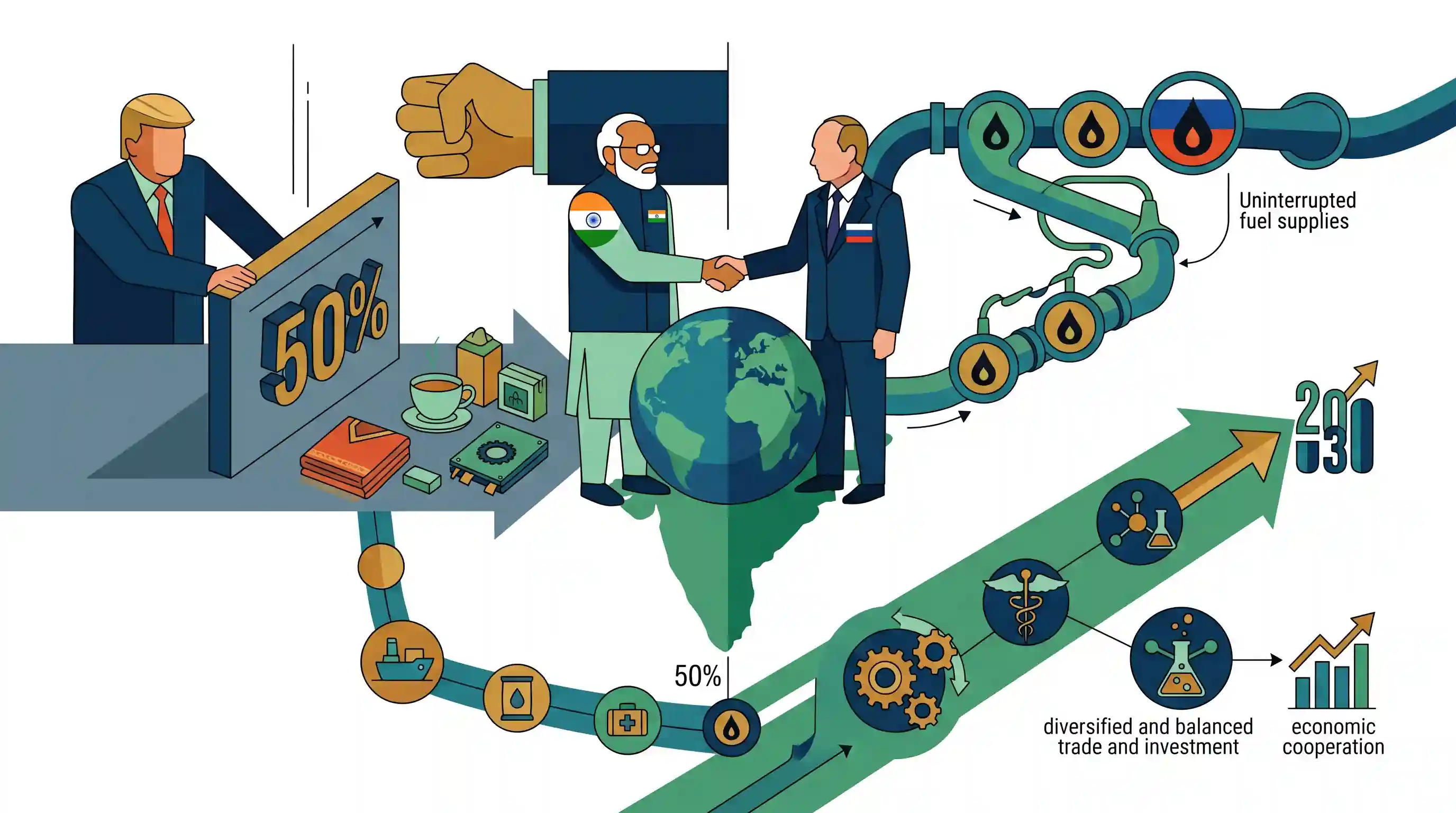
During his visit to New Delhi, Russian President Vladimir Putin assured Prime Minister Narendra Modi of uninterrupted fuel supplies to India. This commitment arrives amid intense US pressure, marked by President Donald Trump's recent 50% tariffs on Indian goods, aimed at halting India's purchase of Russian oil. PM Modi reaffirmed that energy security is foundational to India-Russia ties, and both leaders agreed to an economic cooperation program until 2030 to ensure diversified and balanced trade and investment, encompassing sectors like shipping, health, and chemicals.
Key Points
- Russian President Vladimir Putin assured India of uninterrupted fuel shipments, including oil, gas, and coal, to support its growing economy.
- This energy commitment arrives amid heavy pressure from the U.S., highlighted by President Donald Trump imposing 50% tariffs on Indian products in August to deter purchases of Russian oil.
- Prime Minister Narendra Modi emphasized that energy security remains a foundational pillar of the India-Russia partnership.
- Both nations agreed on an economic cooperation program extending until 2030 to ensure diversified, balanced, and sustainable trade and investment across sectors like shipping, health, and chemicals.
Important Terms
Economic Cooperation Program until 2030

A strategic roadmap adopted in 2025 to diversify bilateral trade and investment, targeting $100 billion in trade by 2030 through sectors like shipbuilding, connectivity, and national currency settlements.
UPSC context
GS Paper II (International Relations). Tests knowledge of long-term bilateral frameworks and India's economic diplomacy in a multipolar world.
Strategic Autonomy
India's foreign policy doctrine of making independent decisions based on national interest, avoiding formal military alliances while balancing relationships with competing major powers like the US and Russia.
UPSC context
GS Paper II (International Relations). A core theme in Indian foreign policy questions regarding non-alignment and multi-alignment.
Energy Security
The uninterrupted availability of energy sources at an affordable price; for India, this involves diversifying suppliers and maintaining ties with Russia despite Western sanctions.
UPSC context
GS Paper III (Economy/Energy). Critical for understanding India's developmental needs and the geopolitical implications of oil imports.
Ad Valorem Duty
A tax based on the assessed value of a product or property. In 2025, the US increased these duties on Indian goods to a cumulative 50%.
UPSC context
GS Paper III (Economy). Tests understanding of trade barriers, fiscal policy, and international trade disputes.
International North-South Transport Corridor (INSTC)
A 7,200-km multi-mode transport network connecting India to Russia and Europe via Iran; a key component of India's strategy to bypass traditional maritime bottlenecks.
UPSC context
GS Paper II (International Relations/Connectivity). Important for questions on regional connectivity and India's Eurasian outreach.
Eurasian Economic Union (EAEU)
An economic union of post-Soviet states (including Russia, Armenia, Belarus, Kazakhstan, and Kyrgyzstan). India is currently negotiating a Free Trade Agreement (FTA) with this bloc.
UPSC context
GS Paper II (Bilateral/Regional Agreements). Relevant for trade diversification and India's engagement with the Extended Neighbourhood.
Prelims Trap
"The Chennai-Vladivostok Eastern Maritime Corridor connects India to Russia via the Suez Canal."
The corridor bypasses the Suez entirely. It routes through the Strait of Malacca and South China Sea, significantly cutting the traditional Suez route's transit time.
Static Concepts Connected
What is the geographical route of the Chennai-Vladivostok Eastern Maritime Corridor (EMC)?
- The Route: It passes through the Sea of Japan, the East China Sea, the South China Sea, and the Strait of Malacca.
- Distance Savings: It reduces the maritime shipping distance from 8,675 nautical miles (via the traditional Suez route) to just 5,600 nautical miles.
- Time Reduction: Transit time is cut significantly from roughly 40 days to just 24 days, boosting logistics efficiency.
How does the WTO address unilateral tariffs imposed for political or strategic reasons?
- Security Exception: Article XXI of GATT allows WTO members to breach trade commitments if deemed necessary to protect 'essential security interests'.
- Weaponization of Trade: Imposing punitive tariffs (like 50%) to force geopolitical compliance bypasses the WTO's standard Dispute Settlement Body (DSB), weakening multilateralism.
Cross-Topic Patterns
Energy security + Currency internationalization
Sustained Russian oil purchases highlight the challenge of massive bilateral trade deficits and the accumulation of Indian Rupees in Russian Vostro accounts.
Suez bypass + Indo-Pacific strategy
The push for the Chennai-Vladivostok EMC synergizes with India's Act East policy and mitigates supply chain risks caused by chokepoint disruptions in the Red Sea.

Expect a Prelims map-based question comparing the transit nodes of the Chennai-Vladivostok EMC, INSTC, and IMEC corridors.
Linked PYQs · 3
Linked PYQs · 3
- 2025MainsGS2
"Energy security constitutes the dominant kingpin of India's foreign policy, and is linked with India's overarching influence in Middle Eastern countries.” How would you integrate energy security with India's foreign policy trajectories in the coming years?
- 2017MainsGS2
The question of India's Energy Security constitutes the most important part of India's economic progress. Analyze India's energy policy cooperation with West Asian countries.
- 2025MainsGS2
"With the waning of globalization, post-Cold War world is becoming a site of sovereign nationalism.” Elucidate.
