AIMIM to contest Bihar assembly polls to build third alternative
Source:The Hindu ↗
Why It Matters
Understanding the evolving nature of the Indian party system—specifically the role of regional parties, third fronts, and minority representation—is crucial for analyzing electoral dynamics and state politics in India, key elements of the GS2 Polity syllabus.
Summary
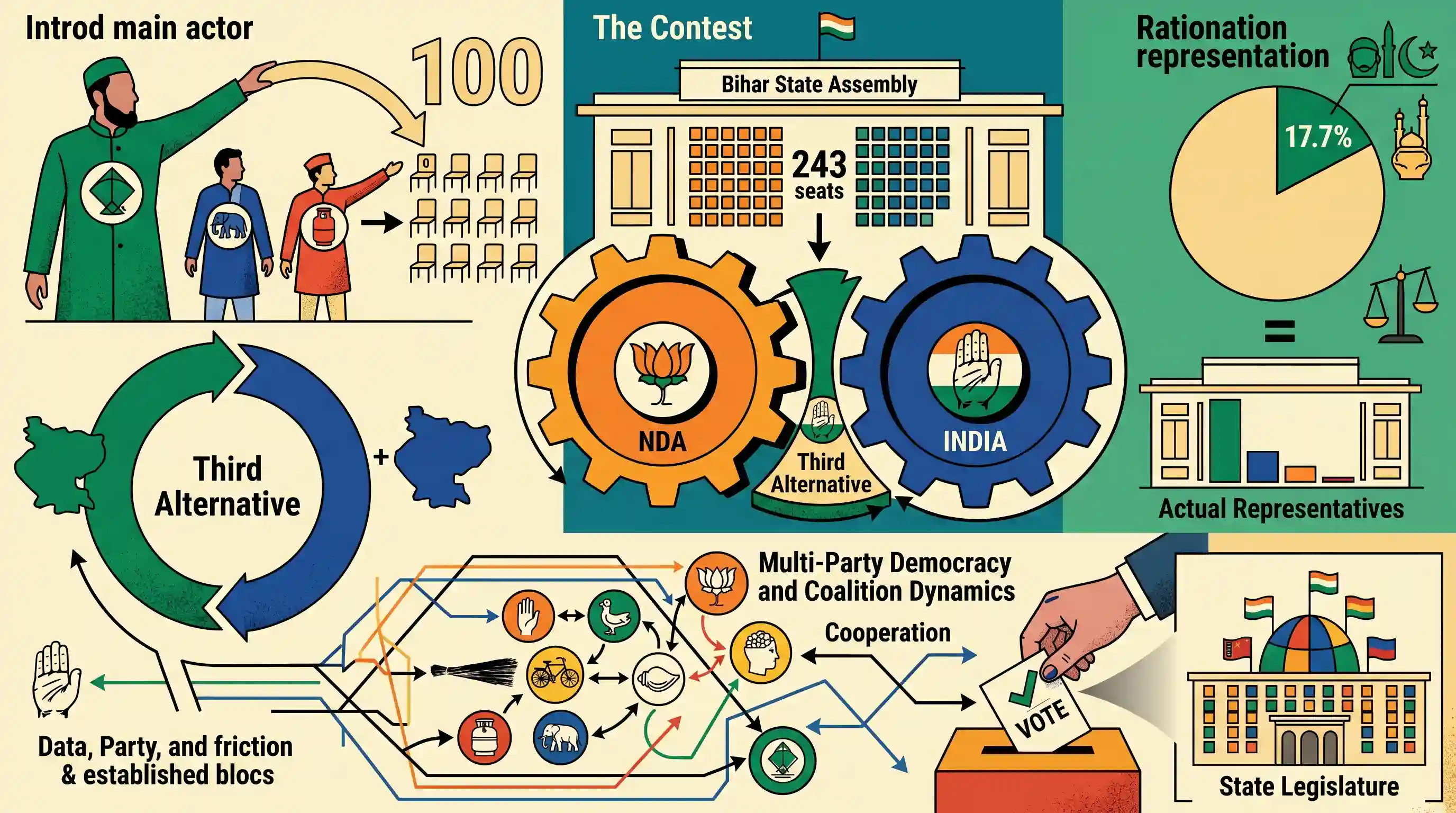
The All India Majlis-E-Ittehadul Muslimeen (AIMIM) has announced plans to contest approximately 100 seats in the upcoming Bihar State Assembly elections, with the intention of leading a 'third alternative' alliance. AIMIM seeks to partner with parties like the BSP and Rashtriya Lok Morcha to challenge the existing dominance of the NDA and INDIA blocs. The party leadership emphasized that despite constituting 17.7% of the state's population, Muslims lack proportionate political representation. The development underscores the dynamics of multi-party democracy, coalition politics, and the strategic role of regional parties in Indian state elections.
Key Points
- AIMIM announced it will contest around 100 seats in the upcoming Bihar Assembly elections to provide a 'third alternative' to voters.
- The party is attempting to forge alliances with other regional and Dalit-focused parties, like the BSP and Rashtriya Lok Morcha, to consolidate minority and marginalized votes.
- A core issue highlighted by AIMIM is the lack of proportionate political representation for the Muslim community, which constitutes 17.7% of Bihar's population.
- The push for a third front highlights the evolving and often fragmented nature of state-level party systems, where smaller parties disrupt traditional bipolar contests.
- Regional parties forming alliances to create alternate fronts often face allegations of being 'vote splitters' that inadvertently benefit larger national parties.
Important Terms
National Democratic Alliance (NDA)

A center-right political coalition in India led by the Bharatiya Janata Party (BJP), established in 1998 to provide an anti-Congress alternative.
UPSC context
GS Paper II: Functions and responsibilities of the Union; electoral systems and political party dynamics.
INDIA bloc
A multi-party opposition alliance formed in 2023 to challenge the NDA, emphasizing democratic values, federalism, and the interests of diverse regional and social groups.
UPSC context
GS Paper II: Salient features of the Representation of People’s Act; dynamics of parliamentary opposition.
Representation of the People Act, 1951
Parliamentary legislation that provides the detailed legal framework for conducting elections, registering political parties, and defining the qualifications and disqualifications of legislators.
UPSC context
GS Paper II: Essential syllabus keyword for the legal and constitutional framework of Indian elections.
AIMIM
A Hyderabad-based political party that advocates for the political representation and civil rights of Muslims, Dalits, and other minority communities across India.
UPSC context
GS Paper II: Role of political parties; impact of identity politics on the Indian electoral system.
Regional Party
A political entity that operates within a specific state or region, focusing on local identity, linguistic rights, or specific social grievances.
UPSC context
GS Paper II: Federalism and the evolving role of state-level actors in national coalition politics.
Coalition Government
A cabinet of a parliamentary government in which multiple political parties cooperate to govern, typically necessitated when no single party secures a majority.
UPSC context
GS Paper II: Parliamentary democracy, executive stability, and the process of consensus-building in governance.
Bahujan Samaj Party (BSP)
A national political party in India primarily focused on the social and political empowerment of Bahujans (Scheduled Castes, Scheduled Tribes, and Other Backward Classes).
UPSC context
GS Paper II: Social justice and the role of caste-based representation in Indian politics.
Prelims Trap
The Indian Constitution mandates proportional seat reservation for religious minorities in State Legislative Assemblies.
Articles 330 and 332 mandate proportional seat reservation only for Scheduled Castes (SCs) and Scheduled Tribes (STs), not for any religious minorities.
Static Concepts Connected
What are the criteria to be recognized as a State Political Party?
- Votes and Seats: 6% of valid votes polled in the state at a general election (Assembly or Lok Sabha) plus 2 Assembly seats or 1 Lok Sabha seat.
- Assembly Seat Minimum: Win at least 3% of the total number of seats in the Legislative Assembly, or 3 seats, whichever is higher.
- Alternative Vote Route: Secure at least 8% of the total valid votes polled in the State during a Lok Sabha or State Assembly general election, regardless of seats won.
How does the First-Past-The-Post (FPTP) system affect minor or regional parties?
- Disproportionate Returns: A party's seat share rarely aligns with its vote share. Small parties with geographically dispersed voters struggle to win seats compared to those with concentrated support.
- Vote Splitting: The presence of multiple regional alliances divides a specific voter base, frequently allowing candidates with a minority of the total polled votes to win the constituency.
Cross-Topic Patterns
FPTP vs Proportional Representation
The underrepresentation of dispersed minorities often drives debates comparing FPTP with Proportional Representation (PR), echoing Law Commission recommendations on electoral reform.
Delimitation and Shifting Demographics
Regional demographic shifts combined with the ongoing freeze on constituency delimitation intensify political friction over proportionate minority representation in specific pockets like Seemanchal.

Mains GS2 2026 may ask how FPTP mechanics and regional party fragmentation affect the substantive political representation of minorities.
Linked PYQs · 2
Linked PYQs · 2
- 2022MainsGS2
“While the national political parties in India favour centralisation, the regional parties are in favour of State autonomy.” Comment.
- 2016MainsGS2
The Indian party system is passing through a phase of transition which looks to be full of contradictions and paradoxes." Discuss.
