Centre to Factor Bihars Concerns Before Ganga Treaty Renewal
Source:The Hindu ↗
Why It Matters
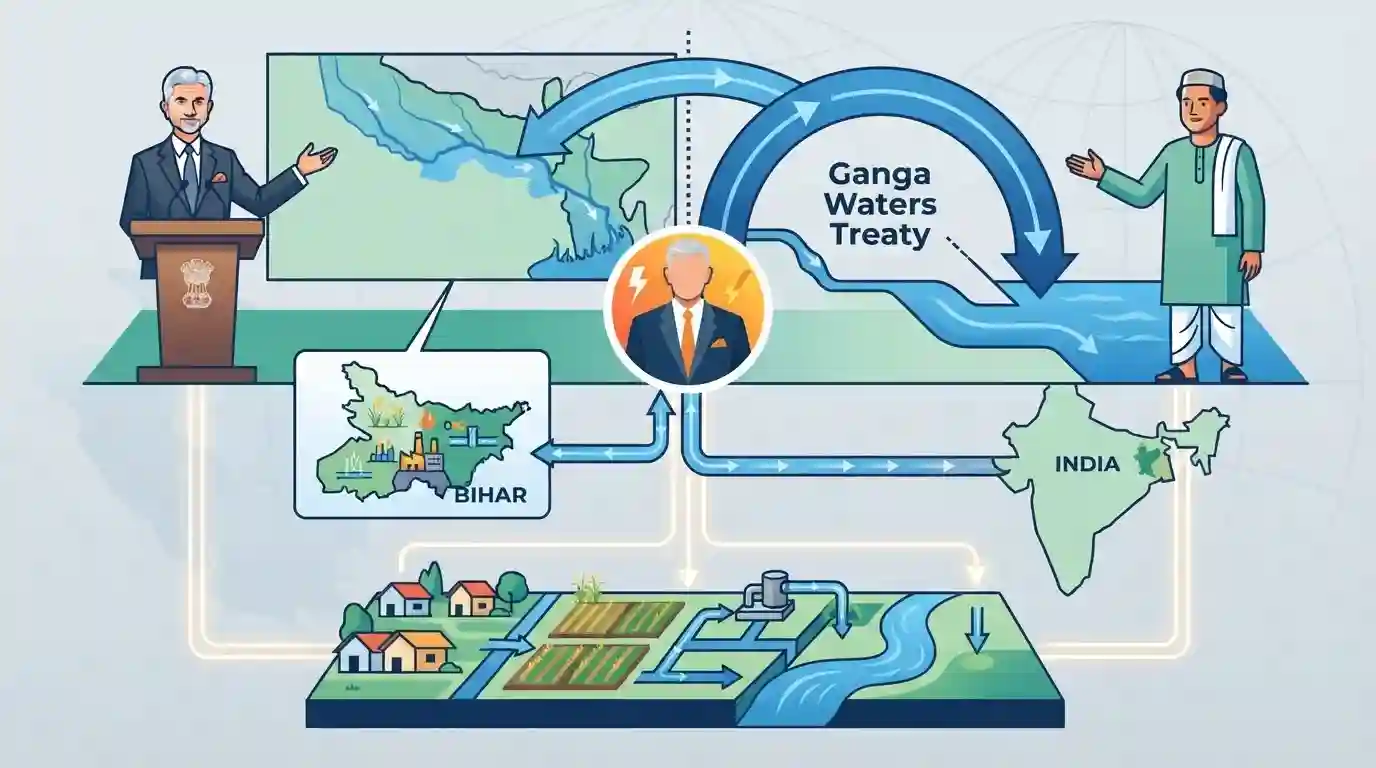
It touches upon transboundary river diplomacy and cooperative federalism, demonstrating how domestic state concerns (like Bihar's siltation and water security issues) influence bilateral treaties such as the Ganga Waters Treaty with Bangladesh.
Summary
External Affairs Minister S. Jaishankar stated that the Union government will take into account Bihar's specific concerns regarding water sharing, siltation, and ecological challenges before the impending renewal of the Ganga Waters Treaty with Bangladesh. This underlines the significance of cooperative federalism and state consultation in India's management of transboundary water diplomacy.
Key Points
- External Affairs Minister S. Jaishankar assured that the central government will carefully consider Bihar's concerns and inputs before proceeding with the renewal of the Ganga Waters Treaty with Bangladesh.
- The 1996 Ganga Waters Treaty, signed for a 30-year period, is approaching its renewal milestone, necessitating consultations with riparian states like Bihar that face critical ecological and developmental issues such as siltation, floods, and water availability.
- The development highlights the intersection of cooperative federalism in India's foreign policy-making, ensuring that state-level stakeholder interests are factored into international transboundary river agreements.
Important Terms
Ganga Waters Treaty

A 30-year bilateral agreement signed in December 1996 between India and Bangladesh to regulate dry-season water sharing of the Ganges River via the Farakka Barrage, expiring in December 2026.
UPSC context
GS Paper II (International Relations - India's neighbors, bilateral agreements, and transboundary water diplomacy).
Cooperative Federalism
A constitutional framework reflecting the harmonious division of powers and mutual consultation between the Union government and states, particularly regarding foreign policy impacts on domestic resources.
UPSC context
GS Paper II (Indian Polity - Federal structure, centre-state relations, and state consultations in national policy).
Ministry of External Affairs
The executive ministry of the Government of India responsible for conducting foreign relations, executing transboundary treaties, and managing diplomatic engagements with neighboring nations.
UPSC context
GS Paper II (Governance and International Relations - Structure and functioning of central ministries in foreign policy formulation).
Prelims Trap
The Ganga Waters Treaty expires completely after 30 years and must be renegotiated from scratch.
The 1996 Ganga Waters Treaty is permanent; aspirants often mistakenly believe the entire treaty expires in 2026, whereas only its specific 30-year operational water-sharing arrangement comes up for renewal.
Static Concepts Connected
What are the key provisions and institutional mechanisms of the 1996 Ganga Waters Treaty?
- Duration & Scope: Signed for a 30-year duration between India and Bangladesh, establishing a framework for sharing Ganga waters at Farakka.
- Lean-Season Focus: Regulates water sharing specifically during the leanest period from January 1 to May 31 based on 10-day averages.
- Water Sharing Formula: Guarantees a 50% sharing formula when lean-season flows at Farakka drop below specific historical thresholds.
- Barrage Purpose: Farakka Barrage was originally constructed by India primarily to preserve and maintain the Calcutta Port navigation channel by flushing silt.
Cross-Topic Patterns
Cooperative Federalism and Treaty-Making Power
Transboundary water treaties signed by the Union require domestic state consultation, reflecting how cooperative federalism intersects with treaty-making powers under Article 253.
Farakka Barrage and Upstream Agrarian Security
Siltation, barrage management, and lean-season flow deficits link transboundary water negotiations directly with agrarian security in riparian states like Bihar.

Ganga Treaty renewal + cooperative federalism in foreign policy likely to feature in IR or polity mains/prelims.
Linked PYQs · 1
Linked PYQs · 1
- 2012MainsGS2
The situation today is far different to that prevalent fifty years back when the Indus Water Treaty was signed." Highlight the complexity of the current challenges on both sides of the border in this regard. Do you think that a review of the Treaty is in India's best interests?
