India US bilateral trade agreement and reciprocal tariff negotiations
Source:Indian Express ↗
Why It Matters
Trade relations with the US directly impact India's export volume, foreign exchange reserves, and macroeconomic stability. The growing trend of developed nations adopting protectionism and bilateralism forms a core part of the GS Paper 3 economy syllabus.
Summary
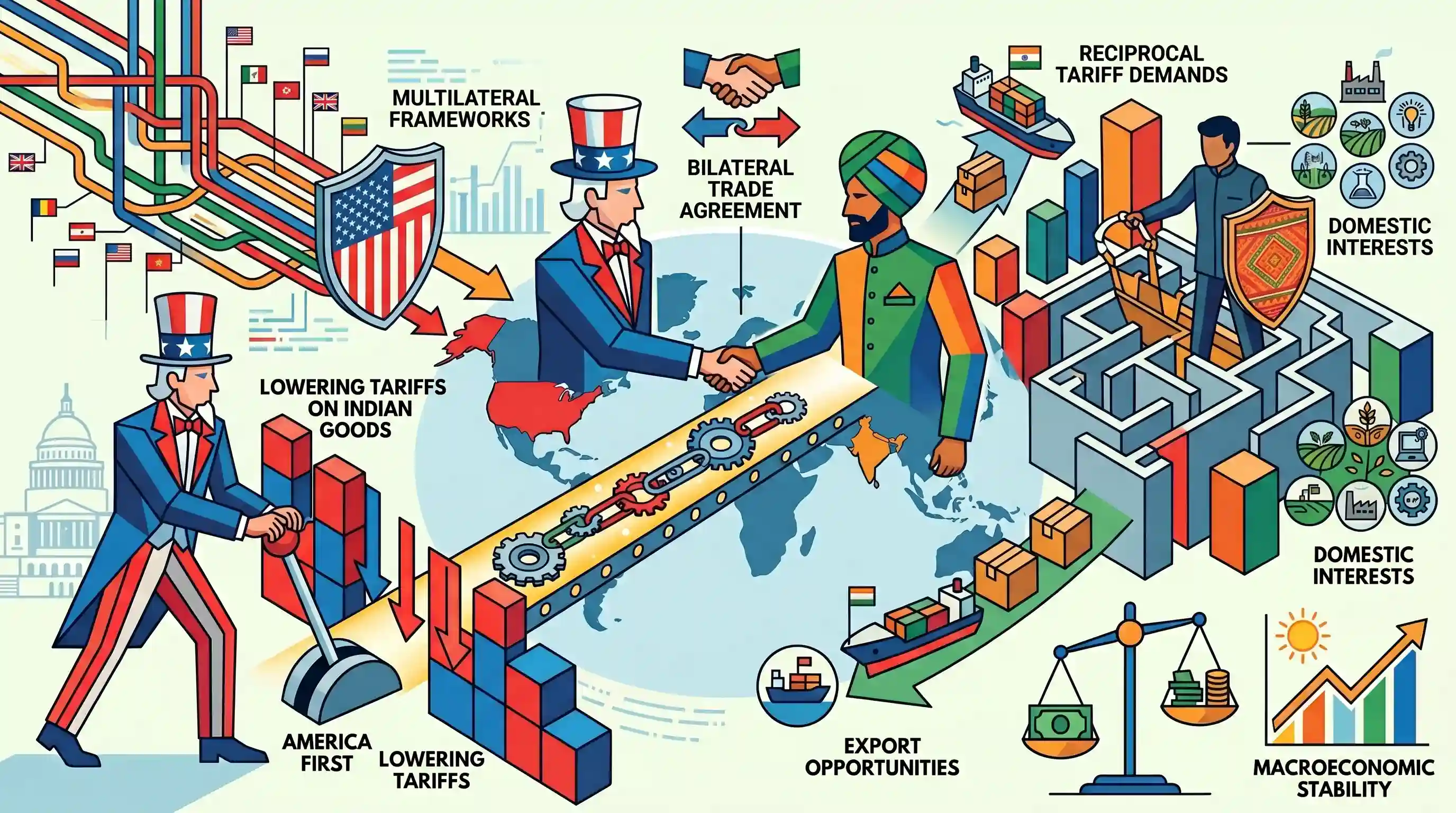
Donald Trump recently stated that the US and India are "pretty close" to a trade deal and indicated intentions to lower tariffs on Indian goods, provided trade terms are reciprocal. This development highlights the continued emphasis on bilateralism and protectionist "America First" policies over multilateral frameworks. For India, a bilateral deal with its largest trading partner offers export opportunities but requires careful navigation of reciprocal tariff demands to protect domestic interests and ensure macroeconomic stability.
Key Points
- US President Donald Trump stated that the US is 'pretty close' to securing a bilateral trade deal with India and expressed a willingness to bring down tariffs on Indian goods.
- The proposed trade adjustments are heavily influenced by the principle of 'reciprocal tariffs', reflecting an ongoing 'America First' protectionist trade policy.
- This development underscores a broader global shift away from multilateral trade negotiations (like those under the WTO) towards bilateral trade pacts.
- For India, navigating these reciprocal tariff demands will be crucial for boosting exports to the US while safeguarding its domestic manufacturing sectors.
Important Terms
Reciprocal Trade Act

A proposed US legislative framework where the United States matches the tariff rates of trading partners on a product-by-product basis to ensure 'fair' and 'reciprocal' trade.
UPSC context
GS-II (IR) and GS-III (Economy); tests understanding of protectionism, transactional diplomacy, and impacts on Indian export competitiveness.
Free Trade Agreement (FTA)
A pact between two or more nations to reduce or eliminate trade barriers like tariffs and quotas, facilitating smoother cross-border flow of goods and services.
UPSC context
GS-III (Economy); core concept for trade liberalization, 'Make in India' integration, and bilateral vs. multilateral trade strategies.
World Trade Organization (WTO)
The only global international organization dealing with the rules of trade between nations, centered on agreements negotiated and signed by the bulk of world’s trading nations.
UPSC context
GS-II (IR); tests knowledge of multilateralism, the 'Most Favoured Nation' principle, and the crisis in dispute settlement mechanisms.
Trade and Technology Council (TTC)
A strategic platform (currently active between India-EU and US-EU) to coordinate on high-level challenges at the nexus of trade, trusted technology, and security.
UPSC context
GS-II (IR); relevant for technology diplomacy and strategic partnerships in critical sectors like AI, semiconductors, and green energy.
Prelims Trap
"GSP (Generalized System of Preferences) requires developing countries to offer reciprocal tariff cuts to developed nations."
GSP is specifically a non-reciprocal preferential tariff system exempt from WTO's MFN principle, designed to help developing economies grow through exports.
Static Concepts Connected
How does GSP differ from the Most Favored Nation (MFN) principle?
- MFN Principle: Requires WTO members to treat all other members equally without discrimination in tariff rates.
- GSP Exception: An exception to MFN allowing developed countries to offer unilateral, non-reciprocal tariff reductions specifically to developing nations.
Why is the WTO Dispute Settlement mechanism currently paralyzed?
- Appellate Body: The 7-member apex body for global trade disputes requires a minimum of three judges to hear appeals.
- US Blockade: The US has systematically blocked new judicial appointments since 2019, halting the multilateral enforcement of trade rules and forcing bilateralism.
Cross-Topic Patterns
Protectionism vs Atmanirbhar Bharat
US "America First" reciprocal tariffs clash directly with India's PLI schemes and import substitution policies, making bilateral FTA negotiations structurally complex.
Trade Surplus & Currency Watchlist
India's structural trade surplus with the US makes it a target for reciprocal tariffs and triggers frequent inclusion in the US Treasury's currency manipulator monitoring list.

Prelims 2026 will likely test the conceptual difference between WTO's MFN principle, bilateral reciprocal tariffs, and GSP exemptions.
Linked PYQs · 3
Linked PYQs · 3
- 2025MainsGS3
What are the challenges before the Indian economy when the world is moving away from free trade and multilateralism to protectionism and bilateralism? How can these challenges be met?
- 2018MainsGS3
How would the recent phenomena of protectionism and currency manipulations in world trade affect macroeconomic stability of India?
- 2023PrelimsGS1
Consider the following statements: Statement-I: Recently, the United States of America (USA) and the European Union (EU) have launched the 'Trade and Technology Council'. Statement-II: The USA and the EU claim that through this they are trying to bring technological progress and physical productivity under their control. Which one of the following is correct in respect of the above statements?
