West Bengal Name Change Bill Proposal and Constitutional Procedure
Source:thestatesman ↗
Why It Matters
Important for understanding Indian federalism, state name change procedures under the Indian Constitution, and regional political dynamics in West Bengal.
Summary
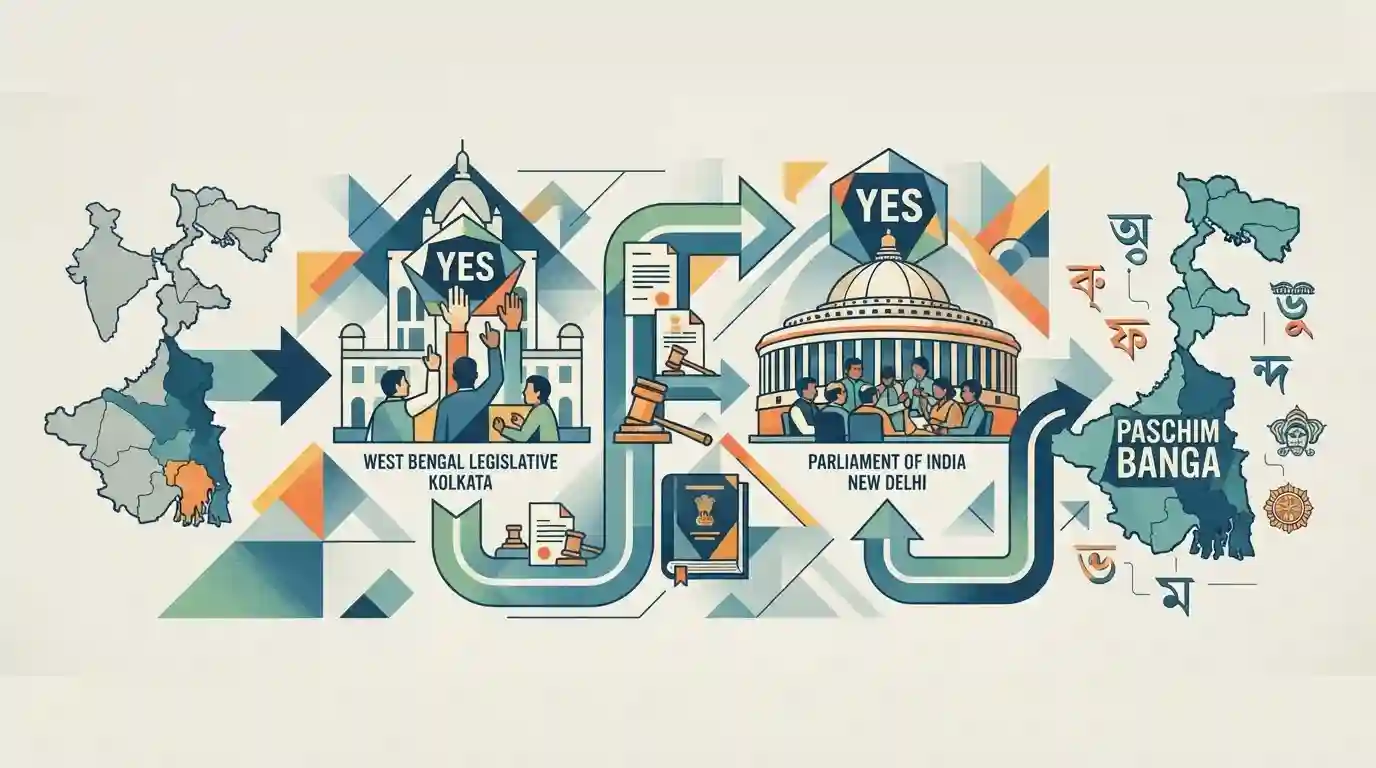
The article discusses political developments concerning the formal proposal to rename West Bengal to 'Paschim Banga' to align local identity and linguistic uniformity, highlighting procedural aspects relevant to state renaming in India.
Key Points
- BJP leader Samik Bhattacharya announced plans to bring a private member's bill or push for officially renaming West Bengal to 'Paschim Banga'.
- The proposal aims to restore uniformity between the Bengali nomenclature and the official English/Hindi state name reference.
- Under Indian constitutional procedures (Article 3), altering a state's name requires legislative resolution and central parliamentary enactment.
Important Terms
State Renaming Bill

A constitutional process under Article 3 of the Indian Constitution whereby Parliament alters the name, boundaries, or area of any state, requiring presidential recommendation and consultation with the concerned state legislature.
UPSC context
WBCS Polity Paper V & VI: Tests knowledge of federal structure, parliamentary procedures, and constitutional provisions under Article 3 for altering state territories or names.
West Bengal Legislative Assembly
The unicameral state legislature of West Bengal responsible for making laws and passing official resolutions, including proposals to change the state's name.
UPSC context
WBCS Polity & West Bengal Administration: Evaluates legislative powers, state governance, and historical resolutions passed regarding state nomenclature.
Prelims Trap
State legislature concurrence is mandatory for altering a state's name under Article 3 of the Constitution.
Aspirants often assume that if a state legislature rejects a renaming bill under Article 3, the Parliament cannot proceed. In reality, state views are purely advisory and non-binding.
Static Concepts Connected
What are the constitutional provisions and major procedural steps for altering a state's name in India?
- Article 3 Scope: Parliamentary Power: Empowered under Article 3 to alter the name, boundaries, or area of any existing state by ordinary legislation.
- State Consultation: Presidential Referral: Bill requires prior President recommendation and mandatory reference to the concerned state legislature for its views within a specified timeframe.
- Union Primacy: Non-Binding Views: The views of the state legislature are advisory and not binding on Parliament, which can pass the bill with a simple majority.
- Schedule Amendment: Schedule Updates: Passing the renaming bill necessitates a consequential amendment to the First Schedule of the Constitution of India.
Cross-Topic Patterns
Article 3 State Reorganization & Federal Supremacy
Article 3 boundary/name changes involve the President referring the bill to the state legislature, but state views remain entirely non-binding on the Union Parliament.
Legislative Majorities: Ordinary vs Constitutional Amendment
Renaming states requires a simple majority in Parliament rather than an Article 368 special majority, distinguishing state boundary/name bills from constitutional amendments.

WBCS Prelims loves trapping aspirants on whether state assemblies can veto name/boundary changes under Article 3. Practice federal nuances.
Linked PYQs · 1
Linked PYQs · 1
- 2016WBCS_PRELIMSGS1
Which article of the Constitution of India defines the name and the territory of India ?
