WWF Living Planet Report and Global Wildlife Population Decline
Source:Indian Express ↗
Why It Matters
The report provides critical metrics on global biodiversity loss, habitat destruction, and ecological tipping points, which are central to questions on environment, conservation policy, and sustainable development in GS Paper III.
Summary
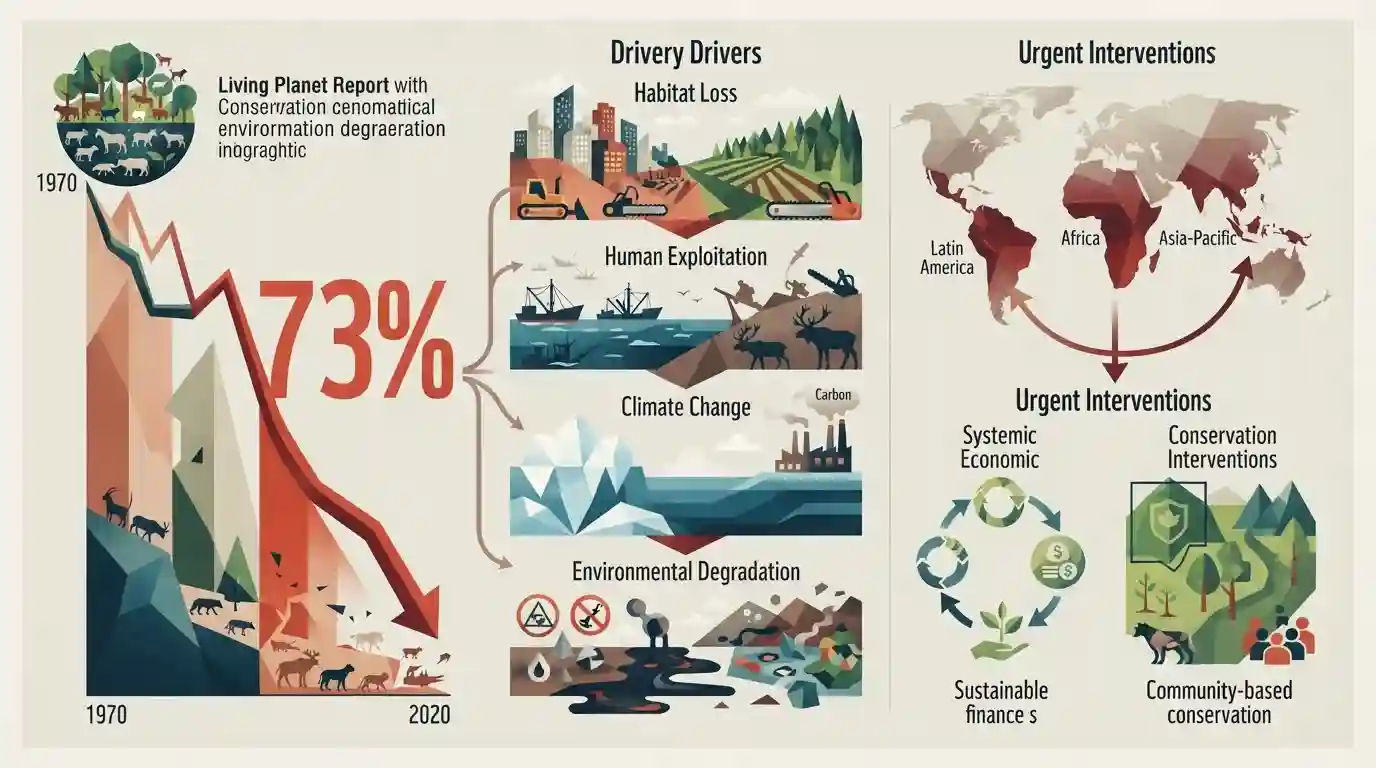
A report released by the World Wide Fund for Nature (WWF) highlights a staggering 73% average decline in monitored global wildlife populations over the fifty-year period from 1970 to 2020. The Living Planet Report points to habitat loss, human exploitation, climate change, and environmental degradation as primary catalysts, with Latin America, Africa, and the Asia-Pacific experiencing the most catastrophic drops. The findings emphasize the urgent need for systemic economic and conservation interventions to avert irreversible ecological tipping points.
Key Points
- According to the WWF Living Planet Report, global wildlife populations have declined by an average of 73% between 1970 and 2020.
- The steepest declines were recorded in Latin America and the Caribbean (95%), followed by Africa (76%), and the Asia-Pacific region (60%).
- Key drivers of this massive biodiversity loss include habitat degradation and loss driven by food production, resource exploitation, invasive species, climate change, and pollution.
- Scientists warn that Earth is dangerously close to tipping points, threatening major biomes like the Amazon rainforest and coral reefs with irreversible collapse.
Important Terms
Living Planet Report

A flagship biennial publication by the World Wide Fund for Nature (WWF) that tracks global trends in biodiversity and the health of the planet.
UPSC context
UPSC Prelims/Mains (Environment & Ecology): Important international reports, biodiversity assessments, and indices tracking global ecological decline.
World Wide Fund for Nature (WWF)
The world's largest independent conservation organization, founded in 1961, dedicated to the preservation of nature, endangered species, and reduction of environmental threats.
UPSC context
UPSC Prelims/Mains (Environment): International environmental organizations, their major initiatives, reports, and conservation frameworks.
Ecological Tipping Points
Critical thresholds in natural and climatic systems where environmental pressures trigger abrupt, profound, and often irreversible changes or ecosystem collapses.
UPSC context
UPSC Prelims/Mains (Environment & Ecology): Core concepts of climate change, ecosystem resilience, and irreversible environmental degradation.
Prelims Trap
73% average decline in monitored global wildlife populations over fifty years
Aspirants often confuse the Living Planet Index (which measures relative population size trends of vertebrate species) with absolute species extinction counts or total animal population figures.
Static Concepts Connected
What is the Living Planet Index (LPI) and which organization publishes it?
- Publishing Bodies: Published biennially by the World Wide Fund for Nature (WWF) in collaboration with the Zoological Society of London (ZSL).
- Core Metric: Tracks trends in global biodiversity by measuring the abundance of vertebrate species populations (mammals, birds, reptiles, amphibians, and fish).
- What It Measures: Does not measure absolute number of animal extinctions, but rather relative changes in population sizes across thousands of monitored species groups since 1970.
Cross-Topic Patterns
Biodiversity Loss & Indigenous Livelihoods
The massive biodiversity drop documented by the WWF Living Planet Report directly impacts indigenous communities and sustainable resource management, connecting conservation science to GS Paper 1 (Indian Society) and GS Paper 3 (Environment).
Ecosystem Tipping Points & Climate Negotiations
Tipping points in ecosystems like the Amazon or coral reefs mirror climate tipping points discussed under the UNFCCC framework, linking global biodiversity metrics to international climate diplomacy.

WWF Living Planet Index trends + freshwater ecosystem vulnerability (85% decline) will likely feature in a statement-based prelims question.
Linked PYQs · 4
Linked PYQs · 4
- 2025PrelimsGS1
Which organization has enacted the Nature Restoration Law (NRL) to tackle climate change and biodiversity loss?
- 2026PrelimsGS1
Which one of the following is the first Plan Vivo certified Reducing Emissions from Deforestation and Forest Degradation (REDD+) project in India ?
- 2023PrelimsGS1
'Invasive Species Specialist Group' (that develops Global Invasive Species Database) belongs to which one of the following organizations?
- 2023MainsGS3
Comment on the National Wetland Conservation Programme initiated by the Government of India and name a few India's wetlands of international importance included in the Ramsar Sites.
