Elephant Migration: Habitat Loss Pushes Chhattisgarh Herds into MP
Source:free-press-journal ↗
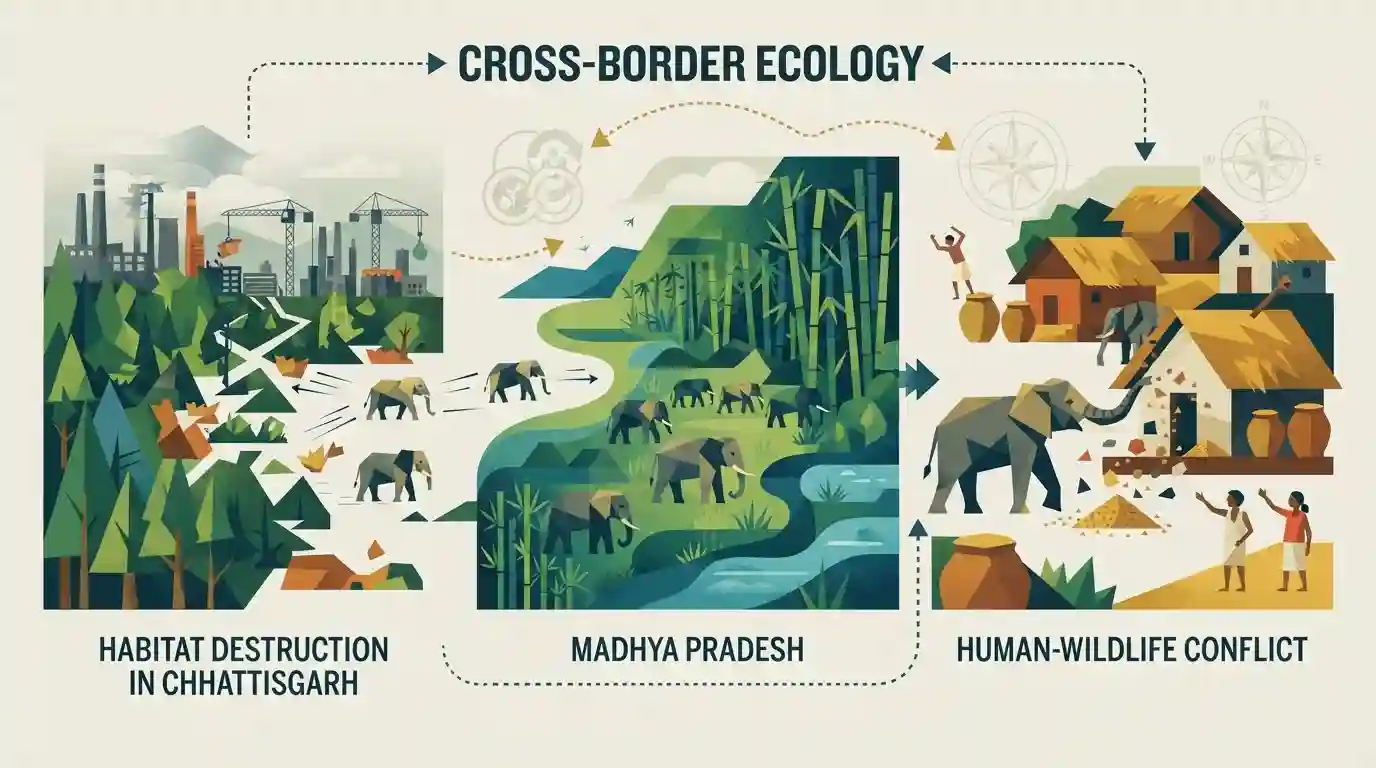
Why It Matters
The issue highlights the trans-boundary nature of wildlife management and the direct ecological fallout (like human-wildlife conflict) resulting from large-scale development and habitat loss in adjacent states. It is a prime example of environment vs. development challenges.
Summary
Rapid development and habitat destruction in Chhattisgarh, particularly in regions like Hasdeo Arand, have forced herds of wild elephants to migrate into neighboring Madhya Pradesh. These elephants have found suitable habitats in areas like the North Shahdol division, drawn by dense bamboo forests and water sources. However, this migration has sparked human-wildlife conflict, as elephants frequently damage village houses in search of stored grains and mahua. The situation underscores the broader ecological consequences of unregulated development and the pressing need for effective, cross-border wildlife conservation strategies.
Key Points
- Rampant habitat loss and deforestation due to development projects in Chhattisgarh are driving wild elephants into Madhya Pradesh.
- A herd of elephants has permanently settled in the West Biohari area of North Shahdol division, finding suitable conditions like dense bamboo cover and water.
- Elephants are attracted to the aromatic cereals and mahua stored in local kuccha houses, leading to human-wildlife conflict and structural damage.
- Forest departments in Madhya Pradesh are grappling with this new challenge, highlighting the need for inter-state coordination for wildlife management and habitat conservation.
Important Terms
Hasdeo Arand

A sprawling, ecologically sensitive forest region in north-central Chhattisgarh. Known as the state's "lungs," it hosts rich biodiversity, pristine Sal forests, elephant corridors, and significant coal deposits.
UPSC context
Relevant for GS-3 (Environment) and GS-1 (Geography). Tests knowledge of coal mining impacts, deforestation, and wildlife corridors.
Human-Wildlife Conflict
Negative interactions between humans and wild animals resulting in loss of life, livelihoods, or property. It is increasingly driven by habitat fragmentation, ecological degradation, and competition for resources.
UPSC context
Crucial for GS-3 (Environment). Tests understanding of conservation challenges, mitigation strategies, and socio-ecological impacts of development.
Mahua (Madhuca longifolia)
A multipurpose deciduous tree indigenous to central India, culturally and economically vital to tribal communities. Its flowers, seeds, and bark are utilized for food, liquor, and medicinal purposes.
UPSC context
Key for GS-1 (Society) and GS-3 (Environment). Tests knowledge of minor forest produce, tribal livelihoods, and tropical flora.
Habitat Degradation
The deterioration of natural environments due to human activities like mining, infrastructure expansion, and deforestation. It forces wildlife to migrate, leading to population decline and increased human-animal encounters.
UPSC context
Core concept in GS-3 (Environment). Examines knowledge of biodiversity threats and the ecological consequences of unregulated development.
Forest Department
The state government authority responsible for protecting, managing, and conserving forest and wildlife resources, including mitigating human-wildlife conflict and enforcing environmental regulations.
UPSC context
Important for GS-2 (Governance) and GS-3 (Environment). Focuses on institutional frameworks, wildlife management, and state intervention in conservation.
Prelims Trap
Madhya Pradesh has hosted a continuous, uninterrupted resident wild elephant population throughout the 20th and 21st centuries.
MP actually had no resident wild elephants from 1905 until 2017-18, when habitat destruction in Chhattisgarh forced herds to migrate and settle permanently.
Static Concepts Connected
What is the conservation and legal status of the Asian Elephant in India?
- WPA 1972 protection: Protected under Schedule I of the Wildlife (Protection) Act, 1972, providing the highest level of statutory protection and penal penalties.
- IUCN & CITES: Classified as Endangered on the IUCN Red List and listed under Appendix I of CITES.
- National Status: Designated as India’s National Heritage Animal in 2010 to elevate its conservation profile.
What is the ecological status and drainage of the Hasdeo Arand forest?
- Lungs of Chhattisgarh: Largest unfragmented dense deciduous forest canopy in Central India, spanning over 1,800 sq km.
- Hydrological Catchment: Feeds the Hasdeo River, which is a major tributary of the Mahanadi River system.
- Critical Corridor: Acts as a vital, contiguous migratory corridor for wild elephants and tigers across Central India.
Cross-Topic Patterns
Coal mining vs. forest conservation politics
The Hasdeo Arand conflict highlights the direct trade-off between domestic coal block allocation and the preservation of India's largest unfragmented dense forest corridor.
Minor Forest Produce and economic conflicts
Non-timber forest products like Mahua are critical for tribal livelihoods under FRA 2006, but their aromatic storage acts as an accidental catalyst for severe human-elephant conflict.

Recent Central Indian elephant range shifts and the ecological hydrology of Hasdeo Arand are prime targets for the 2026 Prelims.
Linked PYQs · 2
Linked PYQs · 2
- 2022MPPSC_PRELIMSGS1
Which of the following National Parks is the first in India to officially introduce a mascot named "Bhoorsingh the Barasingha"?
- 2018MPPSC_PRELIMSGS1
Kanha National Park is famous for
