Wildlife Board Clears Projects in Tiger Habitats
Source:Indian Express ↗
Why It Matters
The clearance of infrastructure and mining projects inside protected tiger habitats frequently appears in UPSC questions regarding the conflict between conservation efforts and development. The statutory role of the NBWL and the legal protections afforded to tiger reserves under the Wildlife (Protection) Act, 1972 are critical topics for both Prelims and Mains (GS3 Environment).
Summary
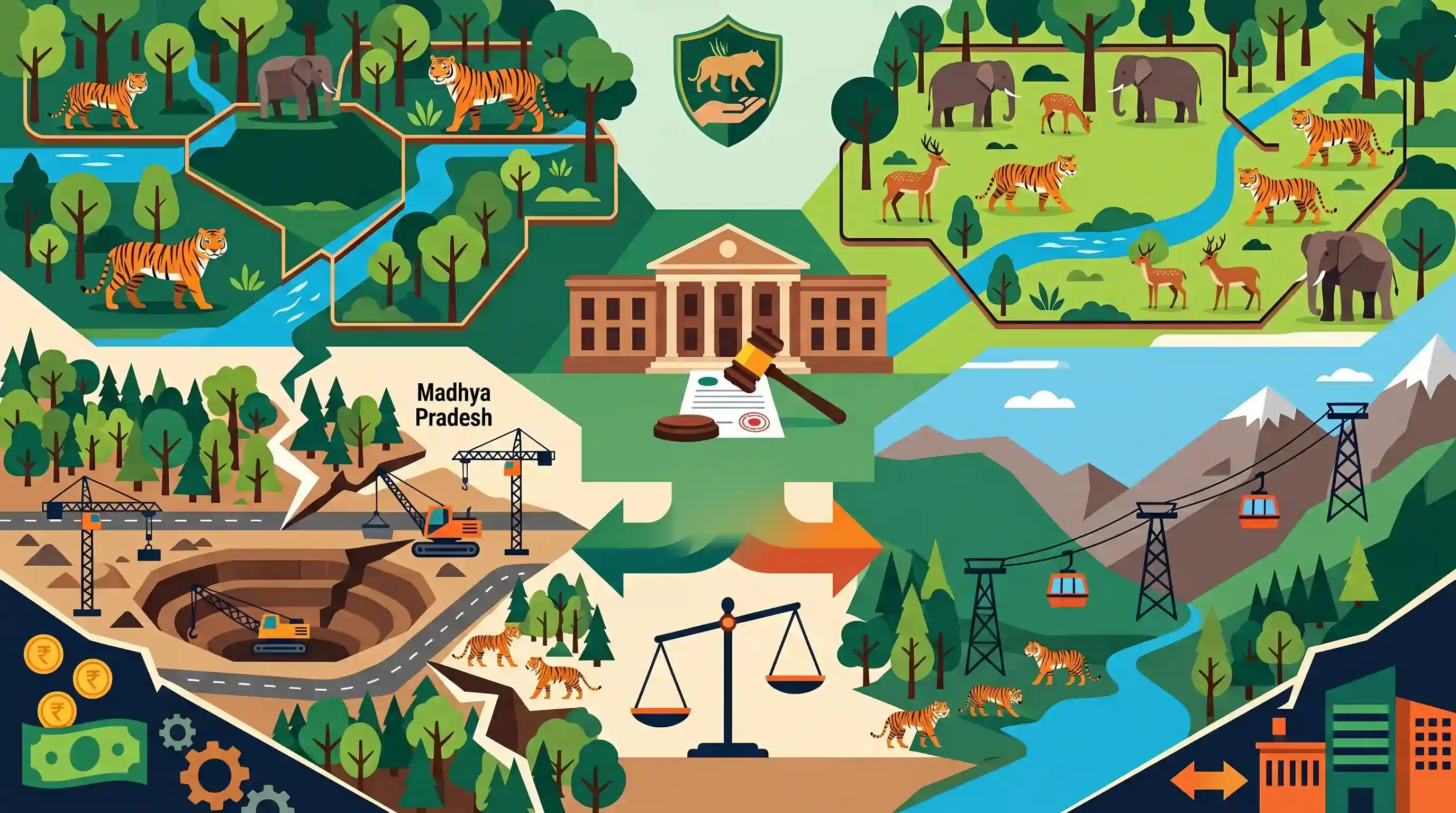
The Standing Committee of the National Board for Wildlife (NBWL) has granted environmental clearances for controversial infrastructure and mining projects in the tiger habitats of Madhya Pradesh. Additionally, it has approved the construction of a ropeway within Uttarakhand's Rajaji Tiger Reserve. These decisions highlight the ongoing policy tension between facilitating economic/infrastructural development and preserving ecologically sensitive zones, raising concerns among environmentalists regarding habitat fragmentation and threats to tiger populations.
Key Points
- The Standing Committee of the National Board for Wildlife (NBWL) has cleared infrastructure and mining projects within tiger habitats in Madhya Pradesh.
- The panel also approved a ropeway project in the Rajaji Tiger Reserve located in Uttarakhand.
- These clearances reignite the debate over balancing developmental needs with the conservation of fragile ecosystems and critical wildlife corridors.
- The NBWL is a statutory body constituted under the Wildlife (Protection) Act, 1972, and plays a crucial role in reviewing projects falling within or near protected areas.
Important Terms
Wildlife (Protection) Act, 1972

A landmark 1972 law providing the legal framework for protecting wild animals, plants, and habitats. It categorizes species into schedules based on the level of protection required and regulates hunting and trade.
UPSC context
GS Paper III: Environment & Ecology; tests understanding of legal safeguards, protected area categories, and statutory conservation bodies.
National Board for Wildlife (NBWL)
A statutory apex body chaired by the Prime Minister that advises the central government on wildlife conservation policy and approves projects within or around National Parks and Sanctuaries.
UPSC context
GS Paper II & III: Statutory Bodies; tests knowledge of executive-led conservation governance and the approval process for developmental projects.
Standing Committee of NBWL
A smaller, executive arm of the NBWL chaired by the Environment Minister. It handles the practical task of clearing infrastructure and development projects located in ecologically sensitive zones.
UPSC context
GS Paper III: Environment; highlights the conflict between environmental protection and industrial/infrastructure development in sensitive areas.
National Tiger Conservation Authority (NTCA)
A statutory body under the MoEFCC, established in 2005, to strengthen tiger conservation. It provides legal backing to tiger reserves and ensures their management follows standardized Tiger Conservation Plans.
UPSC context
GS Paper III: Conservation; critical for understanding the administrative and legal architecture governing India’s flagship conservation program.
Critical Tiger Habitat (CTH)
The core, "inviolate" areas of tiger reserves required to be kept free of human disturbance and infrastructure to ensure the long-term survival of tigers, as defined under the WPA.
UPSC context
GS Paper III: Environmental Impact Assessment; tests knowledge of zoning in protected areas and legal restrictions on developmental activities.
Project Tiger
Launched in 1973, this centrally sponsored scheme aims to maintain a viable tiger population in India. It treats the tiger as an "umbrella species" for entire forest ecosystems.
UPSC context
GS Paper III: Biodiversity; a frequent topic regarding flagship species conservation, tiger census (M-STrIPES), and ecosystem-based management.
Prelims Trap
The Standing Committee of the National Board for Wildlife (NBWL) is chaired by the Prime Minister.
The Prime Minister chairs the apex NBWL, but the Standing Committee—which actually evaluates and clears projects—is chaired by the Union Environment Minister.
Static Concepts Connected
What are the core functions and structure of the NBWL?
- Statutory backing: Constituted under the Wildlife (Protection) Act, 1972, replacing the earlier advisory Indian Board for Wildlife.
- Leadership: Chaired by the Prime Minister, with the Union Minister for Environment, Forest and Climate Change as Vice-Chairperson.
- Boundary alterations: No alteration of boundaries of National Parks and Wildlife Sanctuaries can occur without explicit NBWL approval.
What are the geographical and ecological features of Rajaji Tiger Reserve?
- Origin: Formed in 1983 by amalgamating three wildlife sanctuaries: Rajaji, Motichur, and Chilla in the Shivalik foothills.
- River systems: Uniquely bisected by the Ganga River. The Song River, a major tributary, also flows through the reserve.
- Ecological role: Forms the north-western limit of the Asian elephant's range in India and serves as a critical tiger corridor.
Cross-Topic Patterns
Parvatmala scheme vs. Protected Areas
The push for ropeway infrastructure in hill states often bypasses rigorous EIA under 'public utility' exemptions, creating friction between the Parvatmala scheme and the Wildlife Protection Act.
Single-Window Environmental Clearances
The PARIVESH portal's push to fast-track environmental, forest, and wildlife clearances connects 'Ease of Doing Business' governance directly to ecological concerns over habitat fragmentation.

Expect a 2026 prelims question pairing the river ecology of Rajaji TR (Ganga/Song) with the statutory boundary-alteration powers of NBWL.
Linked PYQs · 4
Linked PYQs · 4
- 2022PrelimsGS1
With reference to Indian laws about wildlife protection, consider the following statements : 1. Wild animals are the sole property of the government. 2. When a wild animal is declared protected, such animal is entitled for equal protection whether it is found in protected areas or outside. 3. Apprehension of a protected wild animal becoming a danger to human life is sufficient ground for its capture or killing. Which of the statements given above is/are correct?
- 2017PrelimsGS1
In India, if a species of tortoise is declared protected under Schedule I of the Wildlife (Protection) Act, 1972, what does it imply?
- 2017PrelimsGS1
According to the Wildlife (Protection) Act, 1972, which of the following animals cannot be hunted by any person except under some provisions provided by law? 1. Gharial 2. Indian wild ass 3. Wild buffalo Select the correct answer using the code given below:
- 2020PrelimsGS1
Among the following Tiger Reserves, which one has the largest area under "Critical Tiger Habitat"?
