Human Wildlife Conflict and Elephant Attacks in Jharkhand
Source:The Hindu ↗
Why It Matters
Human-elephant conflict is a recurrent challenge in India, emphasizing the tension between wildlife conservation and community safety. It exposes critical gaps in early warning systems by local administration and underscores the necessity of securing elephant corridors to mitigate habitat fragmentation.
Summary
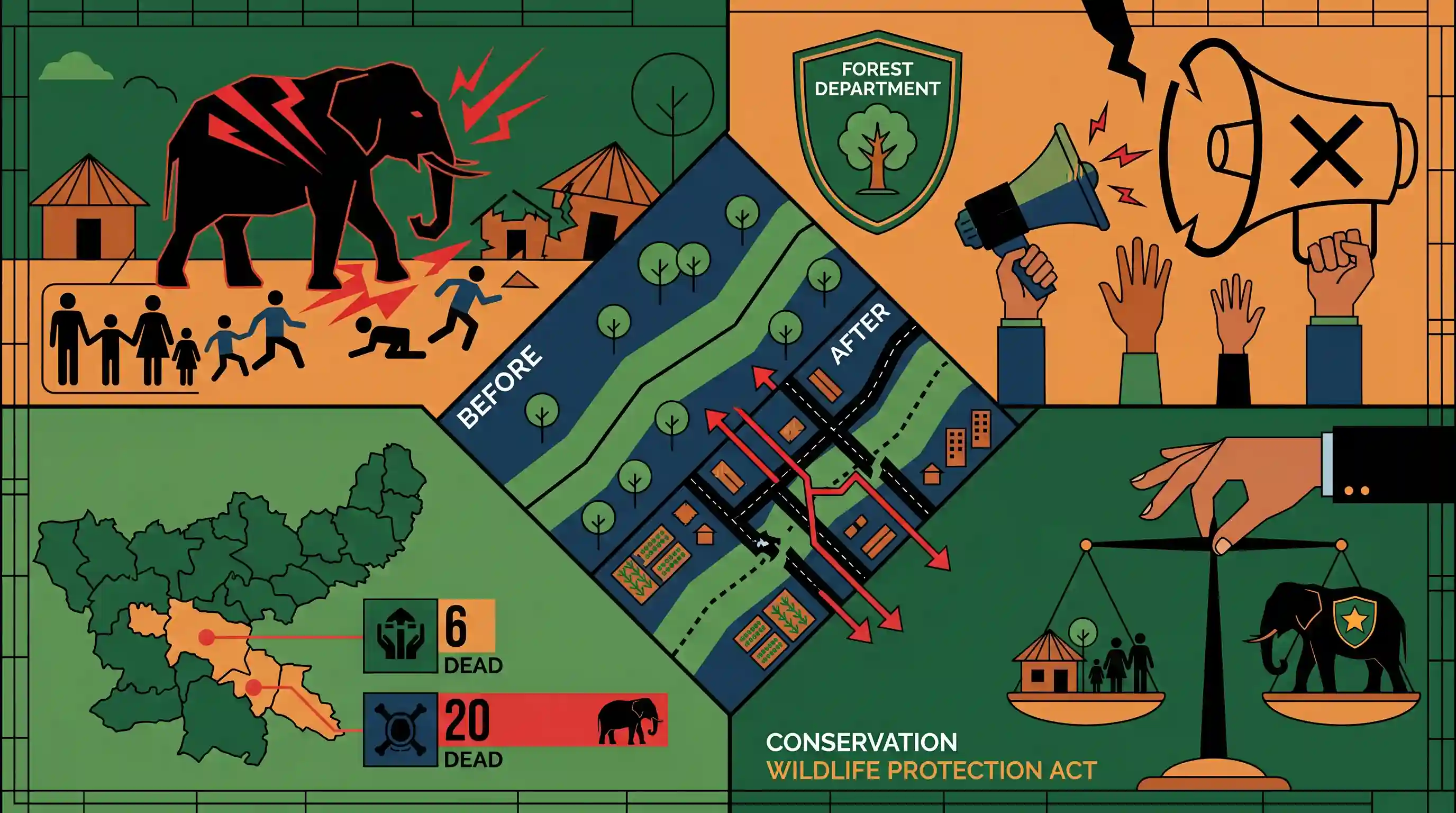
Six people, including four from one family, were trampled to death by a herd of wild elephants in Gondwar village of Hazaribagh district, Jharkhand. The tragedy has triggered local outrage against the forest department for not having adequate early warning systems, such as public sirens, to alert residents. This event highlights the escalating human-wildlife conflict in the state, closely following another recent incident in West Singhbhum where an elephant killed 20 people. Such conflicts are primarily driven by habitat fragmentation and encroachment into traditional elephant corridors.
Key Points
- A herd of wild elephants trampled six people to death, including four family members, in Gondwar village, Hazaribagh district, Jharkhand.
- Locals blamed the forest department for failing to establish an effective early warning system, suggesting the use of sirens to alert villagers when elephants are nearby.
- The incident highlights a growing crisis of human-animal conflict in the region, following a recent spate of 20 deaths caused by a single elephant in West Singhbhum.
- The root causes include habitat fragmentation, encroachment into traditional elephant corridors, and shrinking forest cover, which force wildlife into human settlements.
Important Terms
Wildlife Protection Act, 1972

A landmark 1972 Act providing a legal framework for protecting wild animals, birds, and plants. It establishes schedules for protection; Asian elephants are Schedule I, receiving the highest legal safeguard.
UPSC context
GS Paper 3 (Environment). Crucial for understanding India's legal conservation structure and species-specific protection levels.
Human-Wildlife Conflict (HWC)
Negative interactions between humans and wildlife leading to loss of life, property, or livelihoods. Driven by competition for space and resources, it is a major conservation and social challenge in India.
UPSC context
GS Paper 3 (Environment). Tests understanding of conservation challenges, socio-economic impacts, and mitigation strategies.
Elephant Corridors
Narrow strips of forested land connecting larger elephant habitats, ensuring safe migration and genetic flow. India has 150 identified corridors vital for reducing conflict and maintaining ecological balance.
UPSC context
GS Paper 3 (Environment). Focuses on connectivity conservation, the "Right of Passage," and preventing habitat isolation.
Project Elephant
Launched in 1992, this centrally sponsored scheme aims to protect elephants, their habitats, and corridors. It was recently merged with Project Tiger to form an integrated conservation framework.
UPSC context
GS Paper 3 (Environment). Important for knowledge of government schemes and the recent administrative merger with Project Tiger.
Habitat Fragmentation
The process where continuous habitats are broken into smaller, isolated patches due to infrastructure or agriculture. It forces wildlife into human landscapes, escalating the risk of conflict.
UPSC context
GS Paper 3 (Environment). Fundamental concept explaining the ecological drivers of biodiversity loss and human-wildlife encounters.
Prelims Trap
"Project RE-HAB (using bee fences to deter elephants) is an initiative by the Ministry of Environment, Forest and Climate Change."
Project RE-HAB is actually an initiative of the Khadi and Village Industries Commission (KVIC) under the Ministry of MSME, not the MoEFCC.
Static Concepts Connected
What is the conservation status and legal protection of the Indian Elephant?
- WPA 1972: Listed under Schedule I, providing the highest degree of legal protection.
- IUCN Red List: Classified as Endangered due to habitat loss, poaching, and fragmentation.
- Heritage Animal: Declared as India's National Heritage Animal in 2010 to scale up conservation efforts.
What are the core components of Project Elephant?
- Launch & Nature: A Centrally Sponsored Scheme launched in 1992 to protect elephants, their habitats, and corridors.
- First Reserve: Singhbhum Elephant Reserve in Jharkhand was India's first formally designated Elephant Reserve (2001).
- MIKE Programme: Includes the MIKE (Monitoring of Illegal Killing of Elephants) programme mandated by CITES.
Cross-Topic Patterns
Resource extraction vs Elephant Corridors
Coal and iron-ore mining in the Chota Nagpur Plateau exacerbates habitat fragmentation, directly linking India's mineral economics and resource extraction policies with escalating human-elephant conflicts.
Technology in wildlife conservation
The demand for early warning systems integrates wildlife management with emerging tech, highlighting how AI thermal cameras and IoT can serve as non-lethal conflict mitigation tools.

A composite question linking Project RE-HAB, KVIC's role, and the legal status/notification of elephant corridors is highly probable.
Linked PYQs · 2
Linked PYQs · 2
- 2020PrelimsGS1
With reference to Indian elephants, consider the following statements: 1. The leader of an elephant group is a female. 2. The maximum gestation period can be 22 months. 3. An elephant can normally go on calving till the age of 40 years only. 4. Among the States in India, the highest elephant population is in Kerala. Which of the statements given above is/are correct?
- 2022PrelimsGS1
With reference to Indian laws about wildlife protection, consider the following statements : 1. Wild animals are the sole property of the government. 2. When a wild animal is declared protected, such animal is entitled for equal protection whether it is found in protected areas or outside. 3. Apprehension of a protected wild animal becoming a danger to human life is sufficient ground for its capture or killing. Which of the statements given above is/are correct?
