Wildlife Institute of India halts Chamoli road widening project
Source:thestatesman ↗
Why It Matters
It underscores the vital role of statutory bodies like the Wildlife Institute of India in enforcing conservation norms. For UKPSC aspirants, it draws attention to the geography of Uttarakhand's protected areas (like Rajaji Tiger Reserve) and the administrative challenges of balancing regional connectivity with ecological preservation.
Summary
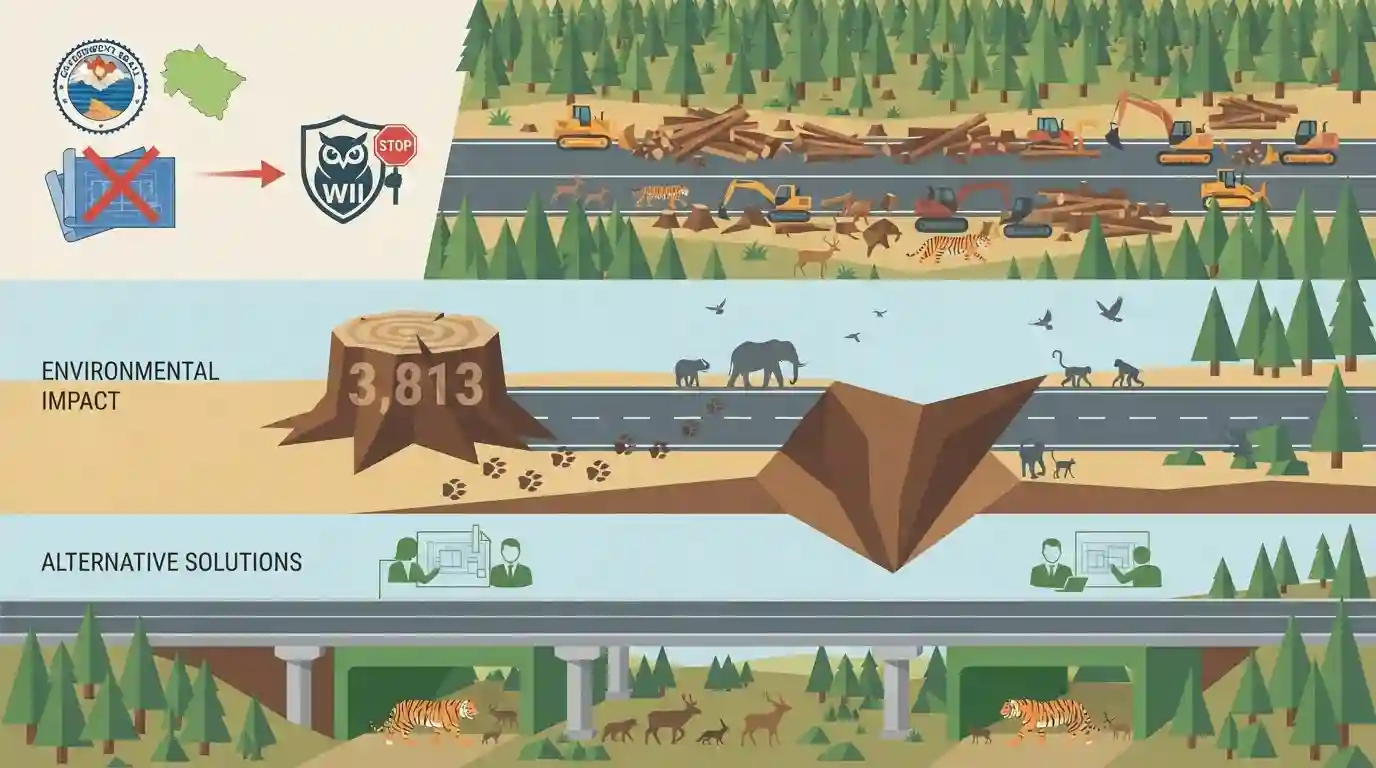
The Wildlife Institute of India (WII) has halted the Uttarakhand government's plan to widen a 22-km road connecting Pipalkoti and Pashulok Barrage, as the route passes through the eco-sensitive Rajaji Tiger Reserve. The proposed expansion would have required cutting down 3,813 trees, posing a severe threat to tigers and local fauna. In response, the Public Works Department (PWD) is reconsidering the project and looking into alternatives like elevated roads or wildlife underpasses to minimize environmental disruption while facilitating connectivity.
Key Points
- The Wildlife Institute of India (WII) has rejected the Uttarakhand government's proposal to widen a 22-km road stretching between Pipalkoti and Pashulok Barrage.
- The project was scuttled due to its alignment through the Rajaji Tiger Reserve, which would have necessitated the felling of 3,813 trees and disrupted wildlife corridors.
- The Public Works Department (PWD) is now exploring alternative infrastructure designs, such as elevated roads or underpasses, similar to those on the Delhi-Dehradun Expressway, to allow safe passage for animals.
- This case highlights the stringent environmental clearance requirements in eco-sensitive zones and the conflict between infrastructure expansion and wildlife conservation in Uttarakhand.
Important Terms
Wildlife Institute of India (WII)

An autonomous institute under the Ministry of Environment, Forest and Climate Change (MoEFCC), established in 1982 in Dehradun, which conducts wildlife research, forensics, policy training, and environmental impact assessments.
UPSC context
GS Paper III (Environment & Ecology); tests knowledge of key conservation institutions and their roles in environmental governance.
Rajaji Tiger Reserve
A major protected area in Uttarakhand's Shivalik range, established by merging three sanctuaries in 1983 and designated a tiger reserve in 2015. It is a critical corridor for elephants and Bengal tigers.
UPSC context
GS Paper III (Biodiversity & Conservation); tests geographical awareness of tiger reserves, local rivers, and fauna of Northern India.
Eco-Sensitive Zone (ESZ)
Ecological buffer areas notified around National Parks and Sanctuaries under the Environment (Protection) Act, 1986, to regulate human activities, mitigate eco-degradation, and serve as "shock absorbers" for delicate wildlife ecosystems.
UPSC context
GS Paper III (Environment); tests statutory frameworks for habitat protection and balancing infrastructure development with conservation.
State Board for Wildlife (SBWL)
A statutory advisory body constituted under the Wild Life (Protection) Act, 1972, and chaired by the State's Chief Minister. It advises state governments on wildlife conservation and protected area declaration.
UPSC context
GS Paper II & III (Environmental Governance); tests statutory setups, decentralized bodies, and executive roles under Indian environmental laws.
Project Tiger
A centrally sponsored conservation program launched in 1973 to ensure a viable population of Bengal tigers in their natural habitats, implemented by the statutory National Tiger Conservation Authority (NTCA).
UPSC context
GS Paper III (Environment); tests understanding of flagship species protection schemes, historical milestones, and legal conservation frameworks.
Prelims Trap
The Wildlife Institute of India (WII) is a statutory body established under the Wildlife (Protection) Act, 1972.
WII is an autonomous society registered under the Societies Registration Act, 1860, not a statutory body. It acts as an advisory and research institution under MoEFCC.
Static Concepts Connected
What is the legal status and role of the Wildlife Institute of India (WII)?
- Legal Status: It is an autonomous institution established in 1982, registered as a society under the Societies Registration Act, 1860, under MoEFCC.
- Core Mandate: Functions as India's premier advisory body, providing scientific research, training, and technical inputs, including the quadrennial tiger estimation.
How are Tiger Reserves legally designated and structured in India?
- Legal Framework: Designated under Section 38V of the Wildlife (Protection) Act, 1972 (amended in 2006) by state governments on recommendations of the NTCA.
- Zonation Strategy: Divided into an inviolate Core Area with high legal protection, and a peripheral Buffer Area to allow co-existence and low-impact human activities.
Cross-Topic Patterns
Linear Infrastructure vs. Conservation Biology
Linear intrusions fragment critical habitats. Green infrastructure mitigation balances infrastructure growth with ecological carrying capacity, linking GS-3 Economic Development with Biodiversity Conservation.
Shivalik-Terai Arc Connectivity
Rajaji and Corbett act as critical nodes. Corridor fragmentation increases human-wildlife conflict, a recurring theme in GS-3 disaster management and geography.

WII's legal status, NTCA's clearance powers, and Rajaji TR's geography are highly probable targets for multi-statement GS-1/3 questions.
Linked PYQs · 4
Linked PYQs · 4
- 2007UKPSC_PRELIMSGS1
In Uttarakhand which of the following wild life reserve is a Tiger Reserve?
- 2024UKPSC_PRELIMSGS1
Which of the following National Park of Uttarakhand has been included in Project Tiger Scheme in 2015 ?
- 2016UKPSC_PRELIMSGS1
Which of the following National Parks of Uttarakhand has been included in 'Project Tiger Scheme' in 2016?
- 2024UKPSC_PRELIMSGS1
Which Constitutional Amendment Act relates to the protection and improvement of environment and safeguarding of forests and wildlife ?
