Karewa Marriage Custom and Widow Pension Entitlement Rights
Source:Indian Express ↗
Why It Matters
This ruling is an excellent case study for UPSC aspirants to cite in GS2 (Gender Justice, Judiciary protecting vulnerable sections) and GS1 (Patriarchal customs, Women's issues). It demonstrates how courts interpret state welfare guidelines in the context of deeply entrenched social customs to protect the financial autonomy of widows.
Summary
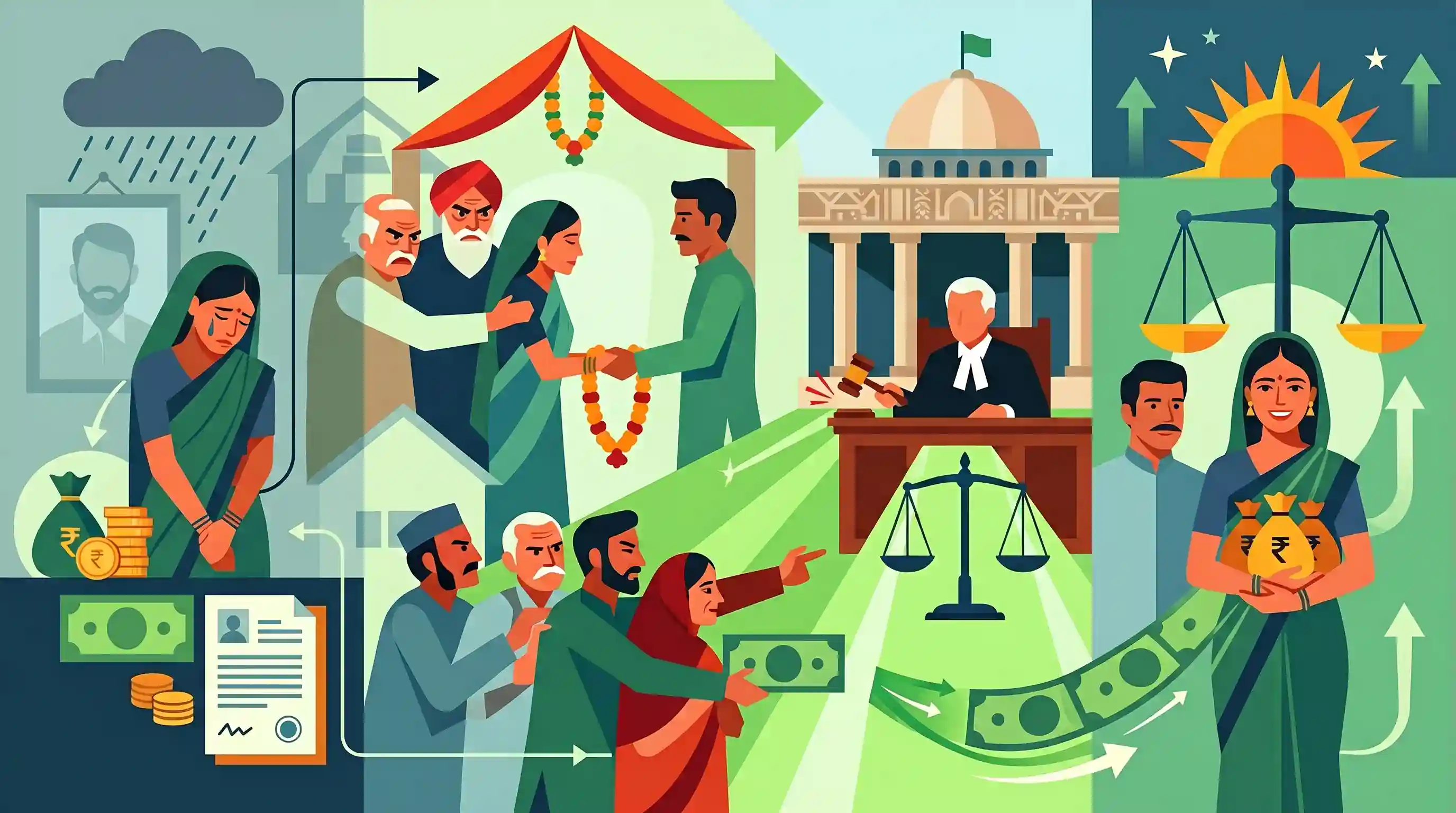
The Punjab and Haryana High Court has ruled that a widow who marries her deceased husband's brother through the customary 'Karewa' practice does not forfeit her right to a family pension. Karewa is a traditional marriage custom in North India, often rooted in patriarchal norms to keep property within the family while ostensibly providing social security to widows. The High Court's progressive ruling ensures that statutory pension rules do not penalize women partaking in such customary marriages, safeguarding their financial entitlements and advancing gender justice.
Key Points
- The Punjab and Haryana High Court ruled that a widow entering into a 'Karewa' marriage (customary marriage to her deceased husband's brother) remains entitled to her family pension.
- 'Karewa' is a traditional customary practice prevalent in North Indian states, historically aimed at retaining family property and offering social security to widows.
- The ruling bridges the gap between statutory pension rules (which often terminate benefits upon formal remarriage) and local customs, protecting vulnerable women from losing financial security.
- The judgment highlights the judiciary's role in advancing gender justice by ensuring that patriarchal marriage customs do not strip widows of their welfare entitlements.
Important Terms
Karewa Marriage

A traditional North Indian custom (e.g., Jats) of widow remarriage to the deceased husband's brother to provide social security and retain property within the family.
UPSC context
GS Paper I (Society) and II (Governance/Social Justice); tests understanding of customary vs. statutory law and gender rights.
Family Pension Scheme
A social security benefit providing financial support to the spouse and dependents of a deceased government employee.
UPSC context
GS Paper II (Social Justice/Welfare Schemes); examines state provisions for vulnerable sections and administrative law.
Model Employer
The legal principle that the State must act fairly, reasonably, and ethically in its employment practices, avoiding technicalities that defeat welfare goals.
UPSC context
GS Paper II (Governance/Polity); explores the judiciary's expectation of the State's conduct under Article 14 and 16.
Gender Justice
The legal and social framework ensuring equal rights and opportunities for women, particularly by removing discriminatory barriers in customs and laws.
UPSC context
GS Paper I (Society) and GS Paper II (Social Justice); critical for essays and questions on women's empowerment.
Article 21
Fundamental right protecting the right to life and personal liberty, interpreted by courts to include the right to live with dignity and social security.
UPSC context
GS Paper II (Polity/Constitution); central to judicial activism and expansion of fundamental rights in India.
Customary Law
Rules and practices established through long-term usage in specific communities, which may carry legal weight alongside formal statutes.
UPSC context
GS Paper I (Indian Heritage/Culture) and II (Polity); examines the intersection of tradition and modern legislation.
Prelims Trap
"Under the Hindu Marriage Act, marriages lacking the 'Saptapadi' ritual are universally void, regardless of local customary practices."
Section 7 of the HMA legally recognizes marriages solemnized through local customary rites; Saptapadi is only mandatory if it is part of those specific customs.
Static Concepts Connected
How does Indian law accommodate and regulate customary practices?
- Article 13: Article 13 defines 'law' to explicitly include any "custom or usage having in the territory of India the force of law", subjecting them to fundamental rights scrutiny.
- Section 7 of HMA: Section 7 validates Hindu marriages solemnized according to customary rites of either party, making standard rituals like Saptapadi non-mandatory if customs differ.
- Tribal Exceptions: Section 2(2) exempts members of Scheduled Tribes from the Act's purview to protect their distinct indigenous customary laws, unless the Central Government notifies otherwise.
What is the constitutional basis for providing Family Pensions?
- Article 39(a): Requires the State to direct its policy towards ensuring that citizens have an adequate means of livelihood.
- Article 41: Directs the State to make effective provisions for securing the right to public assistance in cases of old age, sickness, disablement, and undeserved want.
- Judicial Interpretation: Courts interpret family pension not as a bounty, but as a statutory welfare right under these DPSP provisions to protect dependents from destitution.
Cross-Topic Patterns
UCC debates vs. Customary Diversity
Rulings validating specific regional customs like Karewa highlight a primary challenge in drafting a Uniform Civil Code (UCC): balancing a uniform legal framework with the preservation of diverse socio-cultural traditions.
Patriarchy disguised as Social Security
Customs like Karewa act as a double-edged sword—offering widows social security while inherently functioning to prevent women from taking inherited agricultural land outside the patriarchal family structure.

Expect a prelims statement testing the legal validity of customary marriages under the Hindu Marriage Act without standard Vedic rituals.
Linked PYQs · 3
Linked PYQs · 3
- 2023MainsGS2
Explain the constitutional perspectives of Gender Justice with the help of relevant Constitutional Provisions and case laws.
- 2014MainsGS1
How does patriarchy impact the position of a middle class working woman in India?
- 2019MainsGS2
Performance of welfare schemes that are implemented for vulnerable sections is not so effective due to absence of their awareness and active involvement at all stages of policy process. Discuss.
