Supreme Court Directs Inclusive Electoral Roll Revision in Bihar
Source:The Hindu ↗
Why It Matters
Touches upon the core democratic right to vote, the constitutional mandate of the ECI, and the ongoing debate surrounding Aadhaar's utility as an identity versus citizenship document. It highlights the judicial review of electoral processes and is highly relevant to GS-2 Polity and Governance.
Summary
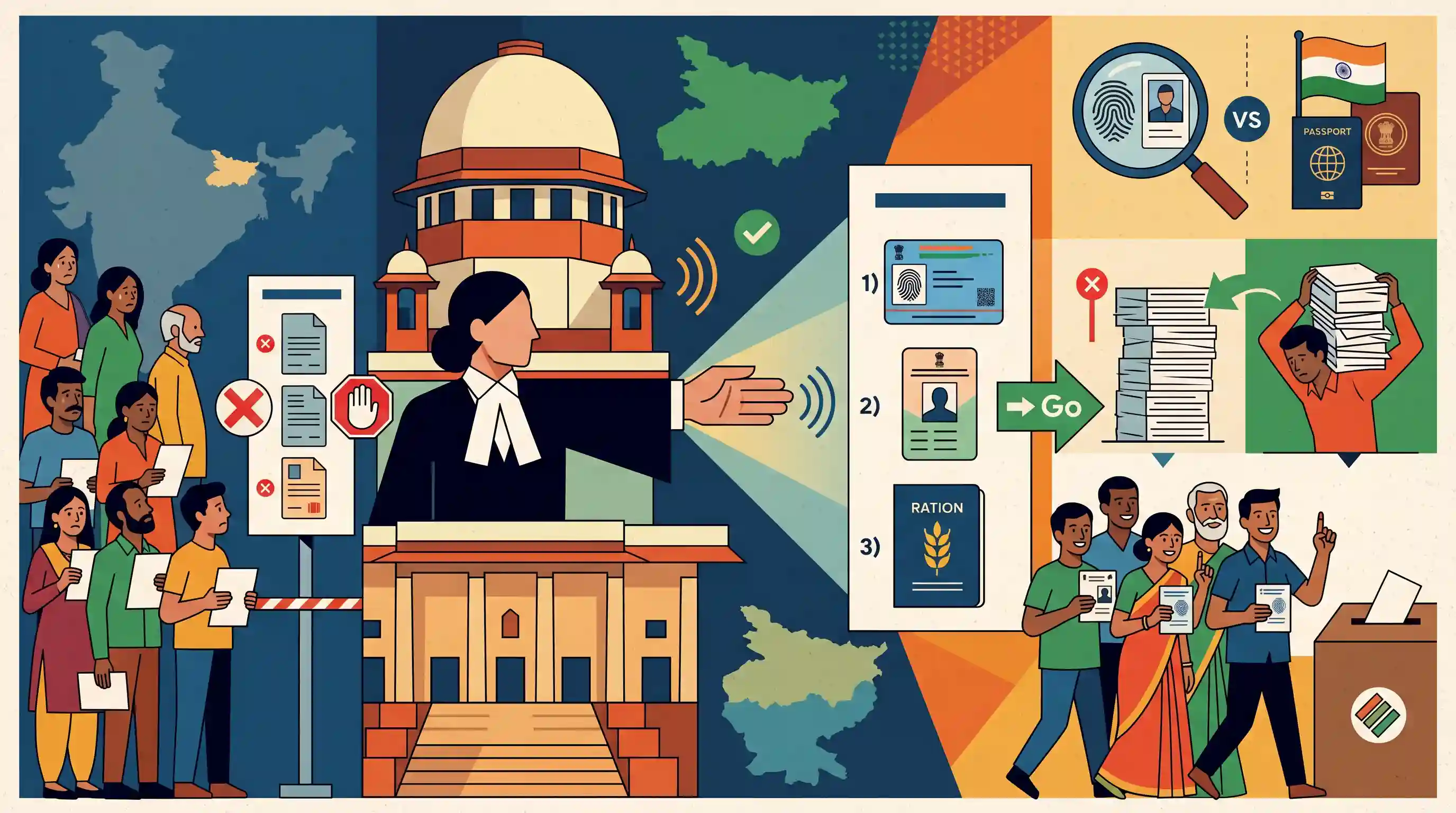
The Supreme Court has directed the Election Commission of India (ECI) to include Aadhaar, EPIC, and ration cards as valid identity documents for Bihar's Special Intensive Revision (SIR) of electoral rolls. Emphasizing that the SIR process is primarily about identity verification rather than citizenship, the Court criticized the ECI's restrictive 11-document list, which risks mass disenfranchisement. The SC reminded the ECI of its constitutional duty under Article 324 to facilitate democratic participation and to avoid placing the unfair burden of proving citizenship on voters who are already enrolled.
Key Points
- The Supreme Court has nudged the Election Commission of India (ECI) to expand the list of acceptable documents for Bihar's Special Intensive Revision (SIR) of electoral rolls to include Aadhaar, EPIC, and ration cards.
- The SC highlighted that the SIR exercise focuses on verifying identity rather than citizenship, making the current list of 11 restrictive documents an unnecessary barrier to voter registration.
- The Court dismissed the ECI's objection that Aadhaar only proves residence, noting the inconsistency of accepting dependent documents like caste certificates while excluding the widely-held Aadhaar.
- Putting the onus of proving citizenship on already enrolled voters contradicts legal precedents and risks the widespread disenfranchisement of marginalized citizens in Bihar.
- The ECI's constitutional mandate under Article 324 is to facilitate democratic participation, and the SC's intervention offers an opportunity to make the SIR process genuinely inclusive.
Important Terms
Election Commission of India (ECI)

A permanent constitutional body responsible for administering union and state election processes in India, ensuring they are free, fair, and impartial.
UPSC context
GS Paper II: Appointment to various Constitutional posts, powers, functions, and responsibilities of various Constitutional Bodies.
Article 324
The constitutional provision vesting the superintendence, direction, and control of elections (Parliament, State Legislatures, President, Vice-President) in the Election Commission of India.
UPSC context
GS Paper II: Indian Constitution—historical underpinnings, significant provisions, and basic structure. Tests knowledge of electoral governance.
Special Intensive Revision (SIR)
A comprehensive, door-to-door verification process by the ECI to update electoral rolls, involving fresh enumeration to eliminate duplicate or ineligible entries before major elections.
UPSC context
GS Paper II: Salient features of the Representation of People's Act; Electoral reforms; Transparency and accountability.
Elector Photo Identity Card (EPIC)
A photo identification document issued by the ECI to registered voters to verify identity and prevent impersonation during the voting process.
UPSC context
GS Paper II: Government policies and interventions; Electoral reforms and the integrity of the voting process.
Aadhaar
A 12-digit unique identity number issued by UIDAI, which the Supreme Court recently mandated as a valid identity document for voter verification in Bihar.
UPSC context
GS Paper II/III: Issues relating to development and management of Social Sector/Services; E-governance and its applications.
Representation of the People Act, 1950
The legal framework governing the allocation of seats, delimitation of constituencies, and the preparation of electoral rolls for India's legislative bodies.
UPSC context
GS Paper II: Salient features of the Representation of People's Act (RPA). Essential for understanding legislative elections.
Prelims Trap
The Election Commission has the final authority to terminate an individual's citizenship status during the Special Intensive Revision of electoral rolls.
The ECI only determines voter registration eligibility under the RPA 1950. The Central Government holds exclusive power to adjudicate citizenship under the Citizenship Act, 1955.
Static Concepts Connected
What are the core provisions of the Representation of the People Act, 1950?
- Seat Allocation: Deals with the allocation of seats and the delimitation of constituencies for Parliament and State Legislatures.
- Electoral Rolls: Prescribes the basic qualifications for voters and mandates the preparation, revision, and updating of electoral rolls.
- Registration Disqualifications: Bars non-citizens, persons of unsound mind, and those legally disqualified by corrupt practices from voter registration.
What is the legal standing of Aadhaar under the Aadhaar Act, 2016?
- Section 9 limit: Explicitly states that an Aadhaar number is proof of identity and residence, but it is not a conclusive proof of Indian citizenship or domicile.
- Welfare Delivery: Primarily intended for the targeted delivery of subsidies, benefits, and services funded by the Consolidated Fund of India.
- Voluntary Linking: Can be voluntarily linked to electoral rolls (via 2021 Amendment Act) but cannot be strictly mandated for essential rights like voting.
Cross-Topic Patterns
Aadhaar linking & Electoral Reforms
The Election Laws (Amendment) Act 2021 authorized voluntary Aadhaar-voter ID linking. The SC ruling treats Aadhaar as valid identity proof to prevent voter exclusion without confusing it with citizenship verification.
NRC vs. Electoral Roll Revisions
Aspirants must distinguish between citizenship-focused enumerations (like Assam's NRC under the Citizenship Act) and demographic roll updates (SIR under RPA 1950), which focus strictly on identity and eliminating duplicate or deceased voters.

Expect a multi-statement question contrasting ECI’s powers under RPA 1950 with the Centre's exclusive citizenship powers under the 1955 Act.
Linked PYQs · 4
Linked PYQs · 4
- 2018PrelimsGS1
Consider the following statements: 1. Aadhaar card can be used as a proof of citizenship or domicile. 2. Once issued, Aadhaar number cannot be deactivated or omitted by the Issuing Authority. Which of the statements given above is/are correct?
- 2022MainsGS2
Discuss the role of the Election Commission of India in the light of the evolution of the Model Code of Conduct.
- 2017MainsGS2
To enhance the quality of democracy in India the Election Commission of India has proposed electoral reforms in 2016. What are the suggested reforms and how far are they significant to make democracy successful?
- 2024MainsGS2
Examine the need for electoral reforms as suggested by various committees with particular reference to "one nation one election" principle.
