Nanomaterials applications in electric vehicle batteries
Source:The Hindu ↗
Why It Matters
Nanotechnology and its practical applications (such as carbon nanotubes) form a core part of the UPSC Science and Technology syllabus. Understanding the specific properties of SWCNTs and their use in EV batteries or advanced electronics directly prepares candidates for both Prelims MCQs on emerging technologies and Mains GS3 answers on scientific advancements and energy security.
Summary
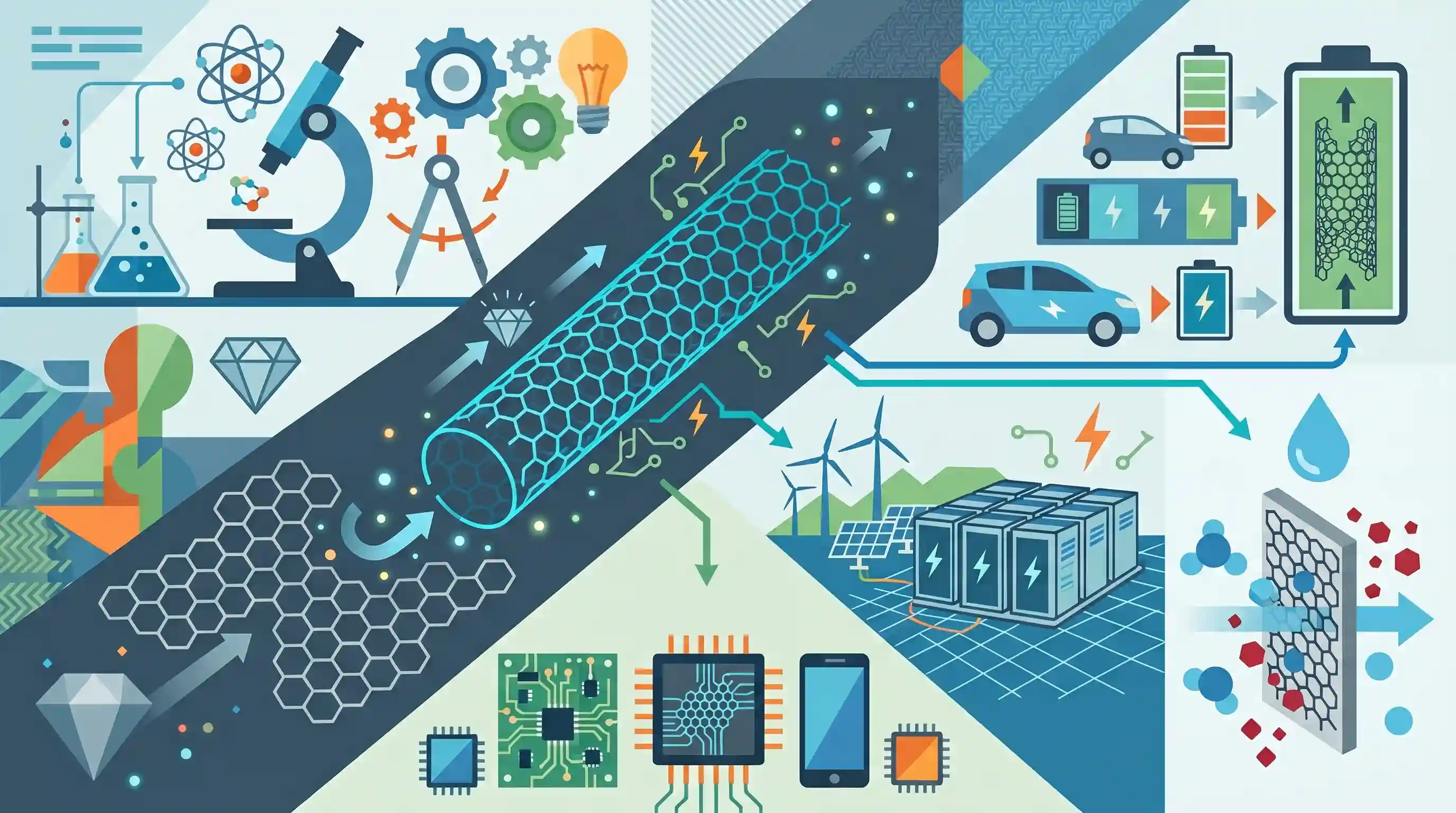
The article explores the potential of nanomaterials through the work of Gadhadar Reddy, founder of NoPo Nanotechnologies, a company specializing in single-wall carbon nanotubes (SWCNTs). SWCNTs are incredibly small, exceptionally strong, and highly conductive. These properties make them invaluable for next-generation technologies, particularly in enhancing the capacity and affordability of electric vehicle (EV) batteries, improving energy storage, creating advanced, energy-efficient electronics, and enabling cleaner water solutions. The piece highlights material science as a crucial, interdisciplinary frontier for solving modern technological challenges.
Key Points
- Single-wall carbon nanotubes (SWCNTs) are extremely small (200,000 times smaller than a human hair) yet rank among the strongest known materials.
- SWCNTs possess unique thermal and electrical properties, functioning as highly conductive materials or semiconductors that transfer heat and electrons rapidly.
- In the Electric Vehicle (EV) sector, SWCNTs can significantly increase battery capacity and reduce overall costs.
- Other critical applications of nanomaterials include developing smaller and more energy-efficient transistors for advanced electronics, as well as enabling cleaner water filtration systems.
- The field of material science and nanotechnology is highly interdisciplinary, combining physics, chemistry, electronics, and engineering.
Important Terms
Nanotechnology

The manipulation of matter at the atomic or molecular scale (1-100 nanometers) to create structures and devices with unique physical, chemical, and biological properties.
UPSC context
GS Paper 3; specific syllabus head regarding awareness and developments in emerging scientific fields.
Nanomaterials
Chemical substances or materials with at least one dimension sized between 1 and 100 nm, exhibiting fundamentally different properties compared to their bulk forms.
UPSC context
GS Paper 3; fundamental to understanding the application of science in daily life and industry.
Single-Wall Carbon Nanotubes (SWCNTs)
One-dimensional cylindrical molecules made of a single graphene sheet, characterized by extreme tensile strength, high electrical conductivity, and thermal stability.
UPSC context
GS Paper 3; relevant for advancements in semiconductors, energy storage, and aerospace technology.
Energy Storage Systems (ESS)
Technologies that capture energy for later use, including Lithium-ion and next-gen batteries, essential for grid stability and the transition to electric mobility.
UPSC context
GS Paper 3; critical for achieving India's Net Zero 2070 targets and renewable energy integration.
Material Science
An interdisciplinary field studying the relationship between the structure of materials at atomic scales and their macroscopic properties to design new technological solutions.
UPSC context
GS Paper 3; foundational for industrial development and the indigenization of high-tech manufacturing.
NoPo Nanotechnologies
An Indian deep-tech startup specializing in the industrial-scale production of high-purity single-wall carbon nanotubes, supporting India's self-reliance in advanced materials.
UPSC context
GS Paper 3; example of 'Indigenization of technology' and 'Achievements of Indians in science & technology'.
Prelims Trap
Carbon nanotubes act solely as highly efficient electrical conductors.
CNT conductivity depends on their structural geometry (chirality). They can function as either metallic conductors OR semiconductors, making them highly versatile for advanced electronics.
Static Concepts Connected
How do carbon nanomaterials (Graphene, Fullerenes, Nanotubes) structurally differ?
- Graphene: A single two-dimensional (2D) layer of carbon atoms arranged in a flat hexagonal lattice.
- Carbon Nanotubes: One-dimensional (1D) cylindrical structures formed by rolling a sheet of graphene. They can be single-walled or multi-walled.
- Fullerenes: Zero-dimensional (0D) spherical, hollow molecules of carbon atoms arranged in a soccer-ball-like structure (e.g., C60).
What are the core applications of CNTs in medicine and environment?
- Biomedical Delivery: Biocompatible CNTs serve as targeted carriers, delivering drugs and antigens directly to specific cells without harming surrounding tissue.
- Artificial Capillaries: Due to their tubular structure and strength, they can be engineered to act as artificial blood capillaries for injured body parts.
- Water Purification: Nano-porous CNT membranes selectively filter out heavy metals, arsenic, and organic pollutants from drinking water.
Cross-Topic Patterns
Nanotech & EV Mineral Dependency
SWCNTs enhance EV battery electrode efficiency and supercapacitors. This material science leap directly mitigates India's import dependency on critical minerals like lithium and cobalt.
Advanced Materials in Space Tech
With tensile strength 100x greater than steel at a fraction of the weight, carbon nanotubes are increasingly critical for next-generation aerospace engineering and theoretical space tethers.

Expect 2026 prelims to test carbon nanotube chirality (semiconductor vs conductor) paired with their biodegradability and EV applications.
Linked PYQs · 3
Linked PYQs · 3
- 2020PrelimsGS1
With reference to carbon nanotubes, consider the following statements: 1. They can be used as carriers of drugs and antigens in the human body. 2. They can be made into artificial blood capillaries for an injured part of human body. 3. They can be used in biochemical sensors. 4. Carbon nanotubes are biodegradable. Which of the statements given above are correct?
- 2020MainsGS3
What do you understand by nanotechnology and how is it helping in health sector?
- 2025PrelimsGS1
In the context of electric vehicle batteries, consider the following elements : I. Cobalt II. Graphite III. Lithium IV. Nickel How many of the above usually make up battery cathodes?
