Rise of Caesarean Sections and Maternal Healthcare Regulation
Source:The Hindu ↗
આ શા માટે મહત્વનું છે
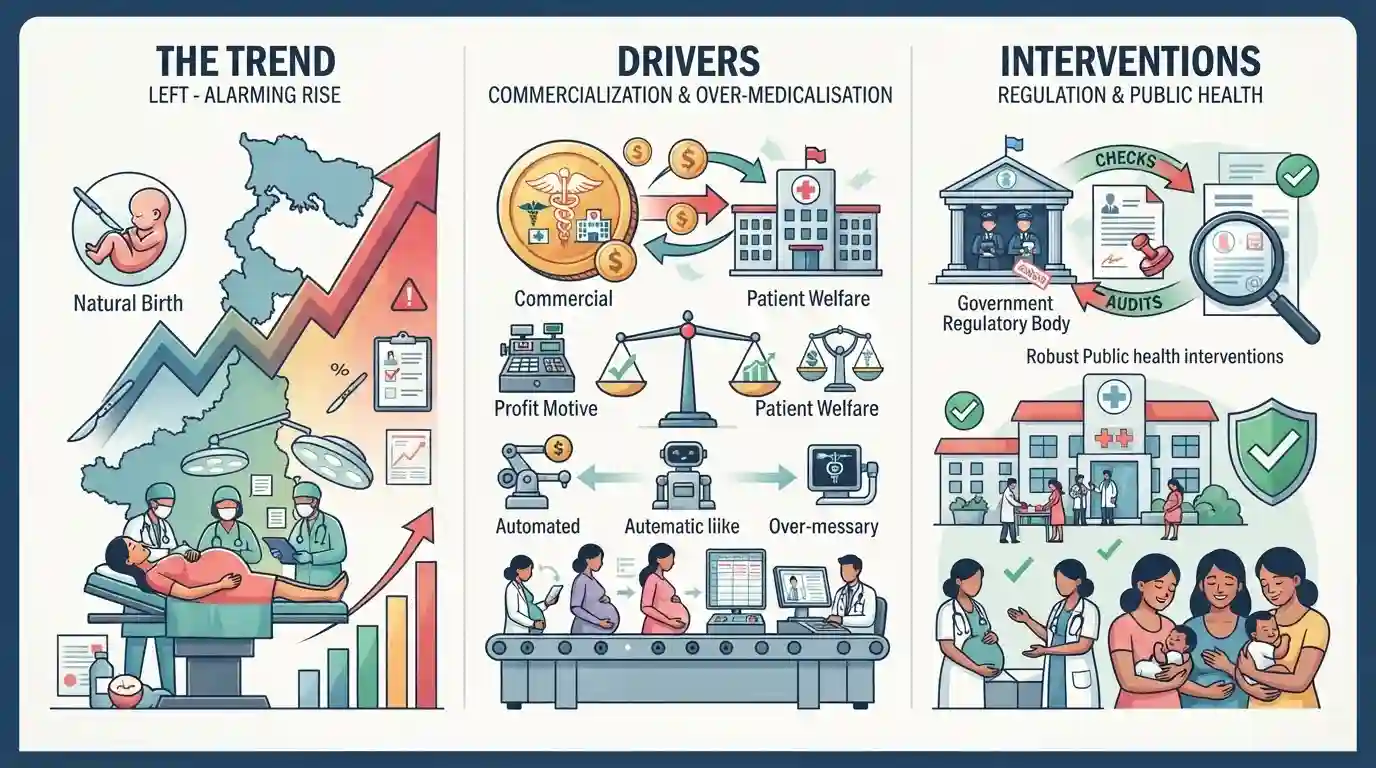
It highlights a critical public health and governance issue concerning maternal healthcare, the commercialisation of medical practices, and the alarming trend of unnecessary C-sections in India.
સારાંશ
The article examines the alarming rise of Caesarean section (C-section) rates in West Bengal, where nearly half of all births are now delivered via C-section. It analyzes the socio-medical drivers behind this trend, including the commercialization of healthcare and over-medicalisation, and stresses the urgent need for regulatory checks, maternal health audits, and robust public health interventions.
મુખ્ય મુદ્દા
- West Bengal's Caesarean section (C-section) rate has surged to nearly 1 in 2 births, far exceeding the WHO recommended threshold of 10-15%.
- Over-medicalisation of childbirth, private healthcare incentives, and lack of adequate monitoring contribute to the high rate of unnecessary C-sections.
- Excessive reliance on C-sections poses maternal and neonatal health risks, highlighting systemic flaws in public and private healthcare delivery.
- There is a critical need for strict audits, ethical medical practices, and strengthening public healthcare infrastructure at the grassroots level.
મહત્વપૂર્ણ શબ્દો
Caesarean section (C-section)

A surgical procedure used to deliver a baby through incisions in the abdomen and uterus, essential when vaginal delivery poses risks, but increasingly driven by over-medicalization and commercial interests.
UPSC context
UPSC Mains GS Paper II: Issues related to health, maternal mortality, and social sector service delivery mechanisms.
World Health Organization (WHO)
The specialized United Nations agency responsible for international public health, which established benchmark guidelines indicating that ideal population-level C-section rates range between 10% and 15%.
UPSC context
UPSC Prelims/Mains: Important international institutions and global health governance standards.
Maternal health audits
Systematic clinical reviews of surgical birth indications and practices conducted in healthcare facilities to curb unnecessary procedures, monitor trends, and ensure rational obstetric care.
UPSC context
UPSC Mains GS Paper II: Governance, transparency, and accountability mechanisms in public health management.
પ્રિલિમ્સ ટ્રેપ
the surge in Caesarean section rates is primarily driven by complications in rural public healthcare facilities rather than private commercialization.
Aspirants often assume high C-section rates are purely a rural phenomenon or restricted to public hospitals, missing the strong private-sector commercial bias driving urban and statewide surges.
સંલગ્ન સ્થિર ખ્યાલો
What is the WHO recommended ideal population-level frequency for Caesarean sections?
- Ideal Range: WHO standard: The World Health Organization considers an ideal population-level C-section rate to be between 10% and 15%.
- Mortality Link: Risk threshold: Rates higher than 10-15% are not associated with reductions in maternal and newborn mortality rates.
- Dual Challenge: Global burden: Both excessively low rates (access issues) and excessively high rates (over-medicalisation) present severe public health challenges.
What are the key institutional mechanisms governing maternal and child health in India?
- JSY Scheme: Janani Suraksha Yojana: A safe motherhood intervention under the National Health Mission (NHM) promoting institutional delivery among poor pregnant women.
- LaQshya Initiative: LaQshya initiative: Ministry of Health program designed to improve quality of care in labour rooms and maternity operation theatres.
- MDR Audits: Maternal Death Surveillance: Implementation of Maternal Death Review (MDR) at both facility and community levels to track and prevent maternal mortality.
આંતર-વિષય પેટર્ન
Health Sector Privatisation + Out-of-Pocket Expenditure
The exponential rise of C-sections in private facilities highlights how unregulated healthcare markets directly compromise developmental indicators and out-of-pocket expenditure targets under the National Health Policy.
Maternal Health + Women's Reproductive Autonomy
Excessive reliance on C-sections intersects with gender justice and reproductive autonomy, showing how bodily integrity is impacted by commercial medical practices and patriarchal paternalism.

Excessive C-sections + WHO 10-15% threshold frequently appear in matching or multi-statement public health governance questions.
સંલગ્ન PYQ · 3
સંલગ્ન PYQ · 3
- 2024MainsGS2
In a crucial domain like the public healthcare system the Indian State should play a vital role to contain the adverse impact of marketisation of the system. Suggest some measures through which the State can enhance the reach of public healthcare at the grassroots level.
- 2020MainsGS2
In order to enhance the prospects of social development, sound and adequate health care policies are needed particularly in the fields of geriatric and maternal health care. Discuss.
- 2018MainsGS2
Appropriate local community-level healthcare intervention is a prerequisite to achieve 'Health for All' in India. Explain.
