Mental Health and Structural Reforms in Higher Education Institutions
Source:The Hindu ↗
Why It Matters
The escalating crisis of student suicides (highlighted by NCRB data) is highly relevant for GS1 (Indian Society/Youth Issues) and GS2 (Education and Human Resources). As India implements structural reforms in education, understanding the intersection of academic pressure, digitalization, and mental health is critical for holistic policy-making.
Summary
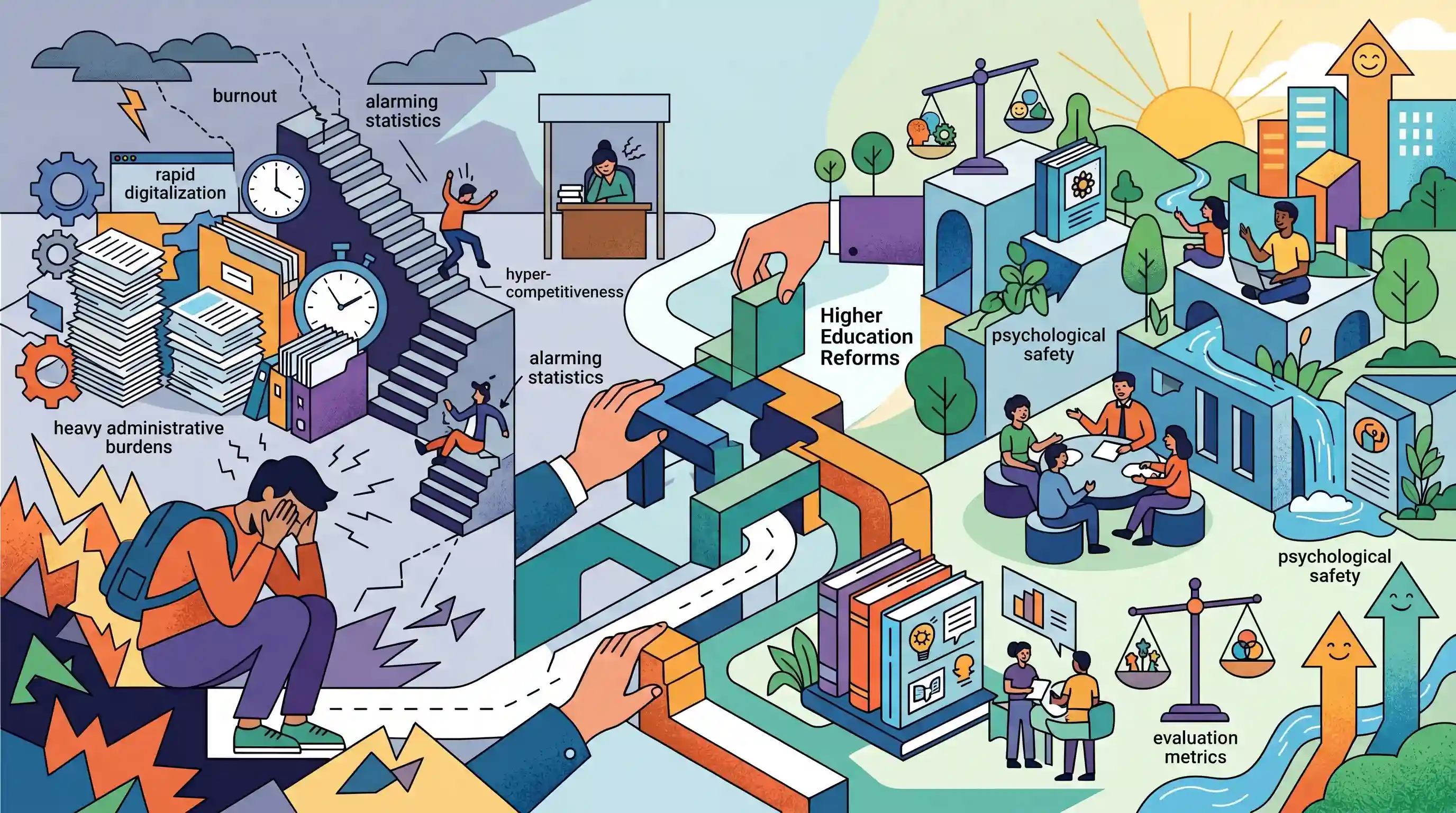
The article underscores the urgent need to prioritize mental health and well-being in Indian Higher Education Institutions (HEIs). Driven by alarming NCRB statistics on student suicides, the author argues that the current educational environment's hyper-competitiveness, heavy administrative burdens, and rapid digitalization induce severe burnout among both students and faculty. To combat this crisis, HEIs must transition from merely offering reactive counseling to fundamentally embedding psychological safety and holistic well-being into their core institutional structures, curricula, and evaluation metrics.
Key Points
- According to 2022 NCRB data, students accounted for 8% of all suicides in India, underscoring a severe mental health crisis in education.
- Well-being in Higher Education Institutions (HEIs) is currently treated as a peripheral, reactive issue (e.g., relying on counseling cells) rather than a proactive systemic priority.
- Hyper-competitiveness, rigid evaluation mechanisms, and increasing administrative loads are driving chronic burnout and a toxic 'grind culture' among both students and faculty.
- As noted in a UNESCO global education monitoring brief, rapid digitalization in education has significantly outpaced the institutional capacity to manage its psychological impact on learners.
- A paradigm shift is required to integrate psychological safety and human well-being directly into HEI curricula, faculty development, and institutional mandates.
Important Terms
National Crime Records Bureau (NCRB)

Nodal agency under the Ministry of Home Affairs responsible for collecting and analyzing crime data, including statistics on suicides and accidental deaths across India.
UPSC context
GS II (Governance) and GS I (Social Issues); essential for data-driven analysis of societal trends like the student mental health crisis.
ADSI Report
The annual statistical publication by the NCRB that tracks national trends in fatalities, providing the empirical foundation for addressing public health issues like suicides.
UPSC context
GS I (Social Issues); critical for citing official statistics on student suicide rates in Mains answers.
University Grants Commission (UGC)
A statutory body under the Ministry of Education tasked with coordinating and maintaining the standards of higher education in India through funding and regulations.
UPSC context
GS II (Education); the primary regulator for implementing mental health mandates and counselor-to-student ratios in HEIs.
National Education Policy (NEP) 2020
A comprehensive framework launched in 2020 to transform India's education system, emphasizing holistic development, multidisciplinary learning, and the integration of mental well-being into curricula.
UPSC context
GS II (Government Policies); the guiding policy for current reforms aimed at reducing academic pressure and fostering student wellness.
UNESCO
A United Nations specialized agency that promotes global peace and security through international cooperation in education, sciences, culture, and communication.
UPSC context
GS II (International Institutions); leads the "Education 2030" agenda and establishes global standards for inclusive and safe learning environments.
National Institutional Ranking Framework (NIRF)
A methodology adopted by the Ministry of Education to rank higher education institutions in India based on parameters like Teaching, Learning, and Graduation Outcomes.
UPSC context
GS II (Education/Governance); relevant for discussions on institutional accountability and the inclusion of well-being metrics in rankings.
Psychological Safety
The shared belief that an environment is safe for interpersonal risk-taking, where students and faculty can speak up without fear of repercussions.
UPSC context
GS IV (Ethics/Institutional Ethics); a core requirement for transforming high-pressure educational environments into supportive institutional cultures.
Prelims Trap
"Official statistics on student suicides are compiled and published annually by the Ministry of Education."
Aspirants often logically link student well-being to the Education or Health ministries. However, official suicide data (ADSI report) is published by NCRB under the Ministry of Home Affairs.
Static Concepts Connected
How does NEP 2020 address student well-being in Higher Education Institutions (HEIs)?
- Holistic Education: Shifts from rigid academic silos to multidisciplinary, flexible learning to reduce performance-related stress.
- Counseling Mechanisms: Mandates the creation of institutional mechanisms for academic mentoring, professional counseling, and psychological support.
- Evaluation Reform: Replaces high-stakes summative examinations with continuous, formative assessments to lower chronic anxiety and burnout.
What is the mandate of the NCRB regarding suicide statistics in India?
- Nodal Agency: Functions under the Ministry of Home Affairs as the nodal agency for crime and accident data.
- ADSI Report: Publishes the annual 'Accidental Deaths and Suicides in India' (ADSI) report, categorizing suicides by profession/status (including students).
Cross-Topic Patterns
Demographic Dividend vs. Mental Health
The potential of India's youth bulge is severely undermined if systemic mental health crises and burnout in HEIs erode human capital formation and future workforce productivity.
Digital India's hidden psychological costs
Rapid EdTech expansion (SWAYAM, PM e-VIDYA) often overlooks the UNESCO-flagged psychological isolation and screen-induced anxiety, revealing a policy gap in holistic digital education.

Expect a Mains GS2 or GS4 question linking NEP 2020 reforms to institutional ethics, psychological safety, and the student suicide crisis.
Linked PYQs · 5
Linked PYQs · 5
- 2023MainsGS1
Explain why suicide among young women is increasing in Indian society.
- 2015MainsGS2
The quality of higher education in India requires major improvements to make it internationally competitive. Do you think that the entry of foreign educational institutions would help improve the quality of higher and technical education in the country? Discuss.
- 2016MainsGS4
Explain how ethics contributes to social and human well-being.
- 2020MainsGS2
National Education Policy 2020 is in conformity with the Sustainable Development Goal-4 (2030). It intends to restructure and reorient education system in India. Critically examine the statement.
- 2020MainsGS1
How have digital initiatives in India contributed to the functioning of the education system in the country? Elaborate your answer.
