Youth Heart Disease Rise and Public Health Preventive Strategies
Source:The Hindu ↗
Why It Matters
The shifting demographic of heart diseases towards India's youth poses a severe threat to the demographic dividend and introduces a massive economic and public health burden. Understanding the rise of NCDs is crucial for aspiring civil servants as it directly relates to public healthcare policy formulation, strengthening grassroots health infrastructure, and improving national health indices.
Summary
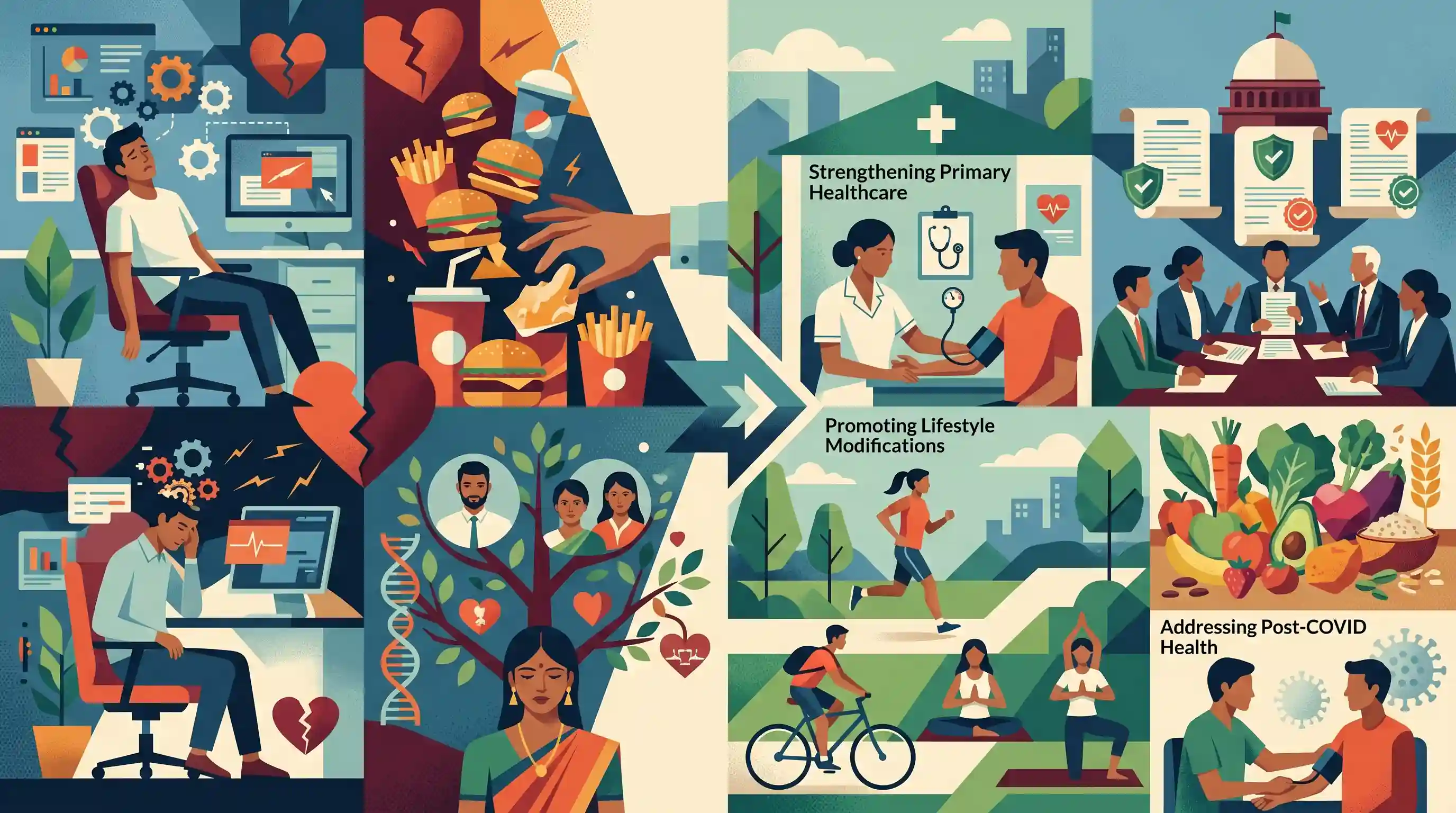
The article addresses the growing public health crisis of cardiovascular diseases (CVDs) increasingly affecting the younger population in India. Driven by a combination of sedentary lifestyles, poor dietary choices, chronic stress, and genetic predisposition among South Asians, heart disease is no longer predominantly an ailment of old age. The piece emphasizes the urgent need to pivot from curative to preventive healthcare. It highlights that tackling this epidemic requires a multi-pronged approach: strengthening grassroots primary healthcare for early screening, promoting lifestyle modifications, addressing post-COVID health impacts, and implementing robust public health policies to reduce the burden of non-communicable diseases (NCDs).
Key Points
- There is an alarming rise in cardiovascular diseases (CVDs) and sudden heart attacks among young Indians, shifting the risk demographic from older adults to youth.
- Major contributors include poor lifestyle choices: highly sedentary routines, consumption of ultra-processed foods, smoking, and chronic stress.
- South Asians possess a genetic predisposition that increases susceptibility to early-onset heart diseases, making early screening vital.
- Post-COVID-19 complications are being increasingly scrutinized for elevating thrombotic events and cardiovascular vulnerabilities in younger people.
- Mitigation requires a shift toward preventive healthcare, strengthening primary public health systems, regular screenings, and policy interventions like front-of-pack nutritional labeling.
Important Terms
National Programme for Prevention & Control of Non-Communicable Diseases (NP-NCD)

A flagship Union initiative (formerly NPCDCS) launched in 2010 to strengthen infrastructure and human resources for the early screening and management of chronic ailments like heart disease and cancer.
UPSC context
GS Paper II: Health Policy; tests knowledge of government interventions to tackle India's rising disease burden.
Fit India Movement
A nationwide campaign launched in 2019 to promote physical activity and healthy lifestyle choices, aiming to shift India's health paradigm from curative to preventive care.
UPSC context
GS Paper II: Social Justice/Health; relevant for discussions on preventive healthcare and human capital formation.
Indian Council of Medical Research (ICMR)
India's apex body for the formulation, coordination, and promotion of biomedical research, providing the scientific evidence and guidelines necessary for public health policy.
UPSC context
GS Paper III: Science & Technology; tests awareness of institutional frameworks driving medical innovation and surveillance.
World Health Organization (WHO)
The UN agency responsible for international public health, which provides the global framework and data targets (e.g., Global Action Plan 2013-2030) for managing chronic diseases.
UPSC context
GS Paper II: International Relations/Global Governance; focuses on international health standards and their domestic implementation.
Non-Communicable Diseases (NCDs)
Chronic conditions like heart disease, stroke, and diabetes that are not transmitted between people but result from genetic, physiological, environmental, and behavioral factors.
UPSC context
GS Paper II: Health; fundamental concept for understanding India's changing disease profile and healthcare challenges.
Epidemiological Transition
The shift in a population's health pattern where chronic, non-communicable diseases replace infectious diseases as the primary cause of death and disability.
UPSC context
GS Paper I/II: Geography/Social Sector; vital for analyzing demographic changes and the future of public health.
Prelims Trap
Communicable and infectious diseases continue to account for the majority of mortality in India.
India has undergone an epidemiological transition; NCDs now cause over 60% of all deaths, significantly surpassing communicable and infectious diseases.
Static Concepts Connected
What defines India's epidemiological transition in public health?
- Definition: The shift in disease burden from communicable, maternal, and nutritional diseases to primarily non-communicable diseases (NCDs).
- Current Burden: NCDs like cardiovascular diseases and diabetes now account for roughly 63-65% of all deaths in India.
- Key Drivers: Rapid urbanization, dietary shifts toward ultra-processed HFSS foods, sedentary lifestyles, and changing work habits.
What is the NPCDCS framework for non-communicable diseases?
- Core Objective: A national programme focused on health promotion, early diagnosis, and management of cancer, diabetes, CVDs, and stroke.
- Delivery via HWCs: Screening and management are operationalized at the grassroots level through Ayushman Bharat Health and Wellness Centres (HWCs).
- Target Demographics: Mandates population-based opportunistic screening for common NCDs targeting individuals aged 30 years and above.
Cross-Topic Patterns
NCDs threatening Demographic Dividend
Rising early-onset CVDs directly impact India's working-age youth, threatening to convert a demographic dividend into a prolonged healthcare and economic liability.
FSSAI Labelling + NCD Prevention
Proposed Front-of-Pack Nutritional Labelling (FOPNL) serves as a GS2 regulatory tool to combat ultra-processed foods high in fat, sugar, and salt (HFSS).
COVID-19's Long-Term Endothelial Impact
The pandemic shifted from acute respiratory focus to chronic cardiovascular vulnerabilities (hypercoagulable states), bridging GS3 biology and GS2 health policy.

Expect a multi-statement question linking the 'South Asian Phenotype' (high visceral fat) to India's >60% NCD mortality burden in 2026.
Linked PYQs · 2
Linked PYQs · 2
- 2022MainsGS3
The increase in life expectancy in the country has led to newer health challenges in the community. What are those challenges and what steps need to be taken to meet them?
- 2024MainsGS2
In a crucial domain like the public healthcare system the Indian State should play a vital role to contain the adverse impact of marketisation of the system. Suggest some measures through which the State can enhance the reach of public healthcare at the grassroots level.
