Escalation Dynamics and Security Architecture in West Asia
Source:Indian Express ↗
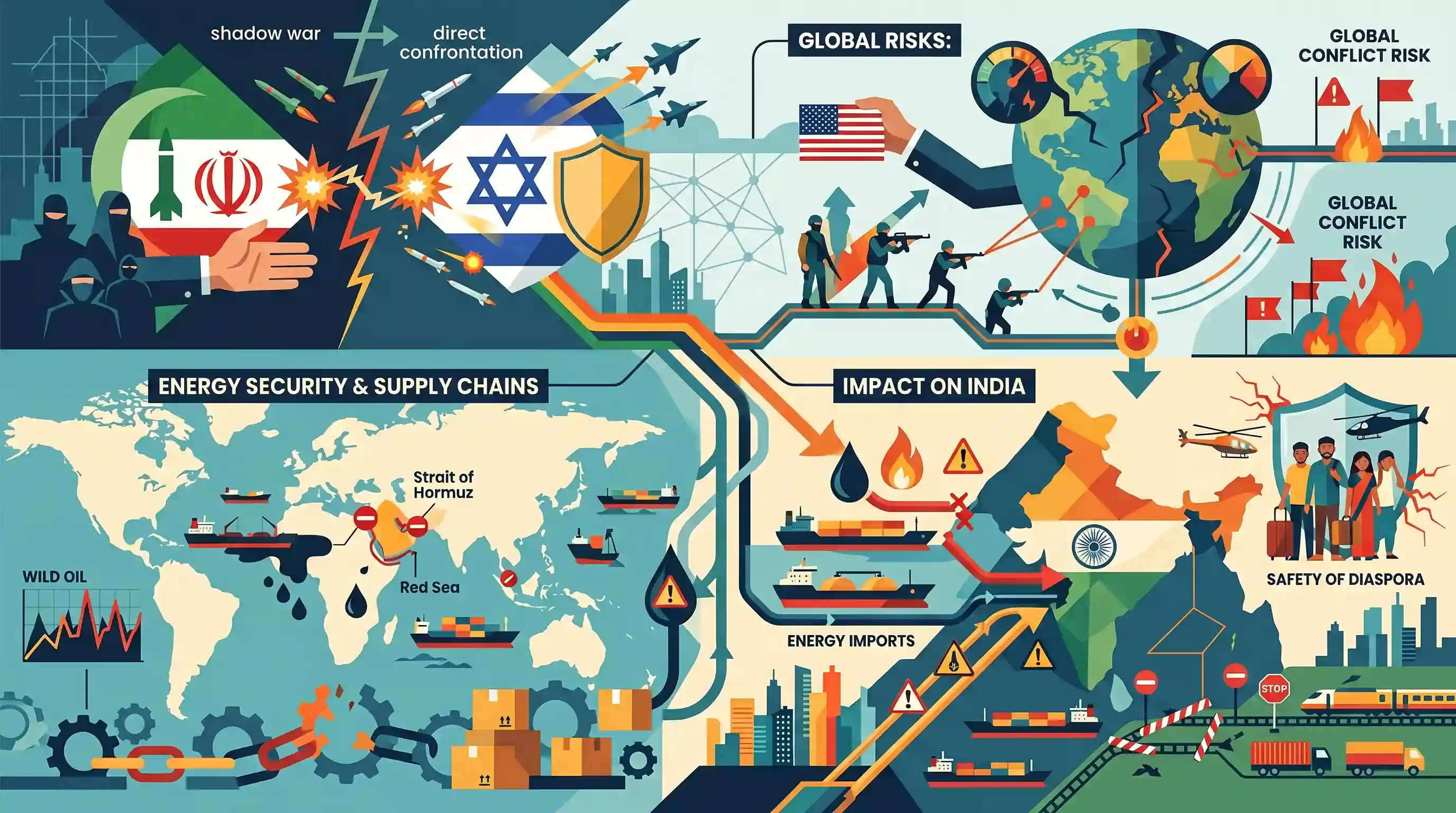
Why It Matters
The Middle East is strategically critical for India due to its heavy reliance on the region for energy needs, a large expatriate population, and vital trade routes. Direct conflict between major regional powers like Israel and Iran can destabilize global energy markets and complicate India's delicate diplomatic balancing act in the region.
Summary
The article analyzes the recent escalation in the Middle East, highlighting the shift from a decades-long "shadow war" to direct military confrontation between Israel and Iran. Following direct strikes on each other's territories, the geopolitical balance in the region is severely threatened. This escalation risks triggering a broader conflict involving the United States and various regional proxies. Furthermore, it poses significant risks to global energy security and supply chains by threatening crucial maritime chokepoints like the Strait of Hormuz and the Red Sea. For India, the crisis endangers its strategic interests, including energy imports, the safety of its diaspora, and regional connectivity projects.
Key Points
- Shift in Conflict Paradigm: The traditional "shadow war" between Israel and Iran has escalated into direct military strikes on each other's territories, crossing previous red lines and increasing the likelihood of an all-out regional war.
- Geopolitical Repercussions: The conflict risks drawing in the United States and Iranian proxy groups across the region, further destabilizing the Middle East and undermining recent diplomatic normalization efforts like the Abraham Accords.
- Threat to Global Commons: Escalation threatens vital maritime choke points such as the Strait of Hormuz and the Red Sea, which are critical for global energy supplies and trade, raising the specter of inflation and supply chain disruptions.
- Implications for India: The crisis presents a multi-faceted challenge for India, encompassing energy security risks, the safety of its large diaspora in the Gulf, and potential delays in strategic connectivity initiatives like IMEC.
Important Terms
India-Middle East-Europe Economic Corridor (IMEC)

A multimodal connectivity project linking India, the Middle East, and Europe through rail, shipping, and digital networks. It serves as a strategic alternative to China's Belt and Road Initiative (BRI).
UPSC context
GS Paper 2/3: Connectivity and International Relations. Tests India's strategic autonomy and its 'Link West' policy amidst regional instability.
Abraham Accords
US-brokered normalization agreements signed in 2020 between Israel and several Arab nations. They shifted regional focus from the Palestinian issue toward economic and security integration against shared threats like Iran.
UPSC context
GS Paper 2: International Relations. Tests knowledge of shifting West Asian alliances and the emergence of plurilateral groups like I2U2.
Islamic Revolutionary Guard Corps (IRGC)
An elite branch of the Iranian Armed Forces established in 1979 to protect the Islamic system. It operates independently of the regular military, managing regional proxy networks and Iran’s ballistic missile program.
UPSC context
GS Paper 2: Effect of politics of other countries. Relevant for understanding Iran's regional influence and the 'Axis of Resistance'.
Hezbollah
A Lebanese Shia militant group and political party backed by Iran. Recognized as a powerful non-state actor, it is a primary military adversary of Israel on its northern border.
UPSC context
GS Paper 2: Regional stability. Tests understanding of non-state actors and proxy warfare in Middle Eastern geopolitics.
Hamas
A Palestinian Sunni-Islamic militant organization that has governed the Gaza Strip since 2007. It rejects the existence of Israel and pursues armed resistance to achieve Palestinian statehood.
UPSC context
GS Paper 2: International Relations. Essential for analyzing the Israel-Palestine conflict and its cascading effects on regional security.
IDF (Israel Defense Forces)
The unified national military force of Israel, comprising ground, air, and naval branches. It is the primary actor in Israel's regional military operations and defense doctrine.
UPSC context
GS Paper 2: Regional conflicts. Relevant in the context of bilateral security cooperation with India and modern asymmetric warfare.
Prelims Trap
The Strait of Hormuz connects the Red Sea to the Arabian Sea.
Hormuz connects the Persian Gulf to the Gulf of Oman. It is the Bab-el-Mandeb strait that connects the Red Sea to the Gulf of Aden.
Static Concepts Connected
What are the critical maritime chokepoints in the Middle East?
- Strait of Hormuz: Connects the Persian Gulf to the Gulf of Oman and Arabian Sea; transits roughly 20% of the world's global oil trade.
- Bab-el-Mandeb: Connects the Red Sea to the Gulf of Aden and the Arabian Sea; forms the southern gateway to the Suez Canal.
- Suez Canal: Artificial sea-level waterway in Egypt connecting the Mediterranean Sea to the Red Sea, separating Africa and Asia.
What is the India-Middle East-Europe Economic Corridor (IMEC)?
- Two Corridors: Comprises an Eastern corridor (India to the Arabian Gulf) and a Northern corridor (Arabian Gulf to Europe).
- Transit Nodes: The multimodal transit route passes through the UAE, Saudi Arabia, Jordan, and Israel via connected rail and ship networks.
- Strategic Goal: Aims to stimulate economic development, counter China's BRI, and reduce transit times, though currently facing severe delays due to regional war.
Cross-Topic Patterns
Middle East conflict & India's CAD
Disruptions at the Strait of Hormuz spike global crude prices, directly widening India's Current Account Deficit (CAD) and exerting imported inflationary pressure on the domestic economy.
IMEC vs INSTC connectivity dynamics
While Israel-Iran tensions stall the US-backed IMEC route via Israel, India may be forced to prioritize the Iran-backed International North-South Transport Corridor (INSTC) and Chabahar port.

Expect a 2026 Prelims question mapping West Asian straits (Hormuz, Bab-el-Mandeb) mixed with IMEC or I2U2 member-country statements.
Linked PYQs · 3
Linked PYQs · 3
- 2025MainsGS2
"Energy security constitutes the dominant kingpin of India's foreign policy, and is linked with India's overarching influence in Middle Eastern countries.” How would you integrate energy security with India's foreign policy trajectories in the coming years?
- 2018MainsGS2
In what ways would the ongoing US-Iran Nuclear Pact Controversy affect the national interest of India? How should India respond to this situation?
- 2022PrelimsGS1
The term "Levant" often heard in the news roughly corresponds to which of the following regions?
