Chemotherapy Drug Shortages and Pharmaceutical Price Regulation Issues
Source:The Hindu ↗
हे का महत्त्वाचे आहे
Ensuring the availability of life-saving chemotherapy drugs is a critical component of India's public health mandate. The crisis exposes structural vulnerabilities in India's pharmaceutical supply chain, heavily dependent on Chinese APIs, and illustrates the policy tension between regulating drug prices for affordability and ensuring adequate profit margins to sustain domestic manufacturing.
सारांश
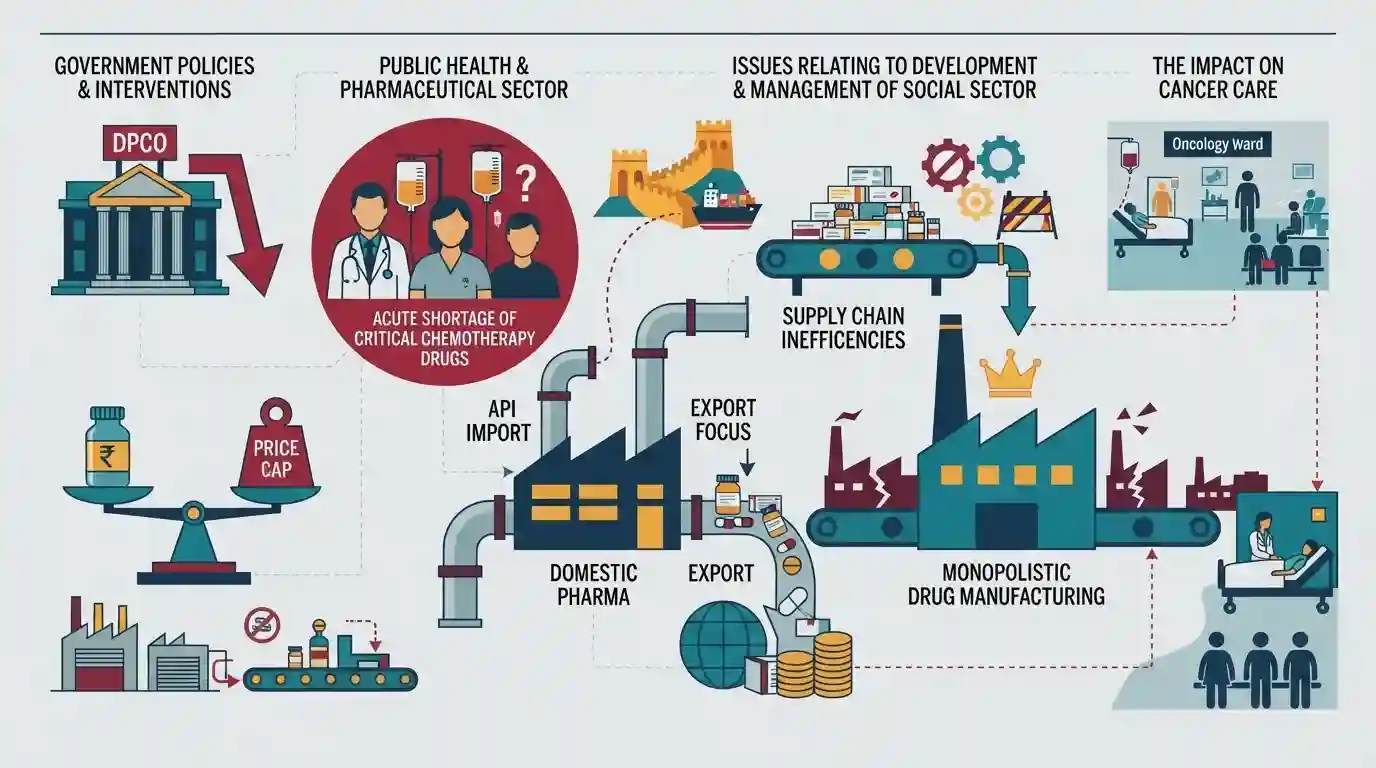
The article highlights the acute shortage of critical, off-patent chemotherapy drugs in India, significantly impacting cancer care. This deficit is driven by a complex mix of systemic issues: rigid price caps under the Drug Price Control Order (DPCO) that make manufacturing generic oncology drugs financially unviable; over-reliance on China for Active Pharmaceutical Ingredients (APIs); and a consequent shift by domestic pharmaceutical companies toward lucrative export markets. The situation is further worsened by inefficiencies in public hospital procurement systems and the monopolistic nature of specific drug manufacturing, emphasizing the need for supply chain resilience and balanced pricing policies.
मुख्य मुद्दे
- Critical shortages of off-patent, foundational chemotherapy drugs (such as cisplatin, carboplatin, and paclitaxel) are disrupting cancer treatments across Indian hospitals.
- Price controls enacted under the DPCO and NLEM, while aiming to keep life-saving medicines affordable, have eroded profit margins, disincentivizing domestic production when raw material costs rise.
- India's severe dependence on Chinese imports for 70-80% of its Active Pharmaceutical Ingredients (APIs) leaves the domestic pharmaceutical sector vulnerable to external supply chain shocks and cost fluctuations.
- Domestic pharmaceutical majors often prioritize higher-margin export markets over domestic supply, further depleting local availability.
- A fragmented public procurement system based on L1 (lowest bidder) tenders often leads to supply defaults when manufacturers are squeezed by thin margins.
- A strategic policy shift, such as robust implementation of the Production Linked Incentive (PLI) scheme for bulk drugs and flexible pricing mechanisms, is required to balance affordability with availability.
महत्त्वाच्या संज्ञा
Drug Price Control Order (DPCO)

A regulatory order issued under the Essential Commodities Act, 1955, enabling the Indian government to set ceiling prices for essential and life-saving medicines to ensure affordability.
UPSC context
GS Paper II (Government Policies/Health); tests understanding of regulatory tools for public health and medicine pricing.
National List of Essential Medicines (NLEM)
A dynamic registry compiled by the Ministry of Health and Family Welfare identifying priority healthcare medicines based on efficacy, safety, and cost-effectiveness, which automatically fall under price control.
UPSC context
GS Paper II (Health/Social Sector); tests knowledge of essential healthcare access, pharmaceutical policies, and affordability mechanisms.
National Pharmaceutical Pricing Authority (NPPA)
An independent regulatory body under the Ministry of Chemicals and Fertilizers established in 1997 to enforce and implement the Drug Price Control Order and monitor medicine availability.
UPSC context
GS Paper II (Statutory & Regulatory Bodies/Health); tests knowledge of pricing governance and regulation of essential drug markets in India.
Production Linked Incentive (PLI) Scheme for Bulk Drugs
A government initiative providing financial incentives on incremental sales of domestically manufactured critical pharmaceutical raw materials like Active Pharmaceutical Ingredients (APIs) and Key Starting Materials (KSMs).
UPSC context
GS Paper III (Economy/Industrial Sector); tests awareness of import substitution strategies and supply chain resilience in critical sectors.
Central Drugs Standard Control Organisation (CDSCO)
India's National Regulatory Authority under the Ministry of Health and Family Welfare responsible for approving new drugs, regulating clinical trials, and enforcing quality standards.
UPSC context
GS Paper II (Government Policies/Regulatory Bodies); tests understanding of regulatory framework governing pharmaceutical safety and clinical efficacy in India.
Ministry of Chemicals and Fertilizers
The federal ministry of India containing the Department of Pharmaceuticals, tasked with policy formulation, pricing regulation, and domestic manufacturing growth of chemical and pharmaceutical sectors.
UPSC context
GS Paper II (Government Policies/Ministries); tests familiarity with administrative distribution and policymaking bodies in India's healthcare supply chain.
पूर्वपरीक्षा सापळा
"DPCO is issued under the Drugs and Cosmetics Act, and NPPA functions under the Ministry of Health and Family Welfare."
DPCO is an order under the Essential Commodities Act, 1955. While NLEM is curated by the Health Ministry, NPPA operates under the Ministry of Chemicals and Fertilizers.
संबंधित स्थिर संकल्पना
How are drug prices regulated in India under NLEM and DPCO?
- Dual Governance: The Health Ministry (MoHFW) curates the National List of Essential Medicines (NLEM), while the NPPA (Ministry of Chemicals & Fertilizers) enforces price caps via the DPCO.
- Statutory Backing: The Drug Price Control Order (DPCO) draws its statutory power from the Essential Commodities Act, 1955, not healthcare-specific legislation.
- Pricing Rules: Scheduled drugs have strict ceiling prices. Non-scheduled drugs (82% of the market) have freely set initial prices, but face a 10% cap on annual hikes.
What are APIs and how is India addressing its import dependency?
- API Definition: Active Pharmaceutical Ingredients (APIs) or Key Starting Materials (KSMs) are the biologically active components in a pharmaceutical formulation that produce the intended health effects.
- Import Vulnerability: Despite being the 'pharmacy of the world' for finished generics, India imports approximately 70-80% of its bulk drugs and APIs from China.
- PLI Scheme: The PLI Scheme for Bulk Drugs provides financial incentives for setting up domestic greenfield manufacturing plants for 41 critical KSMs, drug intermediates, and APIs.
आंतर-विषय नमुने
Price Caps vs Supply Resiliency
Strict price caps on essential medicines inadvertently cause market exits when raw material (API) costs spike, illustrating the classic economic trade-off between consumer affordability and supply chain availability.
Flaws in L1 Public Procurement
The lowest-bidder (L1) mandate in public health tenders creates systemic vulnerabilities. When input costs rise and margins shrink, L1 suppliers default, causing recurring medication stockouts in public hospitals.

Expect a 2026 Prelims question contrasting the Ministries handling NLEM vs DPCO, alongside a statement on India's API import dependency.
संबंधित PYQ · 3
संबंधित PYQ · 3
- 2024MainsGS2
In a crucial domain like the public healthcare system the Indian State should play a vital role to contain the adverse impact of marketisation of the system. Suggest some measures through which the State can enhance the reach of public healthcare at the grassroots level.
- 2015MainsGS2
Public health system has limitations in providing universal health coverage. Do you think that the private sector could help in bridging the gap? What other viable alternatives would you suggest?
- 2025MainsGS3
Discuss the rationale of the Production Linked Incentive (PLI) scheme. What are its achievements? In what way can the functioning and outcomes of the scheme be improved?
