Uttarakhand pauses tree felling for highway expansion after protests
Source:india-today ↗
Why It Matters
This event is highly relevant for the UKPSC prelims as it touches upon core environmental issues in Uttarakhand (such as the Shivalik landscape and elephant corridors), the legacy of regional environmental movements like Chipko, and the broader debate on sustainable development versus infrastructure expansion in fragile ecosystems.
Summary
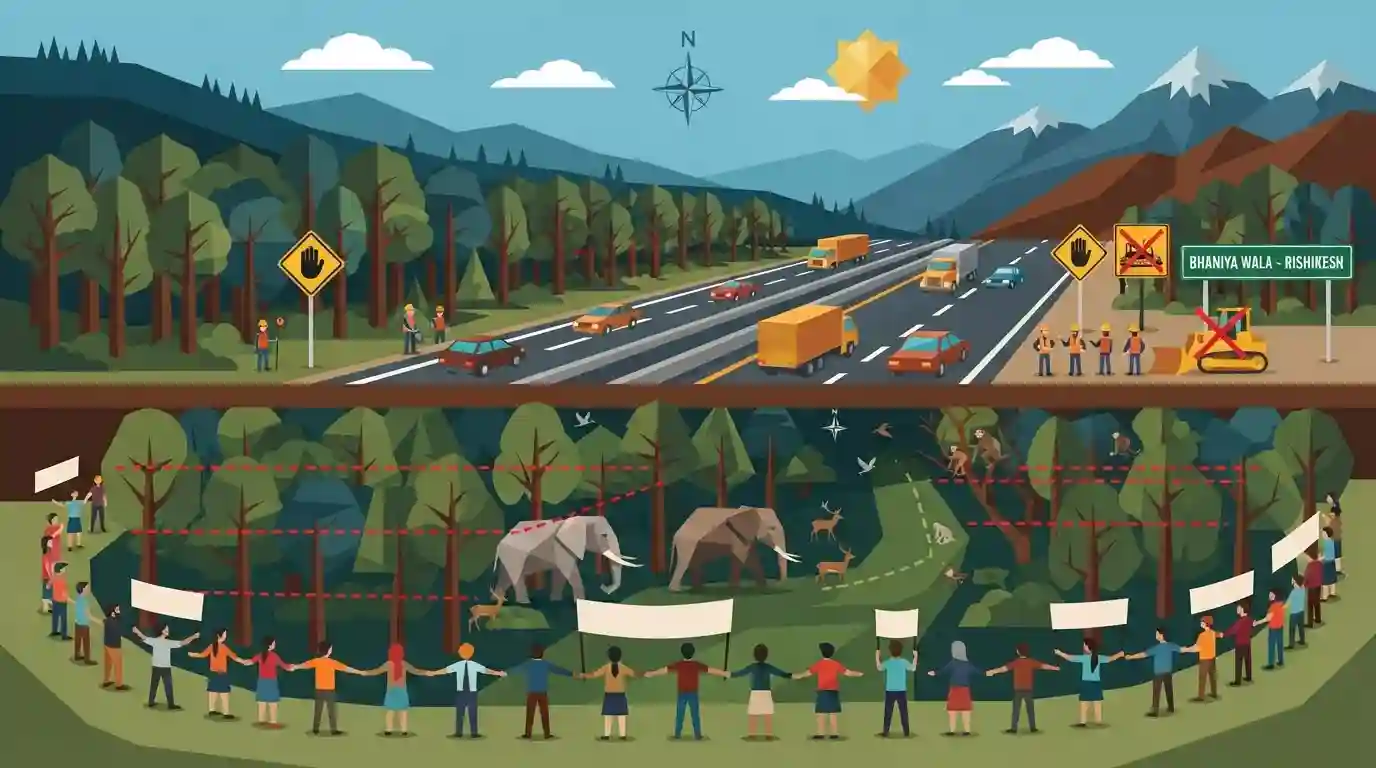
The Uttarakhand government paused the clearing of over 3,300 trees for the Bhaniyawala-Rishikesh highway expansion following intense protests by environmental activists and locals. The project passes through an ecologically sensitive zone of the Shivalik landscape, recognized for its rich biodiversity and crucial elephant corridors. The protests, reminiscent of the state's historic Chipko movement, highlight the persistent tension between infrastructure development initiatives by the NHAI and the need for ecological conservation in the highly vulnerable Himalayan region.
Key Points
- The Uttarakhand government temporarily suspended the felling of over 3,300 trees for the widening of a 19-km stretch of the Bhaniyawala-Rishikesh highway.
- The highway project passes through the Ranipokhari-Rishikesh forest division within the ecologically sensitive Shivalik landscape, a key area for biodiversity and elephant corridors.
- Environmental activists protested the tree felling, drawing parallels to the historic Chipko movement, citing concerns about groundwater depletion, local temperature rises, and wildlife habitat destruction.
- The incident underscores the recurring conflict between large-scale infrastructure development and environmental conservation in the fragile Himalayan ecosystem.
Important Terms
National Highways Authority of India (NHAI)

A statutory body under the Ministry of Road Transport and Highways, responsible for the development, maintenance, and management of India's national highway network.
UPSC context
GS Paper 3 (Infrastructure/Environment). Focuses on the mandate of NHAI and its frequent conflicts with ecological conservation.
Forest Department
The state-level administrative authority responsible for the management, protection, and conservation of forest resources, including reviewing and regulating tree-felling clearances.
UPSC context
GS Paper 2 & 3. Tests understanding of environmental governance, statutory clearances, and state-level ecological administration.
Chipko Movement
A landmark 1970s non-violent ecological movement originating in Uttarakhand, where local communities, primarily women, physically embraced trees to protect them from commercial logging.
UPSC context
GS Paper 3 (Environment). Vital for topics on grassroots environmental conservation and community-led ecological protection.
Elephant Corridors
Narrow, linear tracts of habitat connecting larger forest zones. They are essential for the natural migration of elephants and reducing human-wildlife conflict.
UPSC context
GS Paper 3 (Biodiversity). Important for understanding habitat fragmentation, wildlife conservation strategies, and land-use planning.
Shivalik Landscape
The ecologically fragile and biodiverse outermost range of the Himalayas. It serves as a vital transition zone and wildlife habitat between plains and mountains.
UPSC context
GS Paper 1 (Geography) & 3 (Environment). Highlights Himalayan ecology, biodiversity zones, and regional environmental vulnerability.
Prelims Trap
"Elephant Reserves hold formal statutory legal sanctity under the Wildlife (Protection) Act, 1972, similar to Tiger Reserves."
Unlike Tiger Reserves, Elephant Reserves are administrative designations notified by states under Project Elephant. They lack explicit statutory backing under the Wildlife (Protection) Act.
Static Concepts Connected
What are the primary tectonic faults separating the Himalayan physiographic zones?
- HFF: The Himalayan Frontal Fault separates the flat Indo-Gangetic Plain from the outermost Shivalik hills.
- MBT: The Main Boundary Thrust acts as the major structural divide between the Shivalik range and the Lesser Himalayas.
- MCT: The Main Central Thrust forms the distinct geological boundary between the Lesser Himalayas and the Great Himalayas.
How does the legal status of Elephant Reserves differ from Tiger Reserves?
- Tiger Reserves: Enjoy strict statutory protection under the Wildlife (Protection) Act, 1972, following the creation of the National Tiger Conservation Authority (NTCA).
- Elephant Reserves: Created via administrative state notifications under Project Elephant (1992). They currently lack formal statutory legal sanctity under the WPA, 1972.
Cross-Topic Patterns
Himalayan Carrying Capacity & Infra
The tension between NHAI expansion and Shivalik biodiversity links directly to the Supreme Court's push to assess the 'carrying capacity' of Himalayan states against rampant infrastructure projects.
Wildlife Corridors & Roadkill Mitigation
Highway expansions fragment vital elephant corridors. This ties into GS-3 themes of eco-bridges, animal underpasses, and linear infrastructure mitigation guidelines issued by the MoEFCC.

Expect a 2026 Prelims question mapping Himalayan tectonic faults (HFF, MBT, MCT) against specific protected areas or vegetation types.
Linked PYQs · 3
Linked PYQs · 3
- 2011UKPSC_PRELIMSGS1
From which district of Uttarakhand State 'Chipko Movement' organised?
- 2025UKPSC_PRELIMSGS1
Which of the following is the correct order of the following physiographic regions of Uttarakhand from south to north direction?
- 2025UKPSC_PRELIMSGS1
Consider the following statements and select the correct answer from the options given below : Statement 1 : Uttarakhand is highly vulnerable to climate change. Statement 2 : Climate change is causing water stress and depleting biodiversity in Uttarakhand.
