Strait of Hormuz Chokepoint Vulnerability and Energy Security
Source:Indian Express ↗
Why It Matters
The crisis highlights the vulnerability of global energy supply chains at strategic chokepoints like the Strait of Hormuz. It also underscores the complex dynamics of multilateralism, demonstrating the continued (though contested) reliance on the UN Security Council for conflict resolution amid great power competition and shifting US foreign policy.
Summary
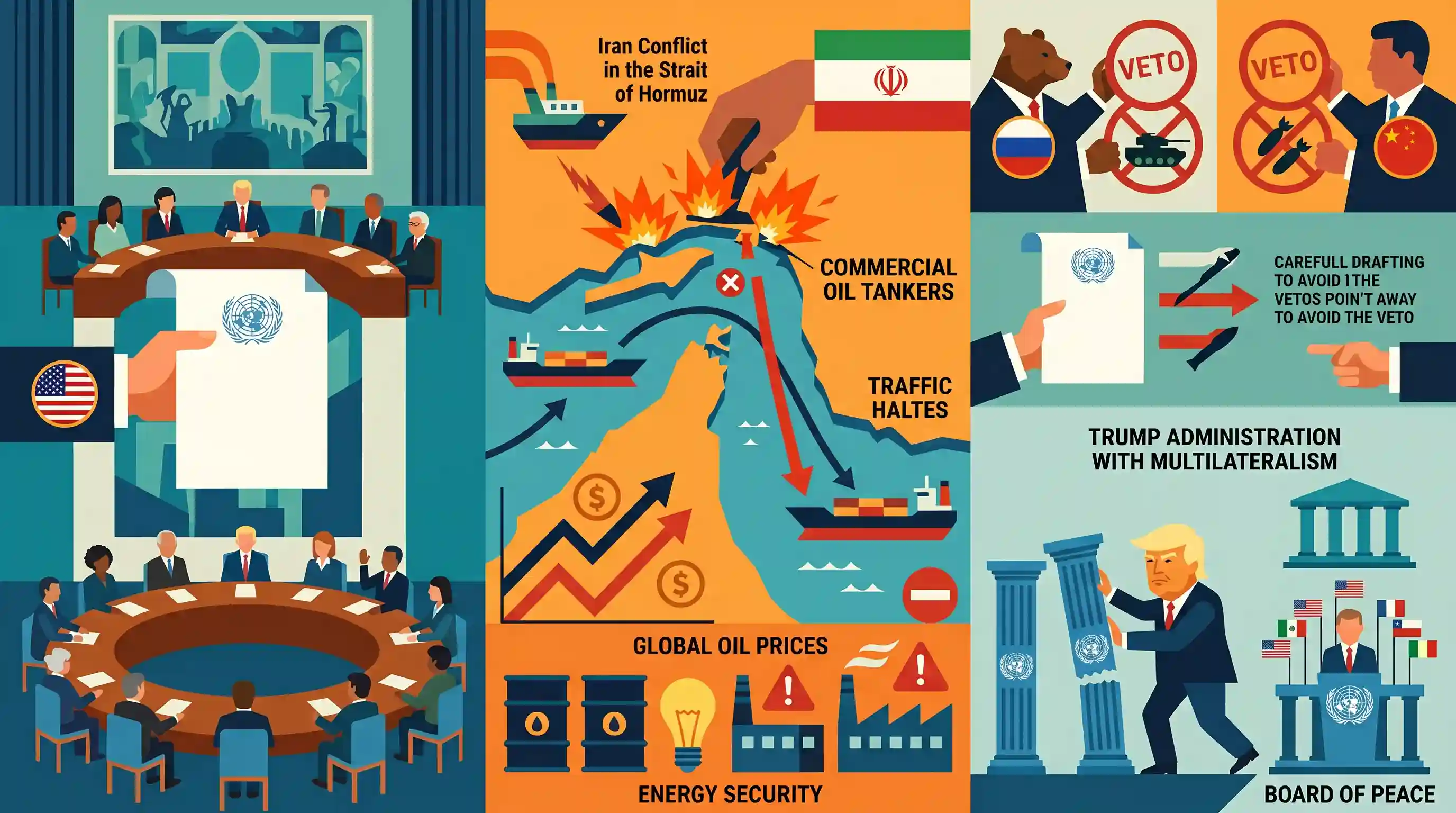
The US has appealed to the United Nations Security Council to pass a resolution demanding Iran cease attacks on commercial shipping in the Strait of Hormuz. The closure of this crucial chokepoint, through which a fifth of global oil supplies pass, has caused a surge in global oil prices. The move serves as a test for the UN\'s relevance, particularly as the Trump administration has previously undermined the multilateral body and even suggested a US-led \'Board of Peace\' could replace it. The resolution, drafted under Chapter VII of the UN Charter, avoids explicit military authorization to prevent potential vetoes from Russia and China.
Key Points
- The Strait of Hormuz, a critical chokepoint handling about 20% of global oil and gas supplies, is closed due to Iranian attacks on commercial ships, causing a surge in global oil prices.
- The US, alongside Gulf allies, has drafted a UN Security Council resolution demanding Iran cease attacks, remove mines, and enable a humanitarian corridor.
- The resolution is drafted under Chapter VII of the UN Charter, but avoids explicit language authorising military force to bypass potential vetoes from Russia and China.
- This diplomatic push contrasts sharply with the Trump administration\'s recent hostility toward the UN, including previous suggestions that a US-brokered \'Board of Peace\' might replace the global body.
Important Terms
United Nations Security Council (UNSC)

The primary UN organ responsible for maintaining global peace, consisting of five permanent members (P5) with veto power and ten rotating non-permanent members.
UPSC context
GS Paper 2 (International Institutions). Tests knowledge of global governance, veto dynamics, and India's quest for permanent membership.
Chapter VII of the UN Charter
A section of the UN Charter granting the Security Council authority to determine threats to peace and mandate enforcement actions, including sanctions or military intervention.
UPSC context
GS Paper 2 (International Relations). Crucial for understanding the legal basis for international sanctions and collective security operations.
Strait of Hormuz
The world's most critical oil chokepoint, located between Iran and Oman, through which approximately one-fifth of global crude oil and LNG supplies transit.
UPSC context
GS Paper 1 (Geography) and Paper 3 (Energy Security). Tests understanding of maritime chokepoints and their impact on global inflation.
Multilateralism
The practice of multiple nations coordinating through shared rules and institutions (like the UN) to address global challenges and maintain international order.
UPSC context
GS Paper 2 (International Relations). Relevant for debates on the 'crisis of multilateralism' and the rise of unilateral/transactional diplomacy.
Board of Peace
A transactional diplomatic body proposed by the Trump administration as a results-oriented alternative to the UN, funded by member contributions and focused on conflict resolution.
UPSC context
GS Paper 2 (Effect of policies of developed countries). Tests analysis of shifting global governance models and challenges to traditional international law.
Energy Security
The uninterrupted availability of energy sources at an affordable price, often threatened by geopolitical disruptions in maritime chokepoints.
UPSC context
GS Paper 3 (Energy/Economy). Critical for understanding India's strategic petroleum reserves and dependency on the Middle East.
Prelims Trap
"Resolutions passed under Chapter VII of the UN Charter automatically authorize the use of military force."
Chapter VII encompasses both non-military measures (Article 41, like sanctions) and military action (Article 42). A Chapter VII resolution does not automatically mean military authorization.
Static Concepts Connected
Which major water bodies does the Strait of Hormuz connect?
- Connected waters: It links the Persian Gulf in the west to the Gulf of Oman and the Arabian Sea in the southeast.
- Bordering nations: It is bordered by Iran to the north and Oman (Musandam Peninsula) and the UAE to the south.
- Strategic importance: It is a global energy chokepoint through which approximately 20% of the world's traded oil passes, making it critical for global supply chains.
What enforcement powers does Chapter VII of the UN Charter grant the UNSC?
- Legally binding: It allows the UNSC to determine threats to peace and issue resolutions that are legally binding on all member states.
- Non-military measures: Under Article 41, the UNSC can impose economic sanctions, arms embargoes, and sever diplomatic relations without using armed force.
- Military action: Under Article 42, it can authorize blockades or the use of armed force by member states if non-military means are inadequate.
Cross-Topic Patterns
Chokepoint closures and India's SPR
Disruptions in Hormuz underscore the critical need for India's Strategic Petroleum Reserves (ISPRL) program and diversified energy imports to buffer against sudden crude supply shocks and price volatility.
Maritime chokepoints and alternative corridors
Security of Middle Eastern chokepoints connects directly to the viability of alternative trade initiatives like the India-Middle East-Europe Economic Corridor (IMEC) and minilaterals like I2U2.

Map-matching questions linking West Asian chokepoints (Hormuz, Bab el-Mandeb) to bordering nations are highly probable for Prelims 2026.
Linked PYQs · 3
Linked PYQs · 3
- 2024PrelimsGS1
Consider the following statements : Statement-I : Sumed pipeline is a strategic route for Persian Gulf oil and natural gas shipments to Europe. Statement-II : Sumed pipeline connects the Red Sea with the Mediterranean Sea. Which one of the following is correct in respect of the above statements?
- 2018MainsGS2
In what ways would the ongoing US-Iran Nuclear Pact Controversy affect the national interest of India? How should India respond to this situation?
- 2012MainsGS2
How have the US sanctions against Iran affected India's bilateral relations with Iran?
