US Military Withdrawal from Iraq and West Asian Security Dynamics
Source:Indian Express ↗
हे का महत्त्वाचे आहे
Understanding US troop withdrawals from Iraq is vital for assessing shifting security dynamics in West Asia, which directly impacts global energy security, regional stability, and India's diaspora and strategic interests in the region.
सारांश
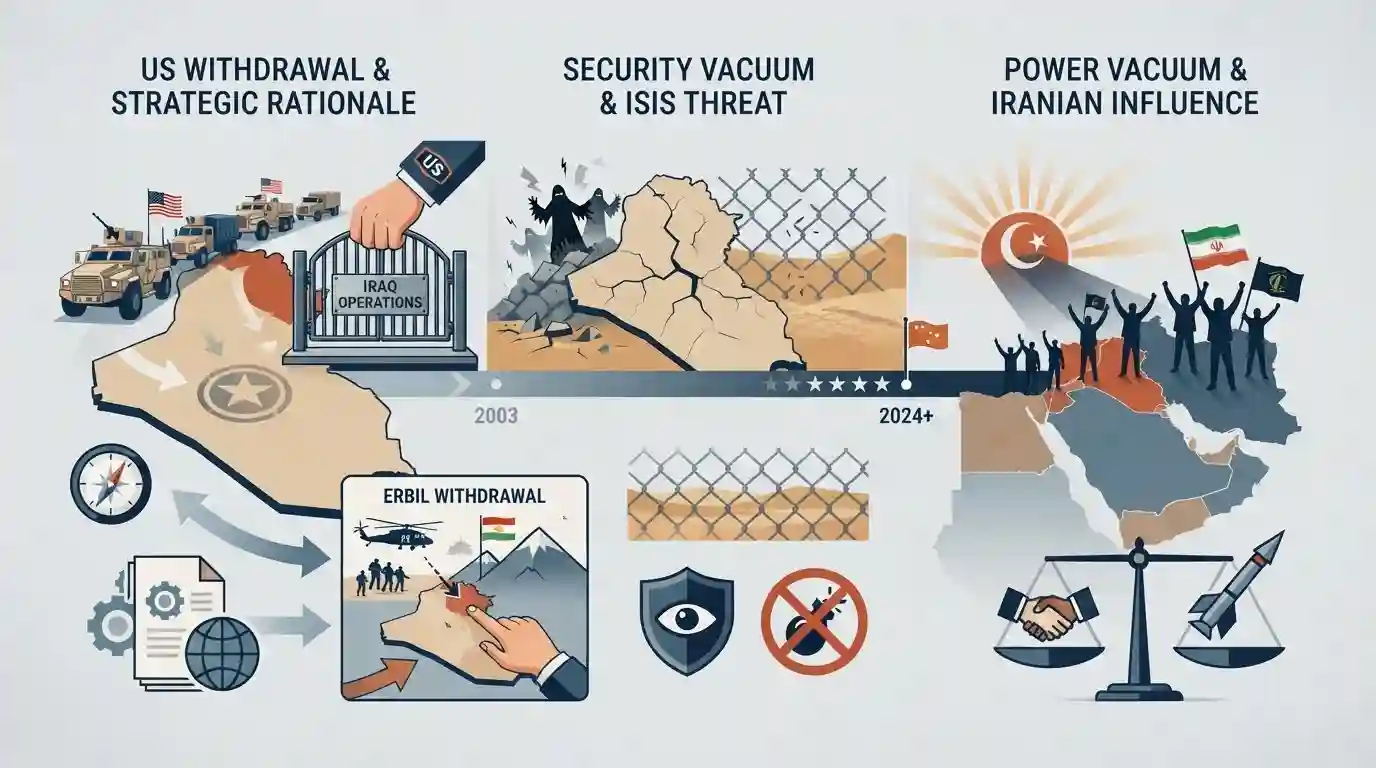
This article analyzes the strategic rationale and geopolitical consequences behind the United States' decision to wind down its military footprint in Iraq after over two decades, touching upon the withdrawal from Erbil, the threat of ISIS resurgence, and the shifting power balance involving Iran-backed militias in West Asia.
मुख्य मुद्दे
- The United States is restructuring or concluding its long-standing military presence in Iraq after more than two decades following the 2003 invasion.
- Troops have begun leaving strategic regional hubs like Erbil, reflecting a shift in US strategic focus away from protracted Middle Eastern counterinsurgency missions.
- The withdrawal raises significant security and geopolitical concerns regarding the resurgence of ISIS and the rising influence of Iran-backed militias in the power vacuum.
- Implications for regional stability, energy security, and international diplomacy in West Asia.
महत्त्वाच्या संज्ञा
Iran-backed militias

Non-state armed groups operating within Iraq that receive financial, logistical, and military backing from Iran, often integrated into state-sanctioned bodies like the Popular Mobilization Forces.
UPSC context
GS Paper II (International Relations - West Asia Geopolitics): Tests understanding of proxy warfare, regional power shifts, and non-state actors affecting security.
ISIS
A violent, transnational Salafi-jihadist extremist group that utilizes terrorism and insurgency to establish an Islamic caliphate, posing persistent security threats in West Asia.
UPSC context
GS Paper III (Internal Security / International Terrorism): Evaluates the evolving threat of global terror networks and security vacuums after foreign troop withdrawals.
US military
The armed forces of the United States, whose prolonged footprint and subsequent winding down in Iraq shape geopolitical alignments and security dynamics in West Asia.
UPSC context
GS Paper II (International Relations): Important for analyzing major power interventions, foreign policy shifts, and strategic stability in the Middle East.
संबंधित स्थिर संकल्पना
What is the strategic significance of the Kurdistan Region (Erbil) and the status of US forces in Iraq?
- Strategic Hub: Erbil is the capital of the autonomous Kurdistan Region in northern Iraq, serving as a vital diplomatic and logistical hub for Western operations.
- Coalition Mandate: Operation Inherent Resolve (OIR) was launched by the US-led coalition in 2014 to advise, assist, and enable partner forces against ISIS.
- Bilateral Framework: Bilateral Agreements like the 2008 US-Iraq Strategic Framework Agreement govern the legal basis and eventual transition of security cooperation away from permanent combat bases.
आंतर-विषय नमुने
West Asia Force Posture vs. Indo-Pacific Pivot
US reduction of combat boots in West Asia directly mirrors force postures in the Indo-Pacific, balancing counter-terrorism commitments with peer-competitor deterrence.

US West Asia drawdown + Iran-backed power vacuums will likely be tested via statements on regional stability and energy security.
संबंधित PYQ · 2
संबंधित PYQ · 2
- 2025MainsGS2
"Energy security constitutes the dominant kingpin of India's foreign policy, and is linked with India's overarching influence in Middle Eastern countries.” How would you integrate energy security with India's foreign policy trajectories in the coming years?
- 2017MainsGS2
The question of India's Energy Security constitutes the most important part of India's economic progress. Analyze India's energy policy cooperation with West Asian countries.
