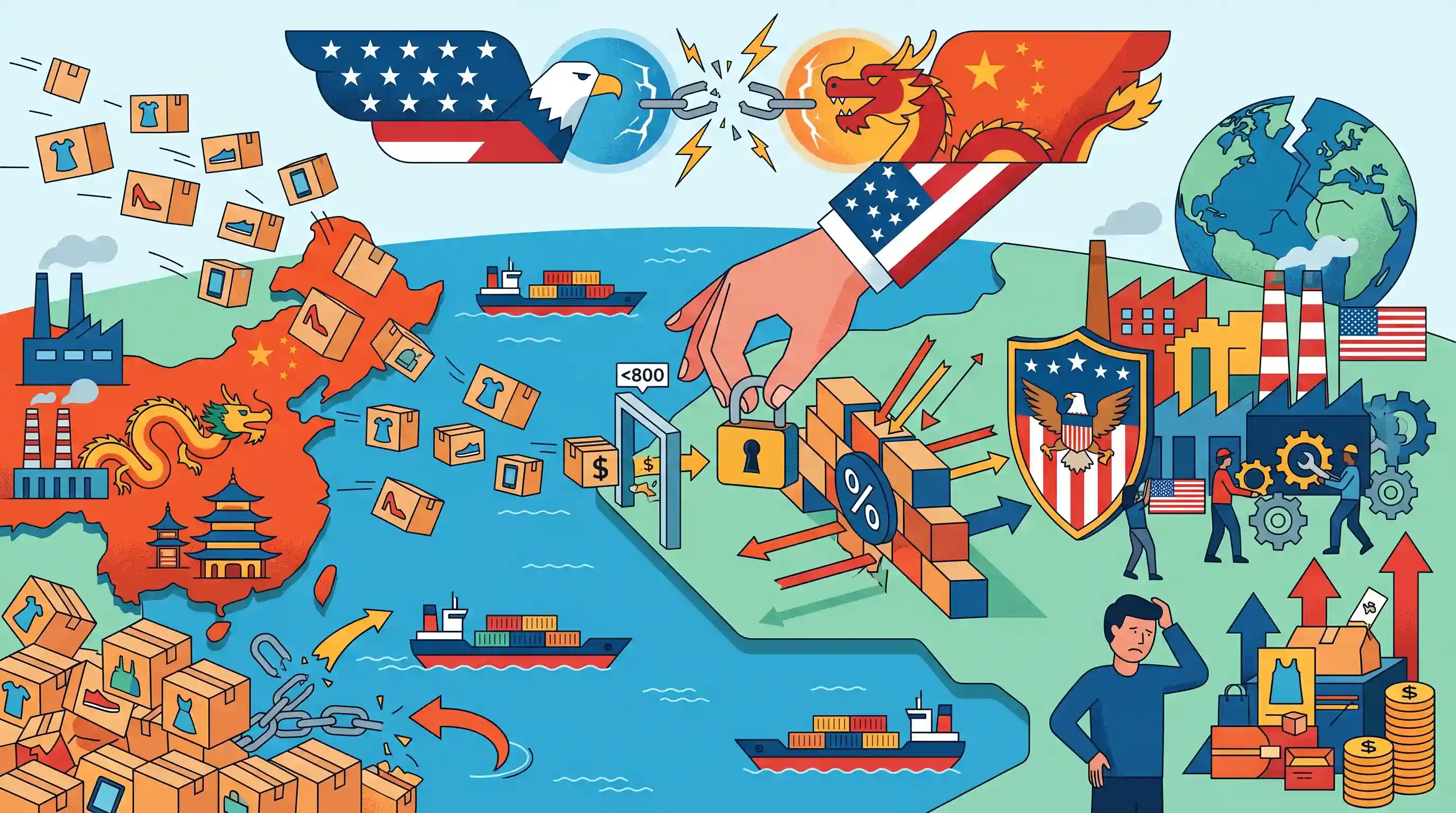
US trade policy changes and elimination of de minimis exemptions
Source:The Hindu ↗
Why It Matters
Illustrates the practical ways countries enforce trade barriers and how geopolitical strategies (like 'de-risking' from China) impact global e-commerce supply chains. It is directly relevant to GS3 Economy (effects of changes in industrial policy, international trade) and GS2 IR (policies of developed nations and their impact on global trade).
Summary
The United States is moving to eliminate the 'de minimis' trade exemption, a loophole that allowed low-value shipments (under $800) to enter the country without facing tariffs or rigorous customs checks. The rule was heavily exploited by Chinese fast-fashion and e-commerce giants like Shein and Temu to ship cheap goods directly to American consumers, effectively bypassing Section 301 tariffs designed to protect US domestic manufacturing. This move underscores the broader US strategy of 'de-risking' from China and reflects a growing global trend towards protectionism. The policy change will significantly disrupt international e-commerce supply chains, raise consumer prices, and represents an escalation in the ongoing US-China trade war.
Key Points
- The US plans to restrict or eliminate the 'de minimis' exemption, which previously allowed shipments valued under $800 to enter the country duty-free.
- The loophole was heavily utilized by Chinese e-commerce and fast-fashion giants (like Shein and Temu) to flood the US market with cheap goods while avoiding tariffs.
- By using this exemption, these companies bypassed Section 301 tariffs that were implemented by the US to protect domestic manufacturing from Chinese competition.
- The closure of this loophole reflects a broader trend of US protectionism, 'de-risking' from Chinese supply chains, and stricter enforcement of customs barriers.
- This policy shift is likely to disrupt global e-commerce supply chains, raise prices for consumers, and escalate the ongoing US-China trade war.
Important Terms
De minimis exemption

A legal threshold allowing low-value shipments (under $800 in the US) to enter a country duty-free and with minimal customs scrutiny.
UPSC context
GS Paper 3: International Trade. Tests understanding of trade facilitation vs. revenue loss and impact on e-commerce/MSMEs.
Section 301 tariffs
A provision of the US Trade Act of 1974 authorizing the President to impose tariffs or restrictions on countries engaging in unfair or discriminatory trade practices.
UPSC context
GS Paper 2: IR. Relevant to the US-China trade war and unilateral trade enforcement mechanisms.
De-risking
A strategic policy aimed at reducing economic reliance on a specific nation in critical sectors to mitigate supply chain and national security risks without total decoupling.
UPSC context
GS Paper 2: IR. Tests conceptual clarity on modern geopolitical strategies and global economic interdependence.
Protectionism
Economic policies, such as tariffs and quotas, designed to restrict imports to protect domestic industries and workers from foreign competition.
UPSC context
GS Paper 3: Economy. Essential for discussing de-globalization trends and their impact on Indian exports.
World Trade Organization (WTO)
A multilateral organization that regulates and facilitates international trade, providing a framework for negotiating trade agreements and resolving disputes between member nations.
UPSC context
GS Paper 2: International Institutions. Focuses on dispute settlement and the conflict between domestic laws and global trade norms.
Customs and Border Protection (CBP)
The primary federal law enforcement agency of the US Department of Homeland Security, responsible for regulating international trade and collecting import duties.
UPSC context
Prelims/GS Paper 3. Relevant for understanding the mechanics of trade administration and border security.
Prelims Trap
"The 'de minimis' trade exemption is a standardized threshold mandated by the WTO for all member nations."
'De minimis' thresholds vary widely by country (set by domestic customs laws) and are not a universal limit mandated by the WTO.
Static Concepts Connected
What is the difference between 'De-risking' and 'De-coupling'?
- De-coupling: Complete severance of economic, technological, and trade ties between nations, creating isolated economic systems.
- De-risking: Targeted reduction of reliance on a single country for critical supply chains, while maintaining broader non-sensitive trade.
How do US Section 301 tariffs conflict with WTO principles?
- Unilateral action: Section 301 is a US domestic law allowing retaliatory tariffs, completely bypassing the WTO's multilateral Dispute Settlement Body.
- MFN violation: Imposing punitive tariffs on a single specific country (like China) violates the WTO's foundational Most-Favored-Nation (MFN) principle.
Cross-Topic Patterns
India's Customs and E-commerce FDI
India previously tightened customs rules on low-value cross-border 'gifts' and banned several Chinese e-commerce apps to protect domestic MSMEs, mirroring this recent US shift against tariff-evading platforms.
De-risking & Global Minilaterals
The US de-risking strategy validates minilateral frameworks like the India-Japan-Australia Supply Chain Resilience Initiative (SCRI), indicating a systemic global shift away from China-centric manufacturing.

Expect a Prelims question contrasting 'de-risking' and 'de-coupling', or Mains analysis on how US-China tariff evasion impacts global trade.
Linked PYQs · 4
Linked PYQs · 4
- 2025MainsGS3
What are the challenges before the Indian economy when the world is moving away from free trade and multilateralism to protectionism and bilateralism? How can these challenges be met?
- 2018MainsGS3
How would the recent phenomena of protectionism and currency manipulations in world trade affect macroeconomic stability of India?
- 2018MainsGS2
What are the key areas of reform if the WTO has to survive in the present context of "Trade War', especially keeping in mind the interest of India?
- 2020PrelimsGS1
With reference to Trade-Related Investment Measures (TRIMS), which of the following statements is/are correct? 1. Quantitative restrictions on imports by foreign investors are prohibited. 2. They apply to investment measures related to trade in both goods and services. 3. They are not concerned with the regulation of foreign investment. Select the correct answer using the code given below:
