Uttar Pradesh madrasas barred from offering higher education degrees
Source:Indian Express ↗
Why It Matters
Crucial for understanding the intersection of religious minority educational institutions, state board regulations, and central higher education standards set by the UGC under Indian law.
Summary
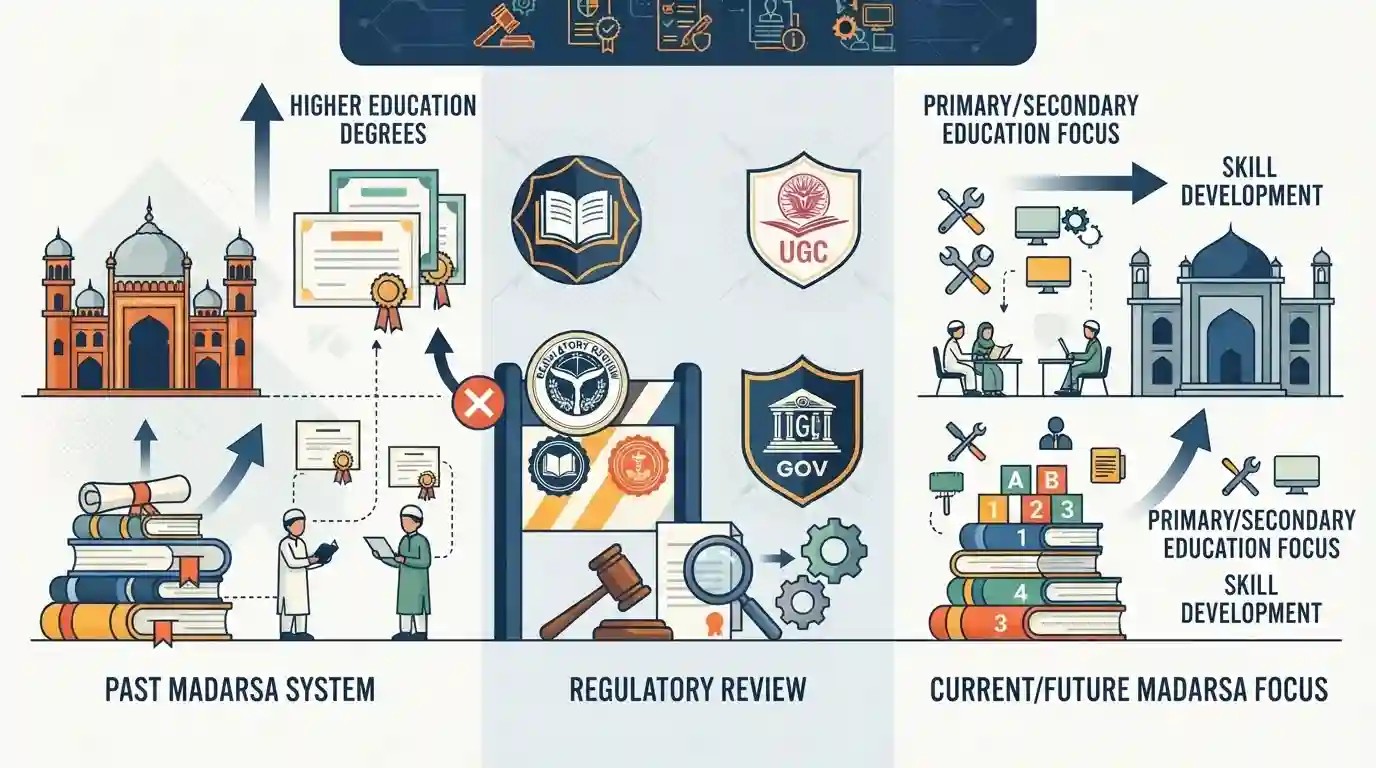
An examination of the regulatory changes affecting Uttar Pradesh's madarsas, which can no longer confer higher education degrees due to conflicts with the University Grants Commission (UGC) norms and statutory university regulations.
Key Points
- Uttar Pradesh madrasas can no longer offer higher education degrees (such as Kamil and Fazil) following legal and regulatory alignment with University Grants Commission (UGC) norms.
- The UGC Act, 1956 empowers only universities established under central/state legislation or deemed universities to grant degrees, rendering autonomous madarsa-level higher degrees without statutory university status invalid.
- This regulatory shift impacts the traditional higher education structure within state-funded or board-recognized madarsas, shifting focus towards standardizing school education (up to secondary/senior secondary levels).
Important Terms
University Grants Commission (UGC)

Statutory body established by an Act of Parliament in 1956 for the coordination, determination, and maintenance of standards of university education in India.
UPSC context
Important for GS Paper II (Governance, Polity, and Educational Standards/Regulatory Bodies).
Uttar Pradesh Board of Madarsa Education
A statutory body set up under a Uttar Pradesh state enactment to regulate traditional Arabic and Persian institutions and school-level madarsa education in the state.
UPSC context
Crucial for UPPSC (GS Paper V/VI) regarding Uttar Pradesh specific governance, minority institutions, and state educational administration.
Supreme Court of India
The apex judicial authority of India empowered under Article 142 and 136, which determines constitutional validity and statutory conflicts concerning state educational boards and central acts.
UPSC context
Important for GS Paper II (Indian Constitution, Judiciary, and Federal Jurisprudence).
Prelims Trap
The Supreme Court declared all madrasa education and the Madarsa Board unconstitutional under the UGC Act, 1956.
Aspirants might assume the Supreme Court struck down all madrasa education in UP, whereas only higher education degrees (Kamil and Fazil) were invalidated for violating UGC norms, while school education remains protected.
Static Concepts Connected
What are the constitutional provisions regarding legislative powers on education under the Seventh Schedule?
- Concurrent List Entry 25: Education, including technical and medical education, was moved to the Concurrent List (Entry 25) by the 42nd Constitutional Amendment Act, 1976.
- Union List Entry 66: The Union List retains exclusive power over coordination and determination of standards in institutions for higher education or research (Entry 66).
- Supremacy of Standards: State legislation under Entry 25 cannot be repugnant to central standards set under Entry 66 by statutory bodies like the UGC.
Cross-Topic Patterns
Madrasa Education vs. Seventh Schedule Concurrent List
The Supreme Court's ruling underscored how state-level education boards must harmonize with Union List entries on higher education standards.
UGC Act Monopolies and Autonomous Higher Degrees
The invalidation of autonomous madarsa degrees highlights the strict statutory monopoly held by the UGC over formal higher education credentials.

UPPSC often tests constitutional divisions of power; expect questions linking Entry 66 Union List with State Board powers over higher education.
Linked PYQs · 3
Linked PYQs · 3
- 2025UPPSC_PRELIMSGS1
With reference to 'Uttar Pradesh', which of the following statements is/are correct ? 1. Uttar Pradesh is the leading producer of potato in the country. 2. Government of India has approved for establishment of South Asia Regional Centre of International Potato Centre at Aligarh. Select the correct answer from the code given below :
- 2021UPPSC_PRELIMSGS1
The functions of the State Public Service Commission of Uttar Pradesh can be extended by
- 2016UPPSC_PRELIMSGS1
The State Finance Commission is a
