United Nations Security Council Reforms and Geopolitical Divides
Source:Indian Express ↗
Why It Matters
Understanding the functional and structural limitations of the UNSC is vital for GS2 International Relations, particularly regarding multilateralism, India's pursuit of permanent membership, and global governance reform.
Summary
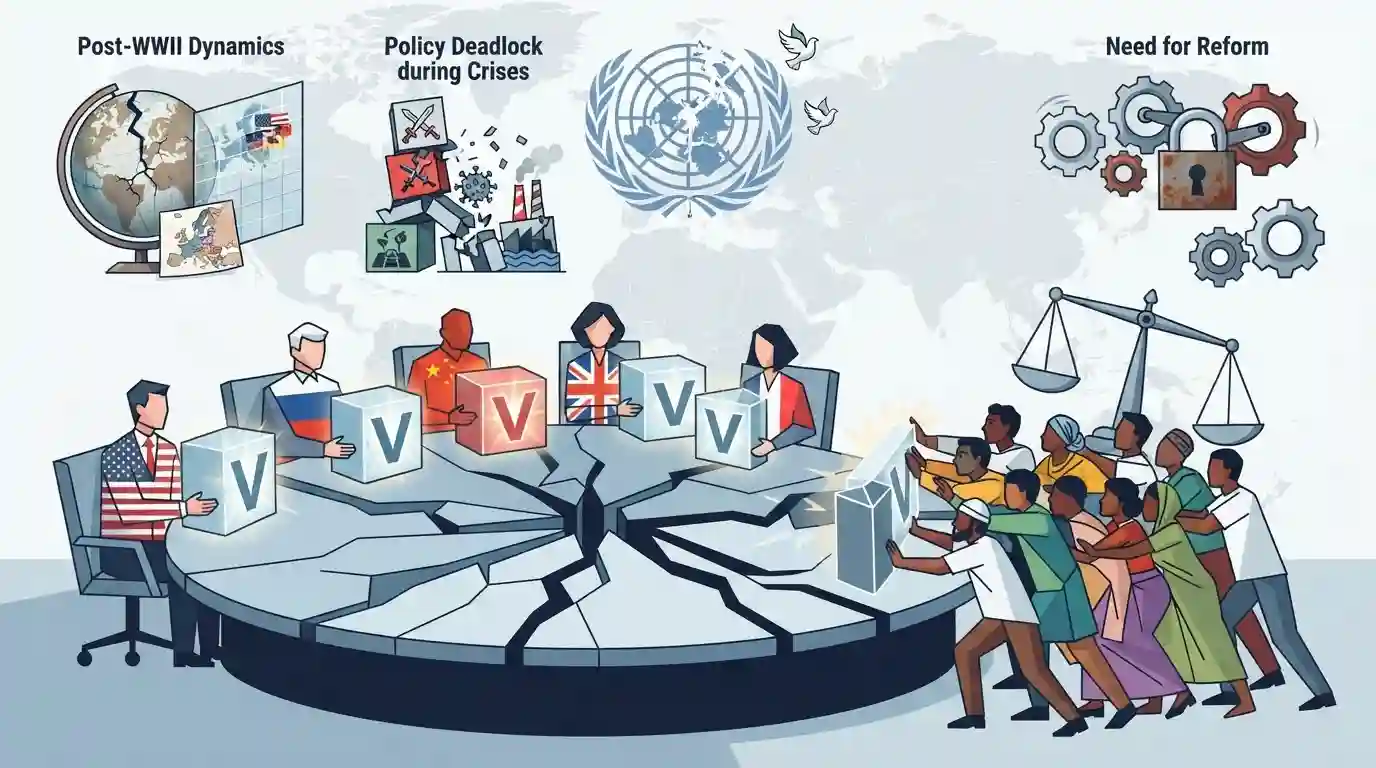
The article explores why the United Nations Security Council (UNSC) often mirrors geopolitical divides instead of fostering global consensus. It delves into structural issues like the veto power of the P5, post-WWII power dynamics, policy deadlocks during major global crises, and the pressing necessity for UN reforms to accommodate contemporary multi-polarity and the voice of the Global South.
Key Points
- The United Nations Security Council (UNSC) frequently reflects geopolitical divides and rivalries among its permanent members (P5) rather than building a unified global consensus.
- The veto power held by the P5 members (US, UK, France, Russia, China) often leads to policy paralysis and deadlocks during major international crises.
- Structural flaws in the post-WWII architecture of the UNSC make it unrepresentative of contemporary geopolitical realities and the Global South.
- There is an urgent need for comprehensive UNSC reforms, including expansion of both permanent and non-permanent categories, to enhance credibility and legitimacy.
Important Terms
United Nations Security Council

The primary executive organ of the UN responsible for maintaining international peace and security, consisting of five permanent members with veto power and ten non-permanent members elected for two-year terms.
UPSC context
GS Paper II (International Relations - Important International Institutions, their structure and mandate). Tests knowledge of global governance reform and power dynamics.
UN Charter
The foundational multilateral treaty that established the United Nations, outlining its core principles, institutional framework, and the rights and obligations of member states.
UPSC context
GS Paper II (IR / Polity). Evaluates understanding of international law, treaty frameworks, and the constitutional basis of global multilateralism.
Static Concepts Connected
What are the key voting rules and structural mechanics of the UN Security Council under the UN Charter?
- Membership Structure: Total composition of 15 members, comprising 5 permanent (P5) and 10 non-permanent members elected for two-year terms by the UN General Assembly.
- Veto Power: Substantive decisions require 9 affirmative votes including the concurring votes of all P5 members; any negative vote by a P5 member constitutes a veto under Article 27.
- Procedural Votes: Procedural matters require any 9 votes, and permanent members cannot exercise a veto on procedural votes or peaceful dispute settlements under Chapter VI.
Cross-Topic Patterns
UN Reforms + Voice of the Global South
India's pursuit of a permanent UNSC seat runs parallel to its leadership in the Global South through initiatives like the Voice of Global South Summits.
P5 Veto + India's Strategic Autonomy
The exercise of the P5 veto power frequently complicates India's strategic autonomy, forcing delicate diplomatic balancing acts across major Western-Russian-Chinese fault lines.

UNSC reform mechanics, P5 veto rules, and the G4 vs Coffee Club fault lines are perennial favorites for UPSC prelims matching questions.
Linked PYQs · 2
Linked PYQs · 2
- 2025MainsGS2
"The reform process in the United Nations remains unresolved, because of the delicate imbalance of East and West and entanglement of the USA vs. Russo-Chinese alliance.” Examine and critically evaluate the East-West policy confrontations in this regard.
- 2009PrelimsGS1
The Security Council of UN consists of 5 permanent members, and the remaining 10 members are elected by the General Assembly for a term of
