Front-of-Pack Warning Labels on Unhealthy Packaged Foods
Source:The Hindu ↗
Why It Matters
It addresses critical issues in public health policy, regulatory enforcement by agencies like FSSAI, and the judicial role in protecting consumer rights against non-communicable diseases.
Summary
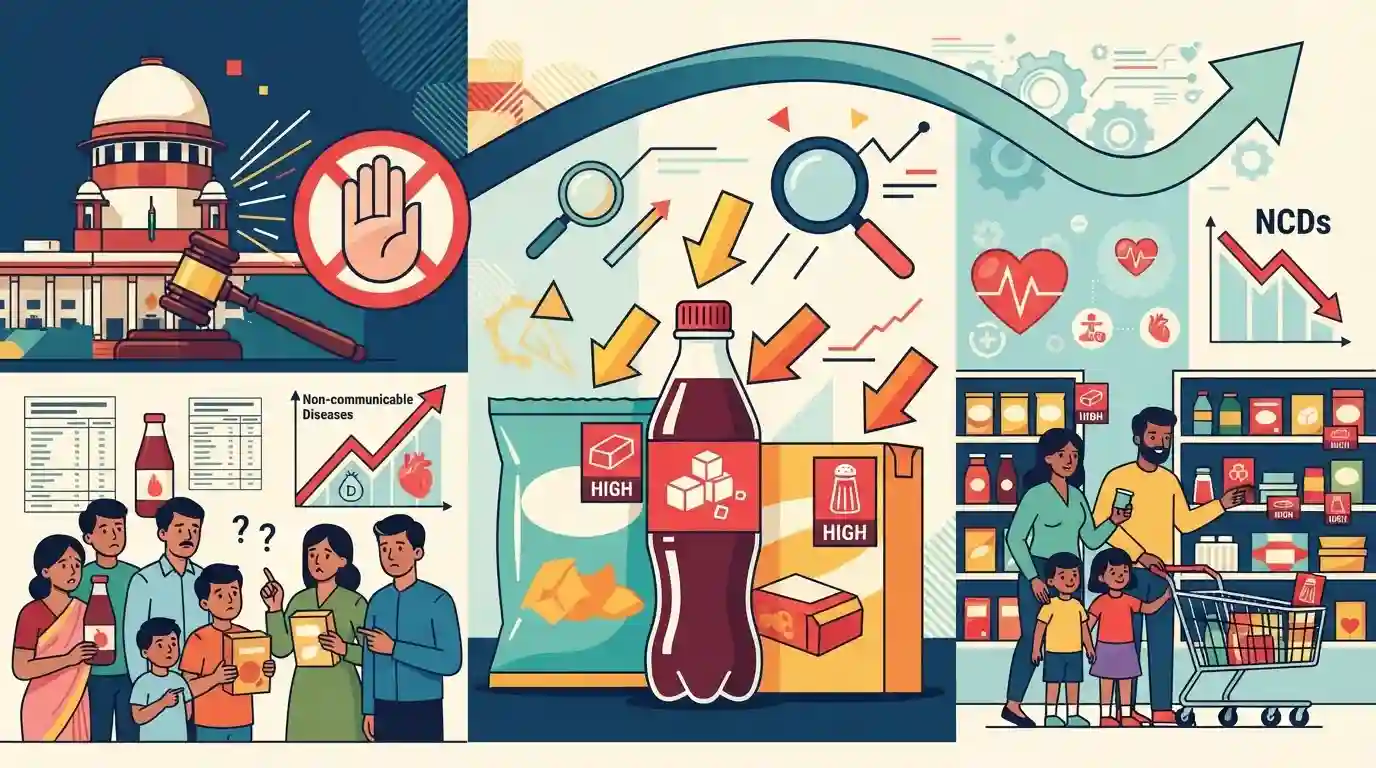
The Supreme Court of India's emphasis on front-of-pack red warning labels for unhealthy packaged foods highlights critical public health and food safety imperatives. Highlighting foods rich in high fat, sugar, and salt (HFSS), the move seeks to address the growing epidemic of non-communicable diseases by enabling consumers to easily identify hazardous products, bypassing complex nutritional tables.
Key Points
- The Supreme Court emphasized the implementation of front-of-pack red warning labels on unhealthy packaged foods high in fat, sugar, and salt (HFSS).
- Current food safety labeling in India primarily relies on nutritional information tables, which ordinary consumers find difficult to interpret quickly.
- Front-of-pack warning labels aim to combat the rising burden of non-communicable diseases (NCDs) like obesity, diabetes, and cardiovascular diseases.
- Public health advocates argue that clear visual warnings empower consumers to make healthier choices and counter misleading marketing by food corporations.
Important Terms
Food Safety and Standards Act

A comprehensive 2006 legislation in India that consolidates previous food laws to establish unified, science-based standards for food manufacturing, storage, distribution, and sale.
UPSC context
UPSC Prelims/Mains (GS Paper II/III): Tests knowledge of statutory bodies, regulatory frameworks, public health legislation, and consumer protection laws.
Food Safety and Standards Authority of India
A statutory apex body under the Ministry of Health and Family Welfare, established under the FSSA 2006 to regulate and supervise food safety and standards across India.
UPSC context
UPSC Prelims/Mains (GS Paper II/III): Important for governance, institutional mechanisms, food security, and regulatory bodies in India.
Prelims Trap
Voluntary star-rating systems like the Indian Nutrition Rating (INR) are the legally mandated standard for packaged foods in India.
Aspirants may assume voluntary star-rating systems like the Indian Nutrition Rating (INR) have been legally finalized, whereas the Supreme Court mandated mandatory red warning labels instead.
Static Concepts Connected
What is the statutory framework governing food safety and standards in India?
- FSSAI Foundation: Statutory Body: Established under the Food Safety and Standards Act, 2006, subsuming previous laws like the Prevention of Food Adulteration Act.
- Administrative Control: Nodal Ministry: Operates under the administrative control of the Ministry of Health and Family Welfare.
- Scientific Standards: Core Mandate: Lays down science-based standards for food articles and regulates manufacture, storage, distribution, sale, and import to ensure safety.
Cross-Topic Patterns
Judicial Activism vs. Statutory Regulators
Judicial directives on consumer health rights under Article 21 frequently intersect with executive delays in regulatory rule-making by statutory bodies like FSSAI.
Public Health vs. Commercial Free Speech
Mandatory front-of-pack warning labels directly confront corporate lobbying and commercial freedom of speech under Article 19(1)(g) versus public health welfare obligations.

FOPL thresholds and Article 21 right to health integration into statutory food safety rules are prime candidates for Prelims and Mains.
Linked PYQs · 2
Linked PYQs · 2
- 2024MainsGS2
In a crucial domain like the public healthcare system the Indian State should play a vital role to contain the adverse impact of marketisation of the system. Suggest some measures through which the State can enhance the reach of public healthcare at the grassroots level.
- 2025MainsGS3
Examine the scope of the food processing industries in India. Elaborate the measures taken by the government in the food processing industries for generating employment opportunities.
