India US Strategic Partnership Balances Autonomy and Geopolitical Risk
Source:Indian Express ↗
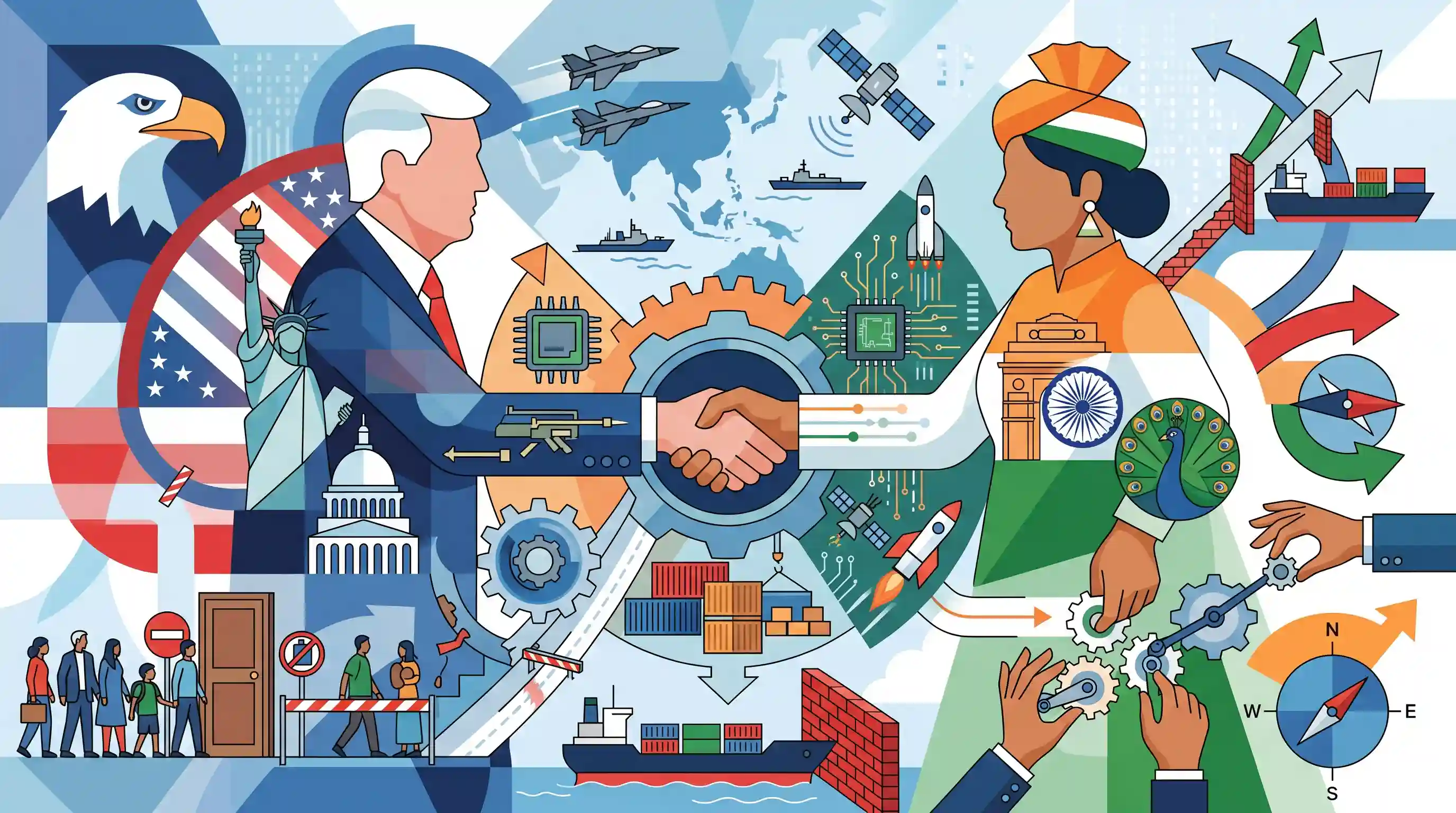
Why It Matters
The evolving India-US strategic partnership is one of the most critical aspects of India's foreign policy. Understanding the balance between deep engagement and managing inherent frictions (trade, geopolitics, domestic policies) is essential for answering questions on bilateral ties and global strategy in GS Paper 2.
Summary
The article analyzes the complex dynamics of India-US bilateral relations, characterized by New Delhi's proactive strategic engagement alongside underlying anxieties about future policy directions in Washington. While cooperation is strengthening in areas like defense, the Indo-Pacific, and emerging technologies, India remains cautiously optimistic due to potential frictions over trade, tariffs, immigration, and differing geopolitical perspectives.
Key Points
- India is proactively engaging with the US ('outstretched hand') to deepen strategic, technological, and defense ties, driven by shared interests in the Indo-Pacific.
- Simultaneously, New Delhi remains anxious ('fingers crossed') about potential uncertainties stemming from changes in US domestic politics and foreign policy priorities.
- Key friction points include trade policies, tariffs, immigration/visas affecting the Indian diaspora, and diverging stances on global issues like the Russia-Ukraine conflict.
- The relationship requires careful diplomatic maneuvering by India to satisfy its strategic ambitions without compromising its strategic autonomy.
Important Terms
Strategic Autonomy

A nation's ability to make sovereign foreign policy and defense decisions without being constrained by external pressures or formal alliance obligations.
UPSC context
GS Paper-II (International Relations); essential for analyzing India's independent stance on global issues like the Russia-Ukraine conflict and ties with China.
iCET (Initiative on Critical and Emerging Technology)
A bilateral framework launched in 2023 to deepen cooperation in critical sectors like AI, semiconductors, space, and defense innovation between India and the US.
UPSC context
GS Paper-III (Science & Tech) and GS Paper-II; tests technology's role as a primary driver of modern strategic partnerships.
Multi-alignment
An evolving foreign policy strategy where India seeks to maintain positive, functional relationships with various global power centers simultaneously to maximize its national interests.
UPSC context
GS Paper-II; relevant for comparing modern Indian diplomacy with the historical Cold War era policy of Non-Alignment.
Comprehensive Global Strategic Partnership
The official status of the India-US relationship, signifying deep, multi-sectoral cooperation rooted in shared democratic values and converging strategic interests.
UPSC context
GS Paper-II; foundational term for describing the current peak state of India-US bilateral engagement.
Indo-Pacific
A vast maritime and terrestrial region where India and the US collaborate through frameworks like the Quad to ensure freedom of navigation and a rules-based order.
UPSC context
GS Paper-II; central to maritime security discussions and India's role as a 'net security provider' in the region.
2+2 Ministerial Dialogue
A high-level institutional mechanism involving the Foreign and Defense Ministers of India and the US to synchronize diplomatic and security strategies.
UPSC context
GS Paper-II; tests knowledge of the executive frameworks that drive high-level strategic and defense cooperation.
Prelims Trap
India and the US share a formal mutual defense treaty under their Comprehensive Global Strategic Partnership.
India and the US have a Comprehensive Global Strategic Partnership and logistical pacts (LEMOA, BECA), but no formal mutual defense treaty. Signing one would violate India's strategic autonomy.
Static Concepts Connected
What are the four foundational defense agreements signed between India and the US?
- GSOMIA (2002): General Security of Military Information Agreement guarantees the protection of classified military information shared between the two nations.
- LEMOA (2016): Logistics Exchange Memorandum of Agreement permits both militaries to use each other's bases for logistics, refueling, and replenishment without stationing troops.
- COMCASA (2018): Communications Compatibility and Security Agreement facilitates interoperability by allowing India to procure highly specialized, secure US military communication equipment.
- BECA (2020): Basic Exchange and Cooperation Agreement enables the sharing of high-end geospatial data, satellite imagery, and topographical information for precision targeting.
How does India's modern 'Strategic Autonomy' differ from historical Non-Alignment?
- Multi-alignment: Strategic autonomy focuses on proactive, issue-based partnerships (e.g., Quad for maritime security, SCO for Eurasian engagement) rather than maintaining strict neutrality or distance from major powers.
- Economic integration: Modern strategic autonomy actively embraces global trade architectures and tech co-production pacts (like iCET), contrasting with NAM's historical focus on self-reliance and third-world autarky.
Cross-Topic Patterns
Tech diplomacy vs WTO rules
The US-India Initiative on Critical and Emerging Technology (iCET) exemplifies 'friend-shoring', blurring the lines between strategic tech partnerships and trade protectionism, which increasingly strains traditional WTO non-discrimination principles.
Diaspora remittances as a BoP buffer
Restrictive US visa policies (like H-1B caps) directly threaten India's Balance of Payments stability. The US is now the top source of inward remittances, heavily offsetting India's structural trade deficits.

Expect a 2026 Prelims question testing the exact scope of iCET tech-sharing against the four foundational Indo-US defense agreements.
Linked PYQs · 2
Linked PYQs · 2
- 2019MainsGS2
‘What introduces friction into the ties between India and the United States is that Washington is still unable to find for India a position in its global strategy, which would satisfy India's national self-esteem and ambitions.’ Explain with suitable examples.
- 2023MainsGS2
Indian diaspora has scaled new heights in the West. Describe its economic and political benefits for India.
