FSSAI Regulates Alcoholic Beverages Under Food Safety Standards
Source:The Hindu ↗
हे का महत्त्वाचे आहे
This issue highlights the vital regulatory role of statutory bodies like FSSAI in public health protection. It demonstrates how food safety laws are applied to demerit goods like alcohol, managing the tension between commercial marketing, public health (Article 47), and complex federal-state jurisdictions.
सारांश
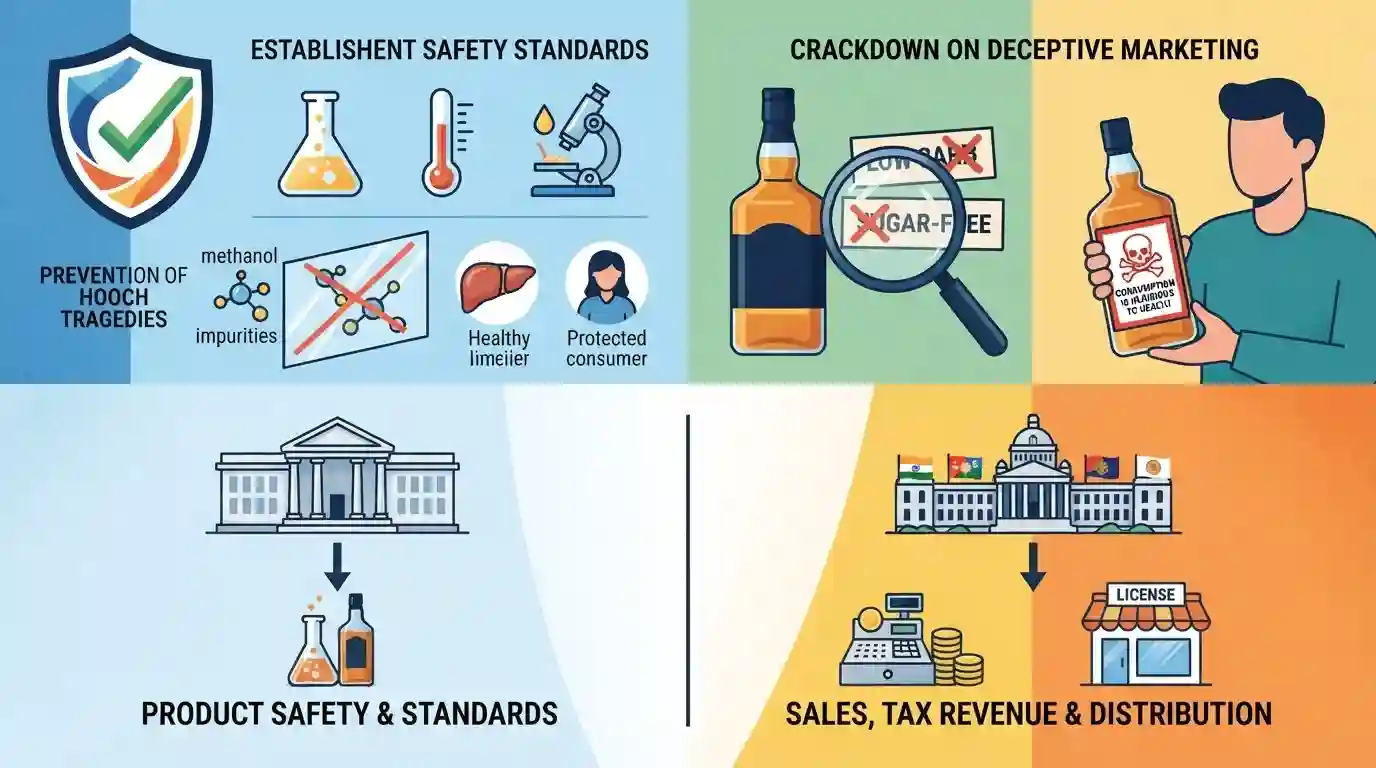
The article examines the Food Safety and Standards Authority of India's (FSSAI) regulatory oversight of alcoholic beverages. Under the Food Safety and Standards (Alcoholic Beverages) Regulations, 2018, FSSAI is cracking down on deceptive marketing practices by banning nutritional claims (e.g., 'low carb' or 'sugar-free') on liquor labels. It highlights FSSAI's role in establishing chemical and physical safety standards—such as setting strict limits on toxic methanol to prevent hooch tragedies—and outlines the federal division of power, where states govern liquor sales and revenue while the central statutory body regulates product safety and consumer warnings.
मुख्य मुद्दे
- FSSAI's Regulatory Mandate: Under the Food Safety and Standards Act, 2006, alcoholic beverages are classified under the definition of 'food', granting FSSAI the statutory authority to regulate their standards, safety, and labeling.
- Cracking Down on Misleading Claims: FSSAI is putting liquor under the scanner to eliminate misleading marketing practices, specifically prohibiting nutritional or health claims (such as 'sugar-free', 'low-carb', 'organic', or 'gluten-free') on alcoholic products to prevent consumers from misperceiving them as healthy.
- Safety and Contaminant Limits: The regulation strictly enforces maximum permissible limits for toxic contaminants like methyl alcohol (methanol), heavy metals (e.g., lead, copper), and pesticide residues to prevent poisoning and chronic health hazards.
- Federal Jurisdictional Division: While the manufacturing standards and food safety regulations are set centrally by FSSAI (Concurrent List), the taxation, distribution, sale, and prohibition of alcoholic beverages remain under state jurisdiction (State List, Entry 8), creating a complex federal regulatory landscape.
- Mandatory Consumer Warnings: Regulations mandate specific size-restricted statutory health warnings ('CONSUMPTION OF ALCOHOL IS INJURIOUS TO HEALTH' and 'BE SAFE - DON'T DRINK AND DRIVE') in English or regional languages on all containers.
महत्त्वाच्या संज्ञा
Food Safety and Standards Authority of India (FSSAI)

An autonomous statutory body established under the FSS Act, 2006, responsible for protecting public health by regulating, supervising, and setting science-based standards for food manufacture, storage, distribution, sale, and imports in India.
UPSC context
GS Paper II: Statutory Bodies. Tests understanding of regulatory governance, public health safety, and federal executive powers.
Food Safety and Standards Act, 2006
A comprehensive, landmark Indian legislation that consolidated eight pre-existing laws into a single science-based framework. It established the FSSAI to regulate food safety, hygiene, and standards across the manufacturing and supply chain.
UPSC context
GS Paper II: Government Policies and Interventions. Tests knowledge of legislative frameworks consolidating multi-sectoral laws to protect consumer welfare.
Food Safety and Standards (Alcoholic Beverages) Regulations, 2018
Specific FSSAI regulations that define standards, alcohol-by-volume limits, labeling rules, and health warnings for alcoholic beverages, while prohibiting misleading nutritional claims (e.g., 'low carb' or 'sugar-free').
UPSC context
GS Paper II & III: Health and Consumer Protection. Tests knowledge of sector-specific standards protecting consumers from deceptive marketing.
Constitution of India (Article 47, Seventh Schedule)
Constitutional provisions governing liquor: Article 47 (DPSP) directs states to endeavor to prohibit intoxicating drinks, while the Seventh Schedule (State List, Entry 8) empowers states to regulate, manufacture, and tax alcohol.
UPSC context
GS Paper II: Federal Structure and DPSPs. Tests understanding of the division of power between Union regulations and State-level policies.
Ministry of Health and Family Welfare
The administrative parent Ministry of the Government of India that oversees FSSAI, formulating national policies, legislative updates, and public health guidelines to ensure food safety and health security.
UPSC context
GS Paper II: Executive governance. Tests knowledge of institutional structures overseeing statutory regulatory authorities in India.
पूर्वपरीक्षा सापळा
Because intoxicating liquor is a State Subject, the central FSSAI lacks statutory authority to regulate its ingredients, labeling, or safety standards.
The FSS Act, 2006 classifies alcohol (>0.5% ABV) as 'food'. Standard-setting falls under Concurrent List Entry 18 (Adulteration), giving FSSAI central legislative authority over safety and labeling standards despite state-level sale control.
संबंधित स्थिर संकल्पना
How is legislative power over alcoholic beverages divided under the Indian Constitution?
- State List (Entry 8): Vests the production, manufacture, possession, transport, purchase, and sale of intoxicating liquors entirely within state legislative domain.
- Concurrent List (Entry 18): Covers 'Adulteration of foodstuffs', enabling the Parliament to enact uniform safety legislation like the Food Safety and Standards Act.
- Article 47 (DPSPs): Directs the State to endeavor to bring about prohibition of the consumption of intoxicating drinks except for medicinal purposes.
What is the statutory mandate and scope of the FSSAI?
- Statutory Origin: Established under the Food Safety and Standards Act, 2006, consolidating multiple legacy food laws under the Ministry of Health and Family Welfare.
- Definition of Food: Defines 'food' broadly to include any substance intended for human consumption, including primary food, genetically modified food, and alcoholic beverages.
आंतर-विषय नमुने
Fiscal state rights vs central food safety
State resistance to central safety mandates on alcohol often highlights the tension between uniform consumer protection laws and the states' heavy fiscal dependence on liquor excise revenues.
Article 47 directive vs state revenues
The constitutional directive to restrict alcohol consumption under Article 47 directly clashes with the state-level political economy and reliance on liquor excise to fund development schemes.

Expect questions testing the federal boundary between FSSAI's safety standards (Concurrent) and state control over liquor sales (State List).
संबंधित PYQ · 1
संबंधित PYQ · 1
- 2018PrelimsGS1
Consider the following statements: 1. The Food Safety and Standards Act, 2006 replaced the Prevention of Food Adulteration Act, 1954. 2. The Food Safety and Standards Authority of India (FSSAI) is under the charge of Director General of Health Services in the Union Ministry of Health and Family Welfare. Which of the statements given above is/are correct?
