European Union Strategic Autonomy and Defence Fragmentation
Source:Indian Express ↗
Why It Matters
Understanding the institutional limits of European strategic autonomy is critical for analyzing the evolving global security architecture, the shifting role of NATO, and how a fragmented European defence impacts the broader geopolitical landscape that India must navigate.
Summary
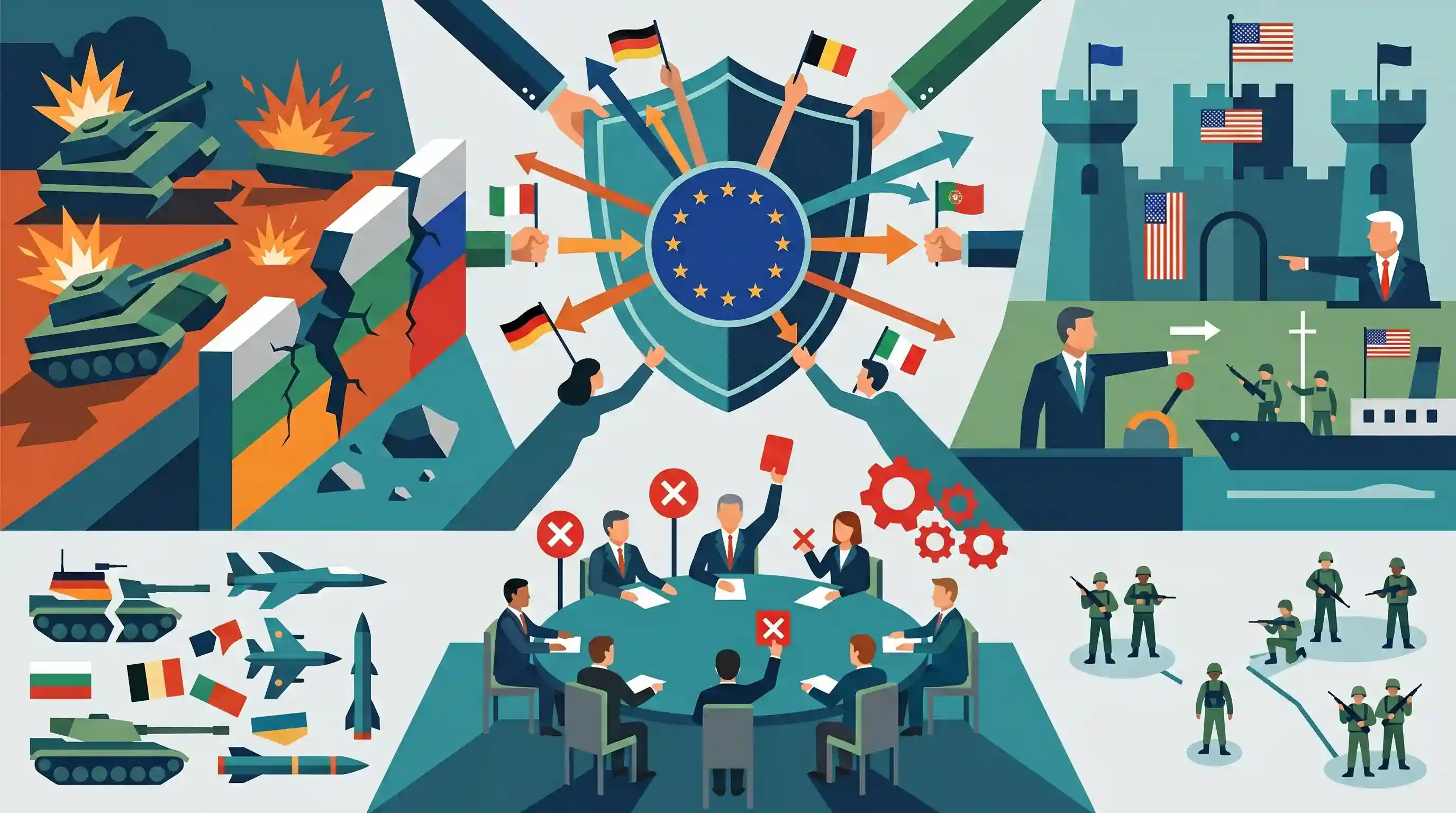
The European Union's aspiration for a unified and autonomous defence framework is structurally constrained by the inherent tension between its supranational institutions and the sovereignty of its member states. Despite external security pressures such as the Russia-Ukraine war and potential US troop drawdowns under Donald Trump, the EU struggles to act cohesively. The requirement for absolute unanimity in the Common Security and Defence Policy (CSDP) enables single-state vetoes, paralyzing swift geopolitical responses. Furthermore, highly fragmented military procurement and the failure to operationalize initiatives like the EU Battlegroups keep Europe fundamentally dependent on the US-led NATO structure for its security architecture.
Key Points
- The structural dichotomy between supranationalism (represented by the European Commission) and intergovernmentalism (represented by the European Council) fundamentally limits the EU's ability to forge a unified foreign and defence policy.
- Through the "Principal-Agent framework," member states restrict the European External Action Service (EEAS) to protect their sovereign interests, keeping ultimate control over geopolitical strategy.
- The Common Security and Defence Policy (CSDP) requires absolute unanimity among member states, allowing any single country to exercise a veto and paralyze collective action (e.g., Cyprus vetoing sanctions in 2020).
- European defence capabilities remain fragmented with duplicated equipment and uncoordinated procurement, reinforcing the continent's reliance on the US-led NATO alliance for genuine security.
- Ambitions like the "EU Battlegroups," conceptualized in 2007, remain largely non-operational due to a lack of political consensus, underscoring the gap between the EU's rhetorical goals and actual strategic autonomy.
Important Terms
Common Security and Defence Policy (CSDP)

The European Union's framework for military and civilian crisis management, enabling collective action in peacekeeping, conflict prevention, and strengthening international security.
UPSC context
GS Paper II: International Relations. Tests understanding of regional security frameworks and EU's global geopolitical role.
North Atlantic Treaty Organization (NATO)
A 32-member intergovernmental military alliance providing a collective defense system, where member states agree to mutual defense in response to an attack by any external party.
UPSC context
GS Paper II: Global Security Architecture. Essential for analyzing Transatlantic relations and European dependency on US security.
European External Action Service (EEAS)
The European Union's diplomatic service that manages foreign relations and implements the Common Foreign and Security Policy, including civilian and military crisis response.
UPSC context
GS Paper II: Regional Groupings. Important for understanding the institutional mechanics of EU diplomacy and security.
EU Battlegroups
Multinational rapid-response military units (approx. 1,500 personnel) designed for swift crisis management under the CSDP; they have remained undeployed due to lack of political consensus.
UPSC context
GS Paper II: Global Security. Illustrates the challenges of operationalizing regional military capabilities.
Strategic Autonomy
The capacity of a state or regional grouping to set its own priorities and make foreign policy/security decisions without being constrained by external powers.
UPSC context
GS Paper II: Policy effects of developed countries. A recurring theme in EU-India-US trilateral dynamics.
Unanimity Rule
The EU's procedural requirement that all member states must agree on foreign and security policy decisions, granting every nation a veto that can block collective action.
UPSC context
GS Paper II: Institutional Challenges. Tests knowledge of structural constraints in supranational governance.
Prelims Trap
"EU defence decisions under the CSDP can be taken by a qualified majority."
The CSDP strictly operates on absolute unanimity. Any single member state holds a veto, which is the primary bottleneck paralyzing swift European geopolitical action.
Static Concepts Connected
How is power divided among the EU's core institutions?
- European Commission: The supranational executive branch; drafts legislation, manages day-to-day operations, and represents collective EU interests.
- European Council: The intergovernmental body comprising member states' heads; it sets overall strategic direction and retains final authority on foreign policy.
- European Parliament: Directly elected legislative body that shares law-making power, though it holds minimal sway over sovereign defense and foreign affairs.
What defines the EU-NATO security relationship?
- Distinct Frameworks: NATO is a US-led transatlantic collective defense alliance, whereas CSDP is the EU's internal framework for crisis management.
- Berlin Plus Agreement: A comprehensive package of agreements allowing the EU to draw on NATO's military assets for its own peacekeeping operations.
- Strategic Autonomy: While the EU aspires for self-reliance through CSDP, fragmented internal procurement keeps Europe structurally dependent on NATO.
Cross-Topic Patterns
EU Indo-Pacific tilt vs Internal fragmentation
Europe's inability to project unified hard power limits its Indo-Pacific maritime security role, forcing India to rely on bilateral ties (like France) rather than an EU-wide security umbrella.
US isolationism & middle-power realignments
Potential US troop drawdowns compel middle powers to ramp up indigenous defense procurement and forge minilateral security architectures outside traditional post-WWII alliances.

Expect a GS-2 Mains question evaluating the EU's quest for "strategic autonomy" amidst structural vetoes and heavy NATO dependence.
Linked PYQs · 2
Linked PYQs · 2
- 2023MainsGS2
‘The expansion and strengthening of NATO and a stronger US-Europe strategic partnership works well for India.’ What is your opinion about this statement ? Give reasons and examples to support your answer.
- 2023PrelimsGS1
Consider the following statements: The 'Stability and Growth Pact' of the European Union is a treaty that 1. limits the levels of the budgetary deficit of the countries of the European Union 2. makes the countries of the European Union to share their infrastructure facilities 3. enables the countries of the European Union to share their technologies How many of the above statements are correct?
