Teacher training reforms central to foundational learning goals
Source:The Hindu ↗
কেন এটি গুরুত্বপূর্ণ
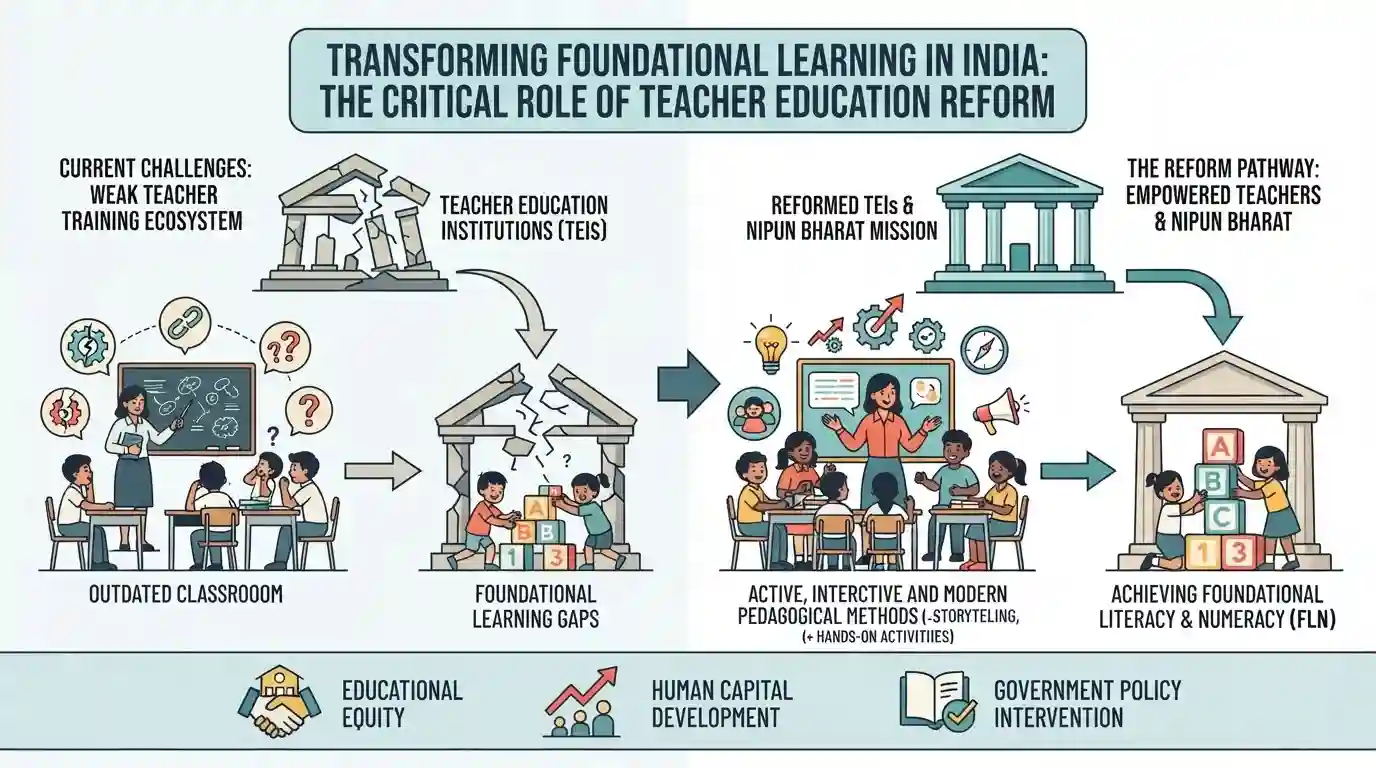
Teacher training is the linchpin of India's educational policy success (NEP 2020) and foundational learning goals. Without addressing systemic defects in teacher preparation, large investments in school infrastructure and digital tools fail to translate into actual learning outcomes, severely impacting human capital formation.
সারসংক্ষেপ
The article emphasizes that achieving India's foundational learning goals, such as Foundational Literacy and Numeracy (FLN) under the NIPUN Bharat mission, depends heavily on comprehensive reforms in teacher training and Teacher Education Institutions (TEIs). It highlights systemic gaps in current pedagogical instruction and argues that empowering teachers with modern, practical training is central to human capital development and educational equity.
মূল বিষয়
- Foundational learning goals (like FLN) hinge crucially on upgrading the quality and pedagogy of teacher training institutions.
- Existing teacher preparation programs often suffer from theoretical gaps, inadequate practical classroom exposure, and outdated curricula.
- Reforming Teacher Education Institutions (TEIs) is essential to transition from rote learning to competency-based, joyful pedagogy at the primary level.
- Aligning continuous professional development (CPD) with ground-level classroom challenges is vital for long-term human capital and educational outcomes.
গুরুত্বপূর্ণ শব্দ
National Education Policy (NEP) 2020

A comprehensive national framework launched to restructure India's school and higher education system, emphasizing foundational literacy, holistic learning, and teacher professional development.
UPSC context
UPSC Mains GS Paper II: Education policy, human resource development, and systemic reforms in the social sector.
NIPUN Bharat Mission
A national mission under Samagra Shiksha aimed at ensuring that every child attains foundational literacy and numeracy by the end of Grade 3.
UPSC context
UPSC Mains GS Paper II: Government policies and interventions for human capital development and elementary education.
National Council for Teacher Education (NCTE)
A statutory body responsible for regulating norms, standards, and procedures in the teacher education system across India.
UPSC context
UPSC Mains GS Paper II: Institutional mechanisms, regulatory bodies, and quality control in educational administration.
প্রিলিমস ফাঁদ
NIPUN Bharat primarily focuses on upgrading physical school infrastructure and digital connectivity in rural primary schools.
Aspirants often assume NIPUN Bharat is exclusively a school infrastructure scheme, when its core mandate is instructional reform and foundational literacy/numeracy outcomes.
সংযুক্ত স্থির ধারণা
What are the key institutional reforms recommended by NEP 2020 for Teacher Education in India?
- Dual-Major B.Ed: Integrated B.Ed: 4-year dual-major liberal integrated B.Ed. degrees to replace sub-standard standalone teacher education institutions (TEIs).
- NCTE Restructuring: NCTE Overhaul: Restructuring of the National Council for Teacher Education as a professional standard-setting body (PSSB).
- Rigorous Standards: Merit-Based Hiring: Strict teacher recruitment through TETs, local hiring, and continuous professional development (CPD).
আন্তঃবিষয় প্যাটার্ন
Teacher Training & Fiscal Federalism
The structural overhaul of TEIs links federal educational targets (NEP/NIPUN) with state-level administrative capacity and fiscal devolution under Finance Commission grants for human capital.
Foundational Learning & Demographic Dividend
Foundational learning deficits directly constrain demographic dividend realization, shifting the policy focus from mere school enrollment numbers to core cognitive outcomes and workforce readiness.

NEP 2020 governance reforms + NIPUN Bharat targets will likely be paired in a multi-statement prelims question on human resource development.
সংযুক্ত PYQ · 2
সংযুক্ত PYQ · 2
- 2023MainsGS2
The crucial aspect of development process has been the inadequate attention paid to Human Resource Development in India. Suggest measures that can address this inadequacy.
- 2023MainsGS2
Skill development programmes have succeeded in increasing human resources supply to various sectors. In the context of the statement analyse the linkages between education, skill and employment.
