Teacher Training Reforms Are Vital for Achieving Foundational Learning
Source:The Hindu ↗
Why It Matters
Teacher quality directly dictates learning outcomes and human capital formation in India. Examining teacher training reforms helps address systemic bottlenecks in foundational literacy and numeracy under initiatives like NEP 2020 and NIPUN Bharat.
Summary
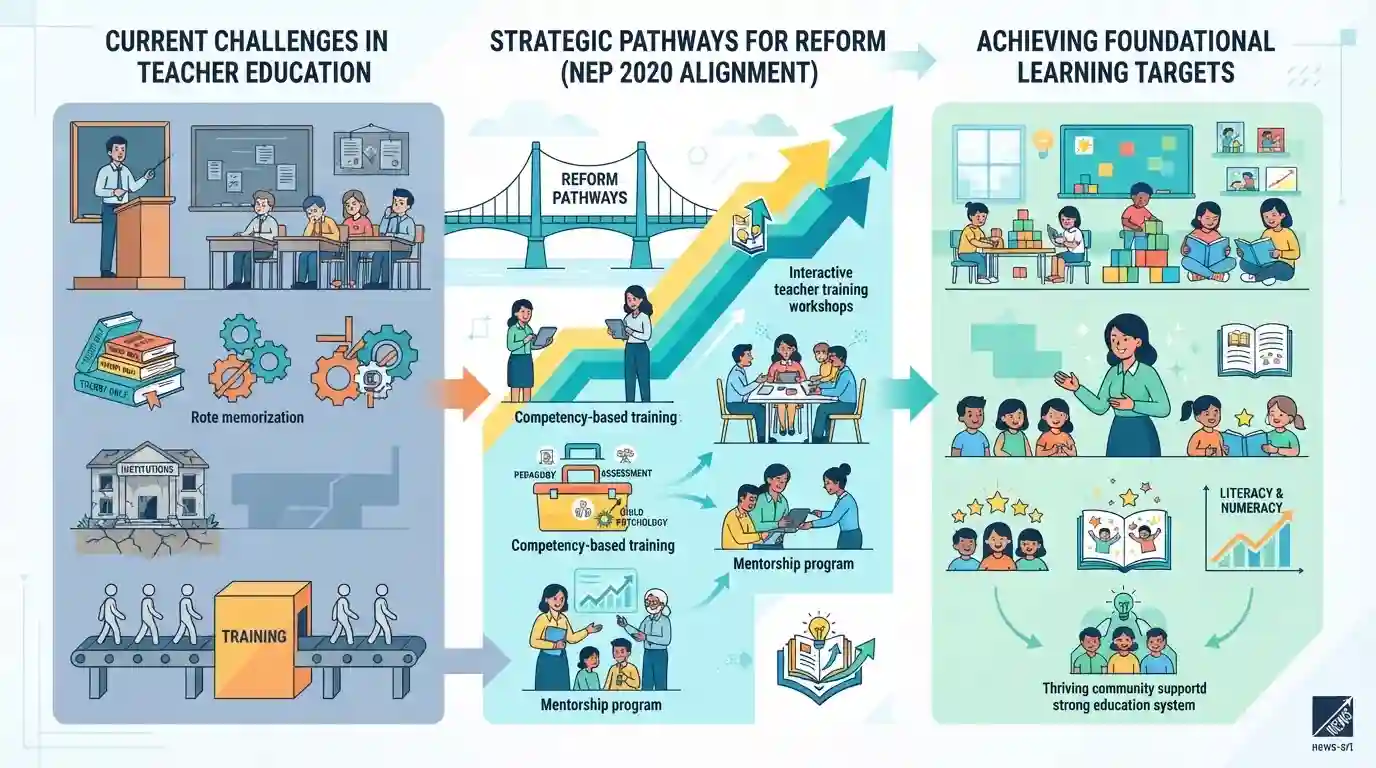
The article emphasizes that comprehensive reform in teacher training and professional development is indispensable for achieving India's foundational learning targets. It critiques current shortcomings in teacher education institutions and outlines strategic pathways, aligned with the National Education Policy (NEP) 2020, to transform educators into effective facilitators of early learning.
Key Points
- Teacher training reform is identified as a critical linchpin for achieving India's foundational learning goals, such as foundational literacy and numeracy (FLN).
- Traditional teacher education programmes often suffer from outdated pedagogies, a disconnect between theoretical training and classroom realities, and lack of continuous professional development (CPD).
- Reforming teacher preparation requires overhauling B.Ed. and D.El.Ed. curricula, integrating experiential learning, and focusing on early childhood care and education (ECCE).
- Empowering educators through institutional backing, peer learning networks, and robust mentorship is vital to improve human resource development and educational outcomes in public schools.
Important Terms
National Education Policy 2020

India's comprehensive framework formulated in 2020 to overhaul the school and higher education structure, emphasizing foundational literacy, teacher training, and multidisciplinary learning.
UPSC context
UPSC GS Paper II: Social Sector, Education Policies, and Human Resource Development. Essential for questions on systemic educational reforms.
NIPUN Bharat Mission
A national flagship mission under the Ministry of Education aimed at ensuring universal foundational literacy and numeracy (FLN) for every child by Grade 3.
UPSC context
UPSC GS Paper II: Government Policies and Interventions for Development in Social Sectors, focusing on primary learning outcomes.
Prelims Trap
Foundational literacy and numeracy targets are managed solely through rural development and child welfare administrative machineries.
Aspirants often assume ECCE and foundational literacy fall exclusively under Ministry of Women and Child Development, missing the overarching pedagogical mandate of the Ministry of Education under NEP 2020.
Static Concepts Connected
What are the key institutional mechanisms and policy frameworks governing teacher education and foundational learning in India?
- NCTE Role: Statutory body established under an Act of Parliament (1993) to formally regulate and maintain norms and standards in the teacher education system across India.
- NISHTHA Scheme: Flagship national initiative for school heads and teachers' holistic advancement, providing integrated teacher training at the elementary stage across states.
- NIPUN Bharat: National mission launched under Samagra Shiksha to ensure every child attains universal acquisition of foundational literacy and numeracy by grade 3.
Cross-Topic Patterns
FLN goals + Fiscal federalism in education
Foundational learning goals (FLN) intersect with fiscal federalism as states implement centrally sponsored schemes like Samagra Shiksha with variable budgetary allocations and administrative capacity.
Teacher reform + Demographic dividend & human capital
Teacher quality reforms directly impact human capital formation, determining whether India's demographic dividend translates into a productive workforce or an under-skilled demographic burden.

Expect a mains analytical question on how NEP 2020 transforms pre-service teacher education (B.Ed/D.El.Ed) to meet FLN and NIPUN targets.
Linked PYQs · 2
Linked PYQs · 2
- 2020MainsGS2
National Education Policy 2020 is in conformity with the Sustainable Development Goal-4 (2030). It intends to restructure and reorient education system in India. Critically examine the statement.
- 2023MainsGS2
The crucial aspect of development process has been the inadequate attention paid to Human Resource Development in India. Suggest measures that can address this inadequacy.
