Criminal Justice System Reforms and Prohibition of Stock Witnesses
Source:Indian Express ↗
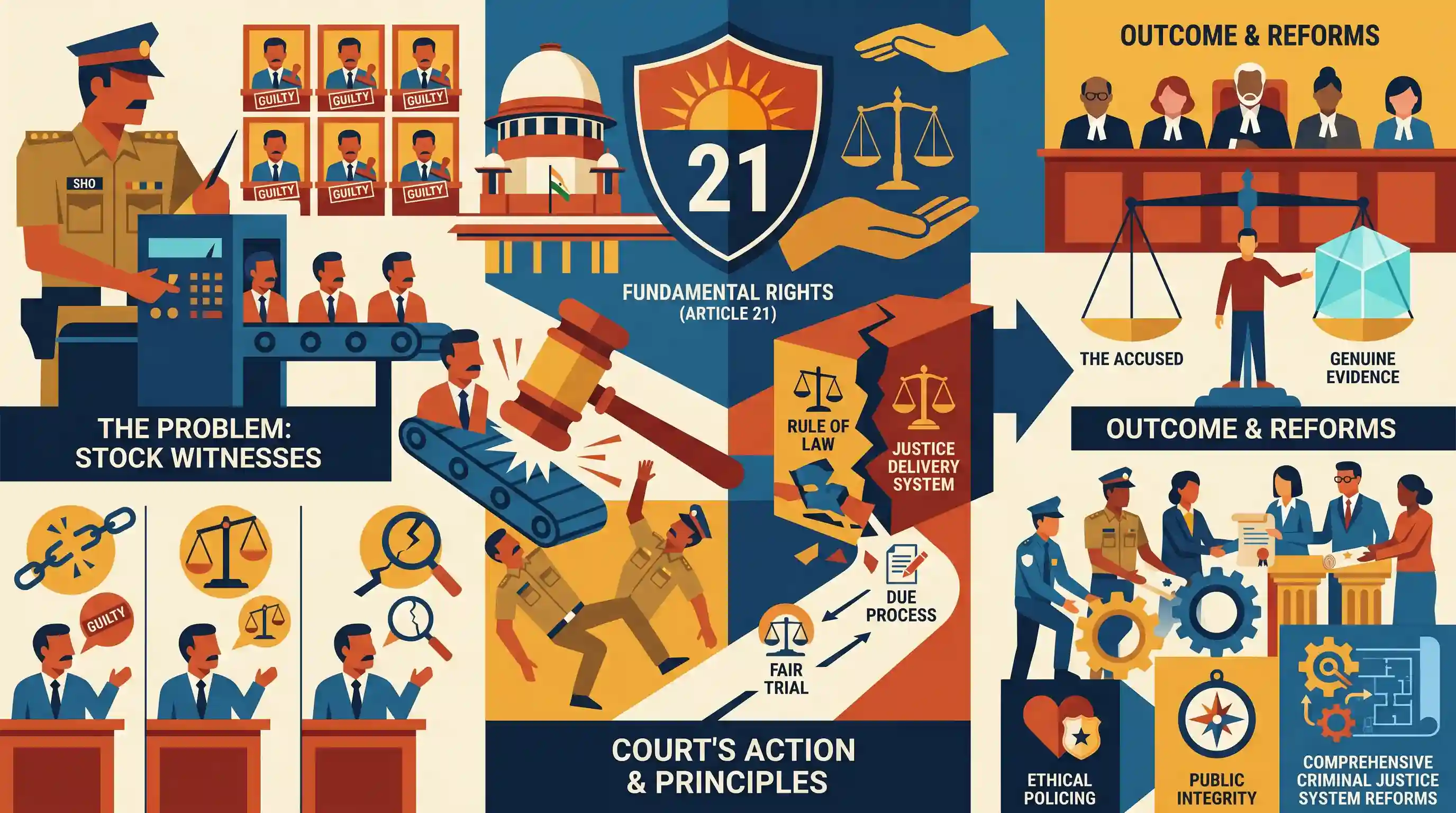
Why It Matters
The use of stock witnesses undermines the foundational principles of justice and fair trial in India. For UPSC aspirants, this illustrates the gap between procedural laws and actual police practices, making it highly relevant for questions on police reforms (GS2), constitutional rights (Article 21), and the ethical conduct of public servants (GS4).
Summary
The Supreme Court of India recently took strict action against the police practice of using 'stock witnesses', ordering the removal of an SHO who relied on such testimonies. Stock witnesses are individuals who routinely testify in favor of the police across multiple, unrelated cases to secure convictions. The Court strongly condemned this, stating it is an "anathema to a country governed by law" and a direct affront to the justice delivery system. The ruling underscores the critical importance of a fair trial—a core component of Article 21 (Right to Life and Personal Liberty)—and highlights systemic flaws in police investigations. It brings to the forefront the need for ethical policing, integrity in public service, and comprehensive reforms in the criminal justice system to prevent the fabrication of evidence.
Key Points
- The Supreme Court of India ordered the removal of a Station House Officer (SHO) for relying on 'stock witnesses' in criminal investigations.
- The Court termed the practice of using stock witnesses—individuals repeatedly planted by police to give favorable testimony—as an 'anathema to a country governed by law'.
- Using fabricated testimonies compromises the integrity of the criminal justice system and violates the accused's fundamental right to a fair trial under Article 21.
- This ruling highlights the urgent need for police reforms to ensure probity, ethical conduct, and scientific investigation rather than reliance on manufactured evidence.
Important Terms
Stock Witness

An individual who routinely provides tailored testimony in favor of police in multiple unrelated cases, often under compulsion or for personal gain.
UPSC context
GS Paper 2: Criminal Justice System and GS Paper 4: Ethics in investigative integrity and police conduct.
Article 21 of the Indian Constitution
Guarantees that no person shall be deprived of their life or personal liberty except according to procedure established by law.
UPSC context
GS Paper 2: Fundamental Rights. Essential for understanding the constitutional basis of a fair trial.
Rule of Law
A legal principle where all individuals and institutions are accountable to law that is fairly applied and independently enforced.
UPSC context
GS Paper 2: Governance and Constitution. The stock witness practice is termed an 'anathema' to this principle.
Fair Trial
A constitutional guarantee ensuring an impartial judge, the right to defense, and the absence of fabricated evidence like stock witnesses.
UPSC context
GS Paper 2: Judiciary and Criminal Justice. It is a 'sine qua non' of Article 21.
Station House Officer (SHO)
The officer-in-charge of a police station in India, responsible for supervising investigations and maintaining law and order within their jurisdiction.
UPSC context
GS Paper 2: Statutory and Regulatory bodies. Tests knowledge of the hierarchy and accountability of police administration.
Police Reforms
Structural changes aimed at making the police force more professional, accountable, and independent from political or unethical interference.
UPSC context
GS Paper 2/3: Internal Security and Governance. Focuses on preventing the systemic fabrication of evidence.
Ethical Policing
The application of moral principles and integrity in law enforcement to ensure justice, public trust, and protection of human rights.
UPSC context
GS Paper 4: Ethics and Human Interface. Vital for case studies on administrative integrity and misuse of power.
Prelims Trap
The Indian Evidence Act explicitly defines and prohibits 'stock witnesses'.
Stock witnesses are not statutorily defined in the Evidence Act or Constitution. It is purely a judicial term describing planted, habitual police witnesses whose testimony violates Article 21.
Static Concepts Connected
What are the core directives of the Prakash Singh case (2006) on police reform?
- Security Commission: Establish State Security Commissions to insulate police forces from unwarranted political pressure and executive interference.
- Separation of Functions: Functionally separate the investigating police from law and order police to ensure speedier, professional, and unbiased criminal probes.
- Complaints Authority: Set up Police Complaints Authorities at state and district levels to inquire into public complaints against police misconduct.
Which constitutional provisions implicitly secure the Right to a Fair Trial?
- Article 21: Expanded via the Maneka Gandhi case, it mandates that "procedure established by law" must be just, fair, and reasonable.
- Article 22: Grants arrested individuals fundamental protections, including the right to consult and be defended by a legal practitioner of their choice.
- Article 39A: A Directive Principle that obligates the State to provide free legal aid to ensure opportunities for securing justice are not denied.
Cross-Topic Patterns
New Criminal Laws (BNSS) + Forensic Push
The SC’s condemnation of stock witnesses aligns with the Bharatiya Nagarik Suraksha Sanhita (BNSS) mandate pushing for mandatory forensic investigations in serious crimes to reduce reliance on easily manipulated human testimonies.
GS4: Ends vs. Means in Policing
Using stock witnesses illustrates the ethical trap of "ends justify the means." Officers prioritize conviction metrics over procedural integrity, violating foundational civil service values of probity and objectivity.

Expect 'stock witness' as a Prelims phrase-match or anchoring a GS2 Mains question linking police reform to the new BNSS evidence rules.
Linked PYQs · 5
Linked PYQs · 5
- 2023MainsGS2
“The Constitution of India is a living instrument with capabilities of enormous dynamism. It is a constitution made for a progressive society.” Illustrate with special reference to the expanding horizons of the right to life and personal liberty.
- 2021MainsGS4
Identify ten essential values that are needed to be an effective public servant. Describe the ways and means to prevent non-ethical behaviour in the public servants.
- 2024MainsGS4
“The 'Code of Conduct' and 'Code of Ethics' are the sources of guidance in public administration. There is code of conduct already in operation, whereas code of ethics is not yet put in place. Suggest a suitable model for code of ethics to maintain integrity, probity and transparency in governance.”
- 2024PrelimsGS1
Under which of the following Articles of the Constitution of India, has the Supreme Court of India placed the Right to Privacy ?
- 2020PrelimsGS1
Consider the following statements: 1. The Constitution of India defines its 'basic structure' in terms of federalism, secularism, fundamental rights and democracy. 2. The Constitution of India provides for 'judicial review' to safeguard the citizens' liberties and to preserve the ideals on which the Constitution is based. Which of the statements given above is/are correct?
