Sardar Sarovar Project Rehabilitation Cost Sharing Agreement
Source:india-today ↗
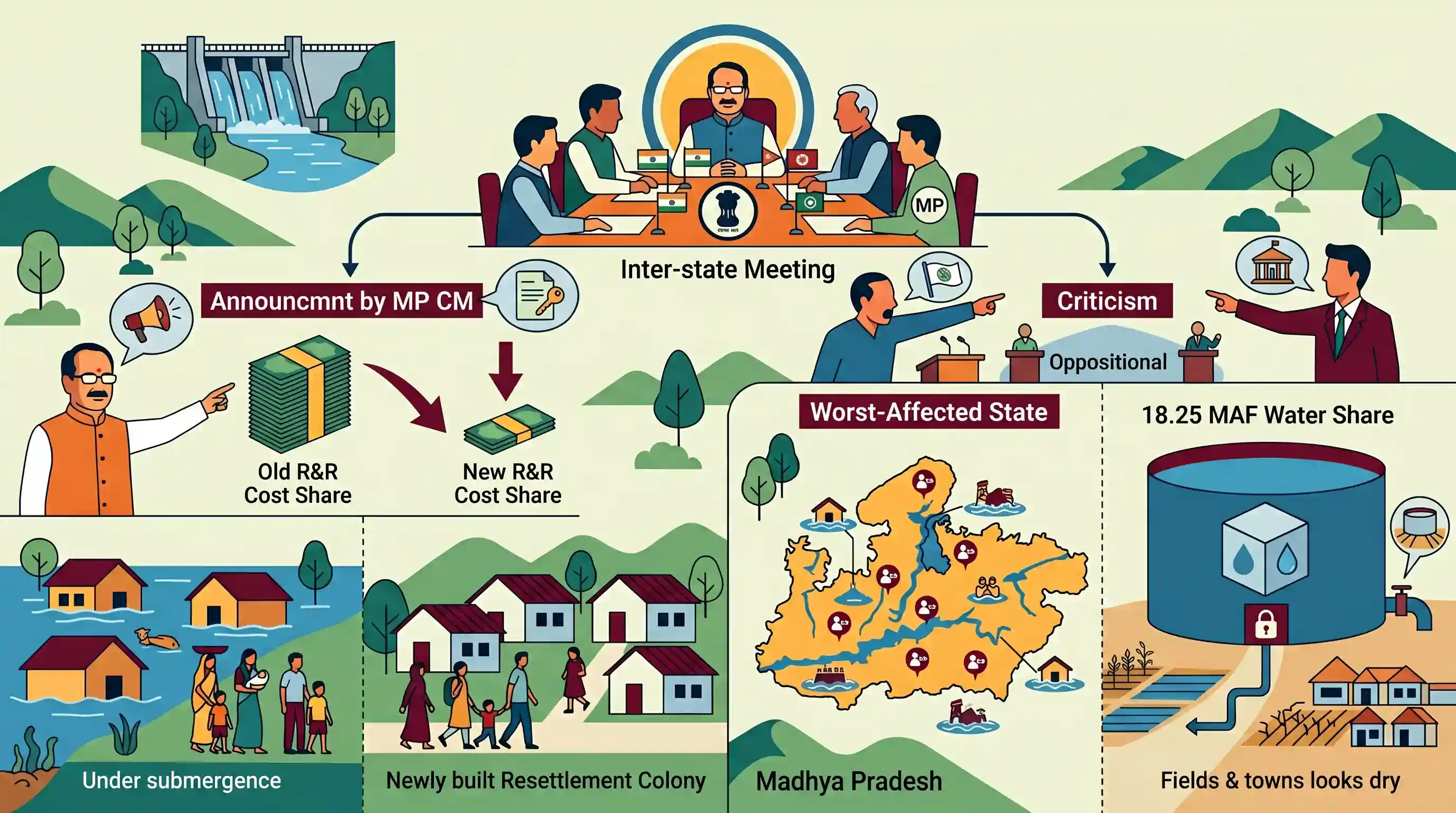
Why It Matters
The Sardar Sarovar Dam is a major multi-state project on the Narmada River. The sharing of its benefits (like MP receiving 57% of power) and costs (rehabilitation expenses) is a crucial topic for MPPSC, touching upon geography, interstate federalism, and socio-environmental issues.
Summary
A significant political row has erupted in Madhya Pradesh over the settlement of long-pending rehabilitation and water-sharing issues under the Sardar Sarovar Project on the Narmada River. Following an inter-state meeting chaired by Union Home Minister Amit Shah on July 7, 2026, MP CM Mohan Yadav announced that the state's share of rehabilitation expenses was slashed from 31.98% to 16.17%, saving MP Rs 1,270 crore. However, the opposition Congress party has criticized the deal, claiming that MP has surrendered its financial interests and remains the worst-affected state by submergence while failing to utilize its allocated 18.25 MAF water share.
Key Points
- On July 7, 2026, a high-level meeting chaired by Union Home Minister Amit Shah and attended by the CMs of MP, Gujarat, Maharashtra, and Rajasthan sought to resolve around 30 long-pending rehabilitation and water-sharing disputes of the Sardar Sarovar Project.
- Madhya Pradesh CM Mohan Yadav announced that MP's share in rehabilitation (R&R) expenses was reduced from 31.98% (approx. Rs 1,500 crore) to 16.17% (Rs 231.8 crore), resulting in savings of around Rs 1,270 crore.
- Under the newly agreed sharing formula, Gujarat's rehabilitation cost share increased from 50.57% to 75%, while Maharashtra's share was reduced from 15.15% to 7.66%. Gujarat is set to receive Rs 553.4 crore from other states.
- Madhya Pradesh receives 57% of the total electricity generated from the project and has an allocated Narmada water share of 18.25 MAF (Million Acre-Feet), supplying areas like Indore, Dhar, Ujjain, and Pithampur.
- The opposition Congress party protested the settlement, claiming MP is the worst-affected state by project submergence and was owed Rs 7,669 crore by Gujarat as compensation but ended up paying Rs 550 crore instead, while failing to utilize its complete 18.25 MAF water share.
Important Terms
Sardar Sarovar Project

A massive multi-purpose concrete gravity dam project on the Narmada River in Gujarat, benefiting Gujarat, Madhya Pradesh, Maharashtra, and Rajasthan with irrigation, drinking water, and hydroelectric power.
UPSC context
GS Paper I & III (Geography & Infrastructure). Tests major multi-purpose projects, water sharing disputes, and rehabilitation challenges.
Narmada Water Disputes Tribunal
A tribunal constituted by the Government of India in 1969 under the Inter-State River Water Disputes Act, 1956, to resolve water sharing and project construction disputes among riparian states.
UPSC context
GS Paper II (Polity & Governance). Tests constitutional mechanisms for inter-state river disputes and federal cooperative structures.
Narmada Water Disputes Tribunal Award
The 1979 final binding decision of the NWDT that allocated Narmada's utilisable water among four beneficiary states, determined the Sardar Sarovar Dam's height, and outlined cost-sharing parameters.
UPSC context
GS Paper II & III (Federalism & Water Resources). Tests historical awards, binding decisions, and inter-state conflict resolution.
Inter-State River Water Disputes Act, 1956
An Act enacted under Article 262 of the Indian Constitution empowering the Central Government to establish ad-hoc tribunals to adjudicate disputes related to the use, distribution, and control of inter-state river waters.
UPSC context
GS Paper II (Polity & Federalism). Tests statutory bodies, legislative entries under Seventh Schedule, and federal conflict resolution.
Narmada Control Authority
An inter-state administrative body established in 1980 to coordinate, monitor, and implement the Narmada Water Disputes Tribunal Award, including water release, power sharing, and environmental safeguards.
UPSC context
GS Paper II & III (Governance & Resource Management). Tests regulatory institutions and multi-state cooperative resource management.
Prelims Trap
Hydroelectric power generated from the Sardar Sarovar Project is shared among all four beneficiary states of the Narmada basin.
While four states (MP, Gujarat, Maharashtra, Rajasthan) share the water of the Narmada river, Rajasthan does not receive any share of the hydroelectric power generated from the Sardar Sarovar Project.
Static Concepts Connected
What are the constitutional and statutory provisions for resolving inter-state water disputes in India?
- Article 262: Empowers Parliament to adjudicate disputes relating to waters of inter-state rivers/river valleys and exclude Supreme Court jurisdiction.
- IRWD Act, 1956: Enables the Centre to constitute an ad-hoc tribunal for resolving water disputes when negotiations fail, with decisions historically being final and binding.
- River Boards Act, 1956: Enacted for the regulation and development of inter-state rivers and river valleys, though historically underutilized.
What are the key geographical characteristics of the Narmada River basin?
- Origin and Course: Rises from the Amarkantak Plateau in Madhya Pradesh and flows westward through a rift valley between the Vindhya and Satpura ranges.
- Drainage Basin: It is the largest west-flowing peninsular river, draining into the Arabian Sea through the Gulf of Khambhat.
- Tributaries: Major left-bank tributaries include the Tawa and Sher, while right-bank tributaries include the Hiran and Orsang.
Cross-Topic Patterns
Tribunal awards vs. executive federalism
Traces how rigid, decades-old tribunal awards (like the NWDT of 1979) are increasingly renegotiated through executive-led mediation (MHA) to balance modern fiscal constraints of states.
Upstream displacement vs. downstream benefits
Highlights the structural asymmetry where upstream states (MP) bear the highest ecological and displacement costs, while downstream states (Gujarat) reap the primary irrigation and drinking water benefits.

Distinction between water-sharing and power-allocation states in SSP likely to be tested under Inter-State Water Disputes Act framing.
Linked PYQs · 1
Linked PYQs · 1
- 2024MPPSC_PRELIMSGS1
In which of the following irrigation projects do four states have partnership?
