Environmental and Resource Impacts of Data Centres in Urban Areas
Source:The Hindu ↗
આ શા માટે મહત્વનું છે
As India pushes for data localization and digital growth, data centres are critical infrastructure. However, this issue highlights the negative externalities—such as water scarcity, noise, and carbon footprint—that conflict with sustainable urban planning. It provides an excellent case study for GS3 on the friction between digital infrastructure expansion, environmental conservation, and local community rights.
સારાંશ
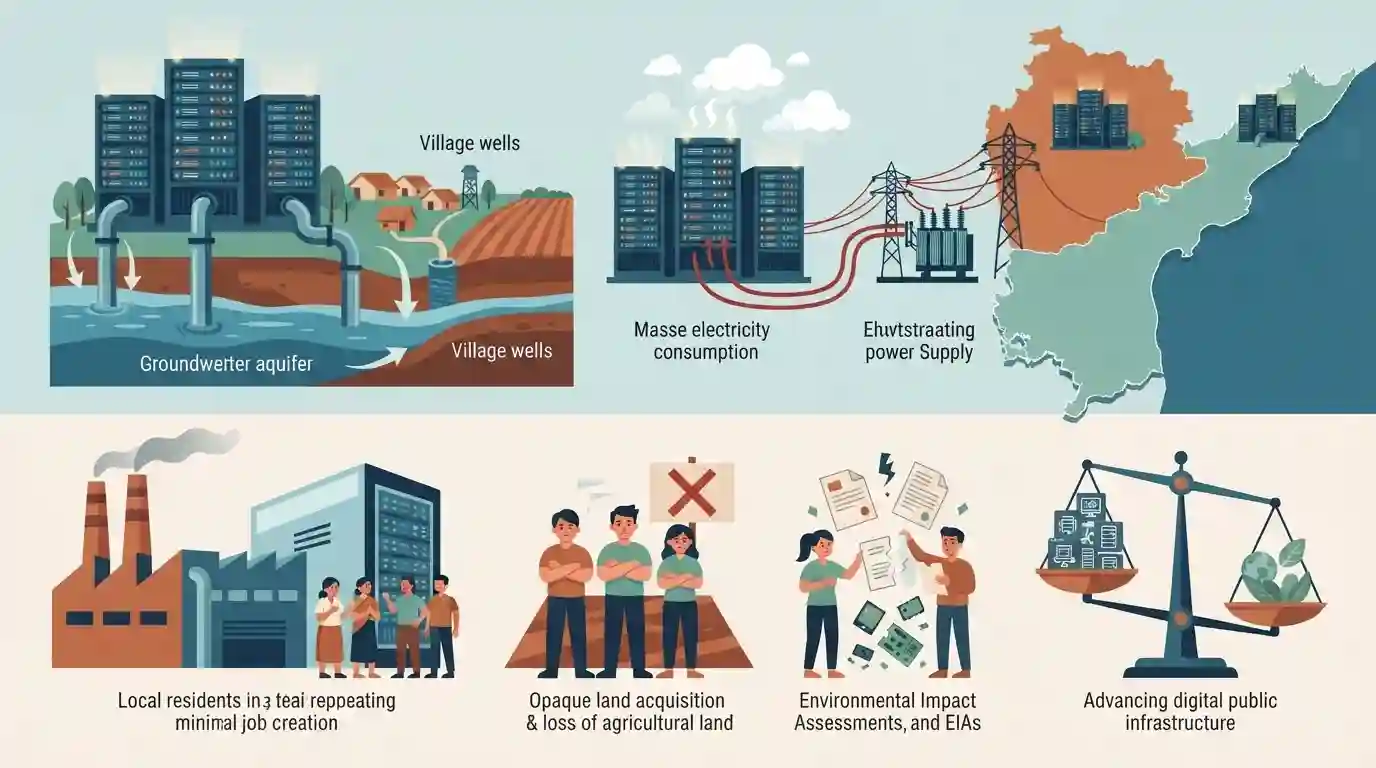
Residents in Andhra Pradesh (Visakhapatnam) and Maharashtra (Navi Mumbai) are protesting against the establishment of massive data centres near their communities. The opposition stems from the severe environmental and health impacts caused by these highly resource-intensive facilities. Key grievances include continuous noise pollution from cooling systems, air pollution from diesel generator backups, and the massive diversion of local freshwater for server cooling. Moreover, despite occupying prime real estate, data centres are highly automated and offer very few local employment opportunities. These protests highlight a crucial conflict between India's push for digital infrastructure and the consequent environmental and social burden placed on local communities.
મુખ્ય મુદ્દા
- Resource Intensity: Data centres require massive amounts of freshwater for evaporative cooling and continuous high-voltage electricity, diverting scarce resources from local communities in cities like Navi Mumbai and Visakhapatnam.
- Pollution and Nuisance: Residents face round-the-clock noise pollution from massive server cooling fans and significant air pollution from heavy diesel generators (DG sets) used during power outages.
- Jobless Land Use: Unlike traditional manufacturing, data centres are highly automated and generate very few direct local jobs, leading to resentment among communities bearing the environmental cost.
- Regulatory Blind Spots: Current urban zoning and Environmental Impact Assessment (EIA) frameworks often fail to adequately address the unique local impacts of data centres, such as micro heat-island effects and continuous acoustic disturbances.
મહત્વપૂર્ણ શબ્દો
Environmental Impact Assessment (EIA) norms

Legal rules and processes used to evaluate and predict the potential environmental, ecological, and socio-economic consequences of a proposed development project prior to granting regulatory clearances.
UPSC context
GS Paper III (Environment); tests understanding of sustainable development, environmental governance, and statutory clearances under the Environment Protection Act, 1986.
Hyperscale Data Centres
Massive computing and data storage facilities housing thousands of servers, requiring immense electrical power, vast land tracts, and continuous water supply for cooling operations.
UPSC context
GS Paper III (Infrastructure & Technology); tests knowledge of digital economy expansion, its ecological footprint, and resource management challenges.
Social Impact Assessment (SIA)
A systematic process to research, analyze, and manage the social consequences—both positive and negative—of planned infrastructure or development projects on local communities and livelihoods.
UPSC context
GS Paper II & III (Governance and Land Reforms); tests understanding of inclusive development, resettlement packages, and citizen-centric project monitoring.
Municipal Corporations
Urban local self-government bodies in India established to administer cities with large populations, responsible for providing urban infrastructure, water supply, sewage treatment, and civic amenities.
UPSC context
GS Paper II (Polity & Governance); tests knowledge of local self-government (74th Amendment Act) and urban ecological resource management challenges.
State Governments
The intermediate tier of government in India's federal system, holding constitutional authority over subjects like land, water, public health, agriculture, and industrial development.
UPSC context
GS Paper II (Federalism & Governance); tests understanding of federal resource allocation, regional policy formulation, and state-level infrastructure administration.
પ્રિલિમ્સ ટ્રેપ
All mega data centre projects require mandatory central-level Environmental Impact Assessment (EIA) clearance and public hearings.
Data centres are often classified under IT/ITeS or Category B2 under state frameworks, allowing them to legally bypass central EIA requirements and public hearings.
સંલગ્ન સ્થિર ખ્યાલો
How are projects categorized under India's EIA Notification 2006?
- Category A: Require mandatory central clearance from the MoEFCC and compulsory public hearings (e.g., major mining).
- Category B1: Evaluated at the state level (SEIAA) but still require EIA reports and public consultation.
- Category B2: Exempted from detailed EIA studies and public hearings (many IT parks and data centres fall here).
What are the key contributors to the Urban Heat Island (UHI) effect?
- Albedo Reduction: Concrete and asphalt absorb and retain solar heat significantly more than natural vegetation.
- Anthropogenic Heat: Waste heat generated from AC exhausts, vehicles, and industrial facilities like data centres.
- Urban Canyon Effect: Dense clusters of tall buildings trap heat and block natural convective wind flows.
આંતર-વિષય પેટર્ન
Data Localization vs. Urban Water Stress
The DPDP Act and RBI data localization mandates force domestic server hosting, inadvertently shifting a massive carbon and water footprint to water-stressed Indian cities like Mumbai and Chennai.
Jobless Growth in Digital Infrastructure
Unlike traditional manufacturing or SEZs, hyperscale data centres reflect extreme 'jobless growth'—consuming prime urban real estate and power while generating almost negligible local employment, sparking socio-economic friction.

Expect a 2026 prelims question merging data centre resource intensity (WUE), EIA Category B2 exemptions, and CPCB IV+ DG set norms.
સંલગ્ન PYQ · 4
સંલગ્ન PYQ · 4
- 2024MainsGS3
What role do environmental NGOs and activists play in influencing Environmental Impact Assessment (EIA) outcomes for major projects in India? Cite four examples with all important details.
- 2023MainsGS3
What is the status of digitalization in the Indian economy? Examine the problems faced in this regard and suggest improvements.
- 2024MainsGS3
The world is facing an acute shortage of clean and safe freshwater. What are the alternative technologies which can solve this crisis? Briefly discuss any three such technologies citing their key merits and demerits.
- 2018MainsGS3
“Access to affordable, reliable, sustainable and modern energy is the sine qua non to achieve Sustainable Development Goals (SDGs).” Comment on the progress made in India in this regard.
