Data Centres Face Local Opposition Over Resource Use
Source:The Hindu ↗
Why It Matters
Highlights the critical socio-economic and environmental trade-offs between rapid digital infrastructure expansion and the sustainable management of natural resources like water and power, a crucial topic for state governance and environmental planning.
Summary
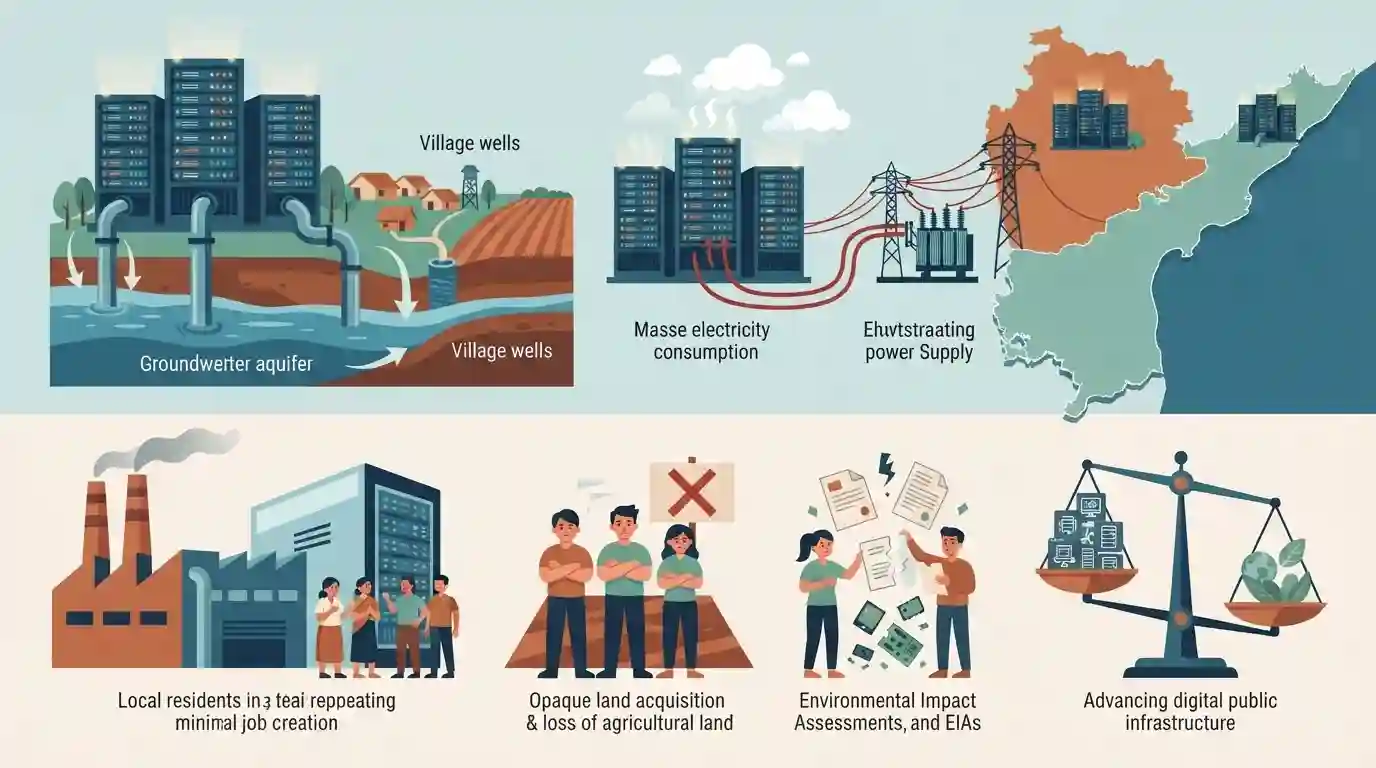
The rapid establishment of data centres in states like Andhra Pradesh and Maharashtra is encountering significant opposition from local residents due to acute environmental and resource concerns. The primary issues stem from the massive volumes of water required for cooling IT infrastructure and their substantial electricity consumption, which heavily burdens local groundwater reserves and power grids. Additionally, protests are fueled by controversies surrounding opaque land acquisition, inadequate Environmental Impact Assessments (EIAs), potential e-waste generation, and the limited scope for local employment compared to traditional manufacturing industries. The situation underscores the emerging governance conflict between advancing digital public infrastructure and ensuring sustainable local resource management.
Key Points
- Data centres in Andhra Pradesh (e.g., Kapuluppada in Visakhapatnam) and Maharashtra are facing local pushback due to their intensive resource footprints.
- The cooling systems of large data centres require vast amounts of groundwater, threatening local water security and exacerbating regional groundwater depletion issues.
- High energy demands of these facilities strain local power infrastructure and often conflict with state renewable energy goals unless expressly powered by green sources.
- Protests emphasize poor land acquisition practices, lack of comprehensive Environmental Impact Assessments (EIAs) prior to project approvals, and the potential for severe e-waste generation.
- Despite the massive capital investment, data centres generate minimal direct local employment compared to traditional manufacturing, fueling community dissatisfaction.
Important Terms
Environmental Impact Assessment (EIA) framework

A regulatory process evaluating environmental and social impacts of proposed projects. Currently, mega data centres often bypass rigorous public hearings by being loosely categorised as basic 'buildings' or 'township development projects'.
UPSC context
GS-3 Environment. Highlights regulatory loopholes, sustainable development challenges, and the lack of public consultation in tech infrastructure.
New and Renewable Energy Development Corporation of A.P. Ltd (NREDCAP)
Andhra Pradesh's nodal agency for implementing renewable energy programmes. It facilitates massive clean energy investments to power highly energy-intensive emerging sectors like hyperscale data centres and green hydrogen manufacturing.
UPSC context
GS-3 Infrastructure/Energy. Tests knowledge of state-level institutional frameworks managing the transition to renewable energy for industrial hubs.
Hyperscale Data Centres
Massive, centralized IT infrastructure facilities crucial for AI and cloud computing. They require enormous volumes of electricity and freshwater for server cooling, leading to groundwater depletion and local protests.
UPSC context
GS-3 Science & Tech/Environment. Essential for understanding the ecological footprint and resource conflicts driven by rapid digital expansion.
Power Usage Effectiveness (PUE)
A standard metric that measures how efficiently a data centre uses energy. India's current regulatory landscape and state policies largely lack mandatory PUE or Water Usage Effectiveness (WUE) performance standards.
UPSC context
GS-3 Science & Tech. Relevant for digital sustainability and the regulatory gaps in mitigating the environmental impact of IT infrastructure.
E-waste Management
The systematic collection, recycling, and disposal of electronic waste. The rapid expansion and frequent hardware upgrades of data centres generate substantial e-waste, posing severe toxic risks without stringent regulatory oversight.
UPSC context
GS-3 Environment. Tests awareness of pollution, circular economy challenges, and the downstream ecological costs of maintaining digital public infrastructure.
Prelims Trap
"Data centres require mandatory prior environmental clearance under the EIA Notification 2006."
Standalone data centres are generally excluded from Schedule I of the EIA 2006. This regulatory vacuum is exactly what communities are protesting.
Static Concepts Connected
What are Power and Water Usage Effectiveness (PUE/WUE)?
- Power Usage Effectiveness: Ratio of total facility energy consumed to the IT equipment energy. A PUE of 1.0 indicates perfect efficiency.
- Water Usage Effectiveness: Ratio of water used for cooling and operations to the IT equipment energy consumed. High WUE indicates heavy stress on local water grids.
How does the EIA Notification 2006 classify projects?
- Category A: Require mandatory prior clearance from the central MoEFCC based on Expert Appraisal Committee (EAC) recommendations.
- Category B: Require clearance from the State Environment Impact Assessment Authority (SEIAA).
- Exemptions: Many new-age infrastructures, like standalone data centres, currently bypass mandatory prior clearance under Schedule I.
Cross-Topic Patterns
EIA loopholes + Digital Infrastructure
The protests expose how the 2006 EIA framework lags behind modern tech infrastructure, allowing high-resource data parks to evade prior ecological scrutiny despite massive footprints.
Jobless growth + Land acquisition
Data centres exemplify the 'jobless growth' paradox; they absorb vast state resources, subsidies, and land, but offer minimal local employment compared to traditional manufacturing.

Expect a multi-statement Prelims question on the exclusion of Data Centres from EIA 2006 alongside PUE/WUE efficiency metrics.
Linked PYQs · 4
Linked PYQs · 4
- 2024APPSC_PRELIMSGS1
Consider the following states of India : I. Punjab II. Odisha III. Haryana IV. Tamil Nadu Which of the above states have relatively high level of groundwater utilization?
- 2024APPSC_PRELIMSGS1
Which of the following statements are valid in connection with Andhra Pradesh Green Hydrogen and Green Ammonia Policy (2023)? I. The objective is to target Green Energy production up to the capacity of 1 MPTA (Million Tonnes Per Annum) or Green Ammonia production up to the capacity of 2-0 MTPA in the next five years. II. New and Renewable Energy Development Corporation of A.P. Ltd (NREDCAP) shall act as a Nodal Agency under this policy. III. All the Ports in the State have infrastructure for storing liquid nitrogen which can then be utilized for storing Green Hydrogen for exporting to other countries. IV. The Policy prohibits the production of Green Hydrogen/Green Ammonia by using Renewable Energy and/or Biomass from 'Third-Party/Power exchange'. Select the correct answer using the codes given below :
- 2024APPSC_PRELIMSGS1
With regard to the progress of Digital Payments in India, which of the following statement/statements is/are valid? I. Promotion of Digital Payments has been transferred from the Ministry of Electronics and Information Technology (MeitY) to the Department of Financial Services. II. e-RUPI is an institution-based voucher management system instead of being person and purpose specific. III. 'Hello! UPI' is an AI voice-enabled payment feature built by a consortium of private sponsored startups recognised by the NPCI. IV. 'UPI LITE X' addresses challenges of remote areas by enabling offline UPI payments. Select the correct answer using the codes given below:
- 2023APPSC_PRELIMSGS1
Match the following: | List I | List II | |---|---| | a. Trade | I. Primary Sector | | b. Water Supply | II. Service Sector | | c. Fisheries | III. Central Statistical Organisation | | d. GDP | IV. Industrial Sector | Choose the correct answer using the codes given below: Code: a b c d
