RBI Consideration to Cap Overseas Remittances Under LRS
Source:The Hindu ↗
Why It Matters
This article is crucial for understanding India's external sector management, foreign exchange reserves, capital account convertibility, and the regulatory role of the RBI in stabilizing the rupee amidst surging global outflows.
Summary
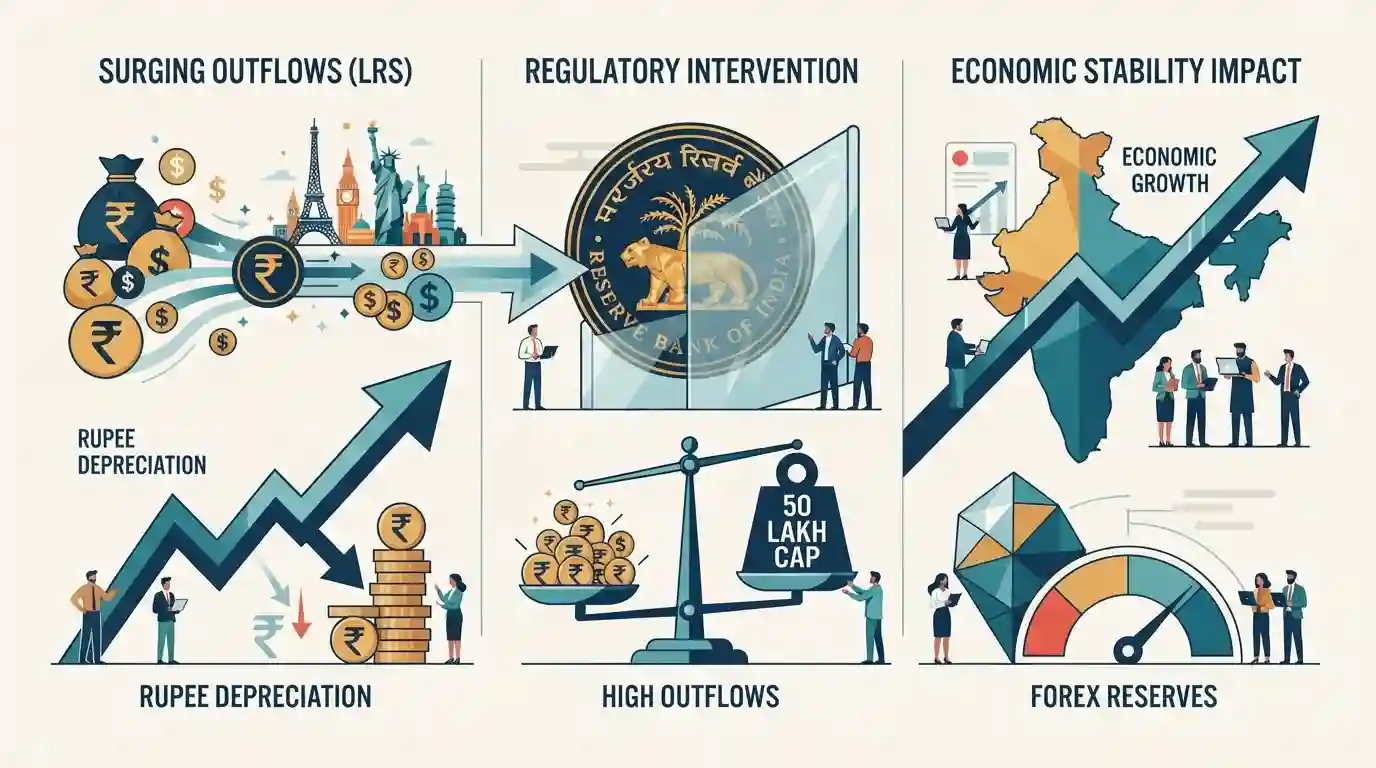
The Reserve Bank of India (RBI) is weighing a proposal to cap select overseas remittances at 50 lakh rupees to manage massive outward capital flows under the Liberalised Remittance Scheme (LRS). Surging outflows have intensified pressure on foreign exchange reserves and the depreciation of the rupee, prompting regulatory intervention to preserve macroeconomic stability.
Key Points
- The Reserve Bank of India (RBI) is considering capping select overseas remittances at 50 lakh rupees to curb massive outward capital outflows and protect the domestic currency.
- Under the Liberalised Remittance Scheme (LRS), resident individuals are currently permitted to remit up to $250,000 per financial year for various permissible current or capital account transactions without prior approval.
- Surging outward remittances have placed pressure on India's balance of payments, foreign exchange reserves, and the stability of the rupee against the US dollar.
- The proposed caps aim to balance individual financial mobility against systemic macroeconomic stability and exchange rate management.
Important Terms
Liberalised Remittance Scheme

A facility by the RBI allowing resident individuals to freely remit up to a certain limit abroad each financial year for permitted current or capital account transactions.
UPSC context
GS Paper III (Indian Economy): Important for understanding capital account convertibility, foreign exchange management, and external sector stability.
Reserve Bank of India
India’s central banking institution that controls monetary policy, issues currency, regulates the banking system, and manages foreign exchange reserves and macroeconomic stability.
UPSC context
GS Paper III (Indian Economy): Essential for questions on monetary policy, central banking functions, and financial sector regulation.
Prelims Trap
LRS permits resident individuals to remit up to $250,000 exclusively for capital account transactions without prior approval.
Aspirants often assume LRS is exclusively for capital investments, ignoring that it covers major current account transactions like education and medical treatment.
Static Concepts Connected
What are the key features and limits of the Liberalised Remittance Scheme (LRS)?
- Eligibility & Limit: Introduced in 2004, LRS allows all resident individuals (including minors) to freely remit up to $250,000 per financial year for permissible current or capital account transactions.
- Permissible Uses: Permitted transactions include overseas education, medical treatment, travel, maintenance of close relatives, and investment in shares/property abroad.
- Prohibitions: Remittances for prohibited activities (such as lottery, gambling, or trading in foreign exchange abroad) and remittances to FATF non-cooperative countries are barred.
Cross-Topic Patterns
LRS Outflows + Forex Reserves + Imported Inflation
Surging LRS outflows drain forex reserves, directly impacting the Reserve Bank's capacity to intervene in currency markets and defend the rupee against imported inflation.
Capital Account Convertibility + Macroeconomic Stability
Restrictions on overseas remittances intersect with capital account convertibility debates, testing India's gradualist approach to macroeconomic policy management.

Expect multi-statement prelims questions on LRS limits, current vs capital account eligibility, and RBI vs govt jurisdiction.
Linked PYQs · 3
Linked PYQs · 3
- 2018MainsGS3
How would the recent phenomena of protectionism and currency manipulations in world trade affect macroeconomic stability of India?
- 2022PrelimsGS1
Consider the following statements: 1. Tight monetary policy of US Federal Reserve could lead to capital flight. 2. Capital flight may increase the interest cost of firms with existing External Commercial Borrowings (ECBs). 3. Devaluation of domestic currency decreases the currency risk associated with ECBs. Which of the statements given above are correct?
- 2013PrelimsGS1
Which of the following constitute Capital Account? 1. Foreign Loans 2. Foreign Direct Investment 3. Private Remittances 4. Portfolio Investment Select the correct answer using the codes given below.
